Institute of Digestive Disease, Department of Medicine and Therapeutics, State Key Laboratory of Digestive Disease, Li Ka Shing Institute of Health Sciences, The Chinese University of Hong Kong, Hong Kong, China.
Department of Anaesthesia and Intensive Care and Peter Hung Pain Research Institute, The Chinese University of Hong Kong, Hong Kong, China.
Gut. 2023 Nov 24;72(12):2272-2285. doi: 10.1136/gutjnl-2023-329543.
Gut microbiota is a key player in dictating immunotherapy response. We aimed to explore the immunomodulatory effect of probiotic and its role in improving anti-programmed cell death protein 1 (PD1) efficacy against colorectal cancer (CRC).
The effects of in anti-PD1 response were assessed in syngeneic mouse models and azoxymethane/dextran sulfate sodium-induced CRC model. The change of immune landscape was identified by multicolour flow cytometry and validated by immunohistochemistry staining and in vitro functional assays. Liquid chromatography-mass spectrometry was performed to identify the functional metabolites.
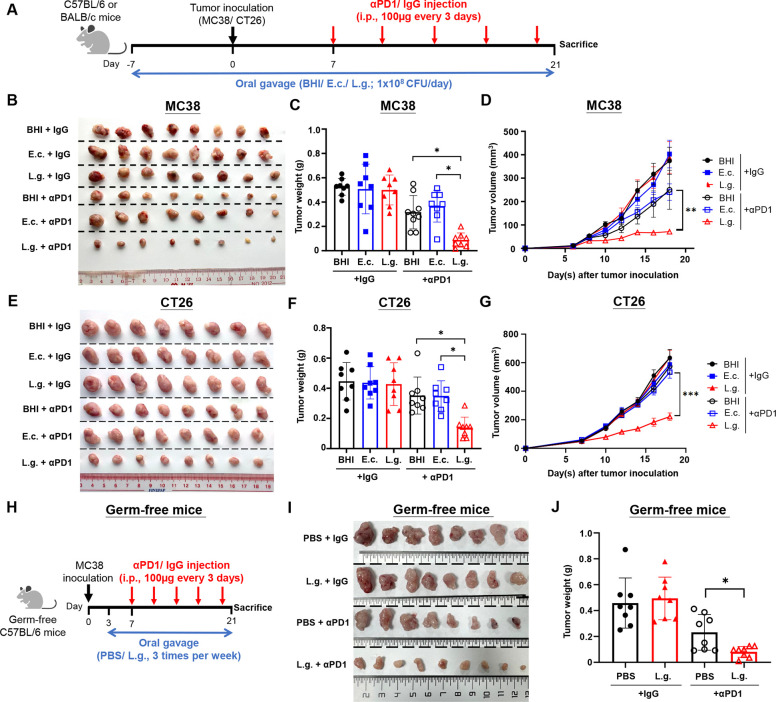
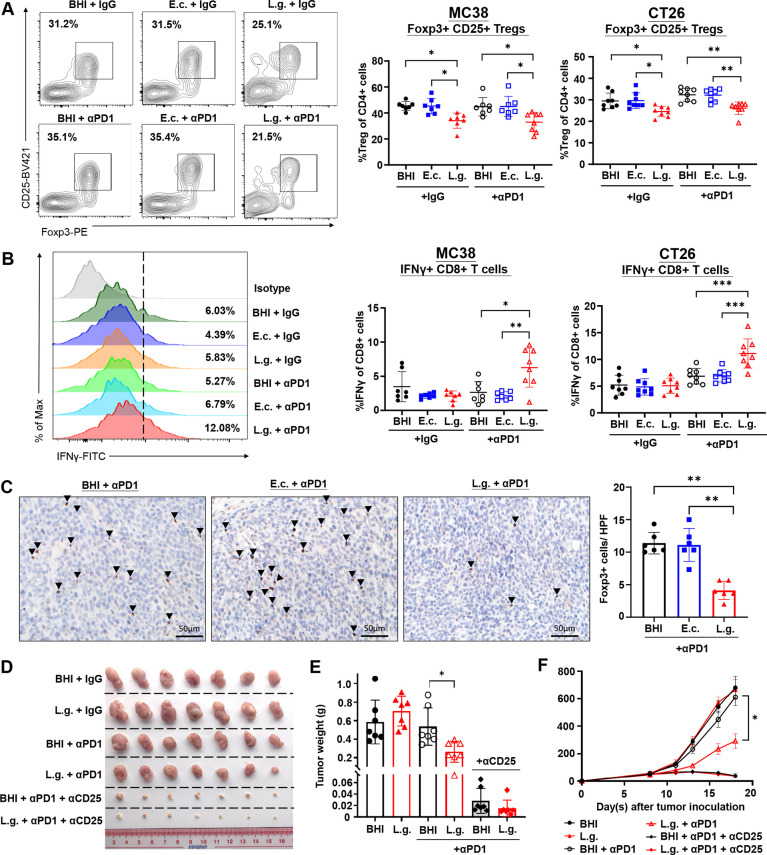
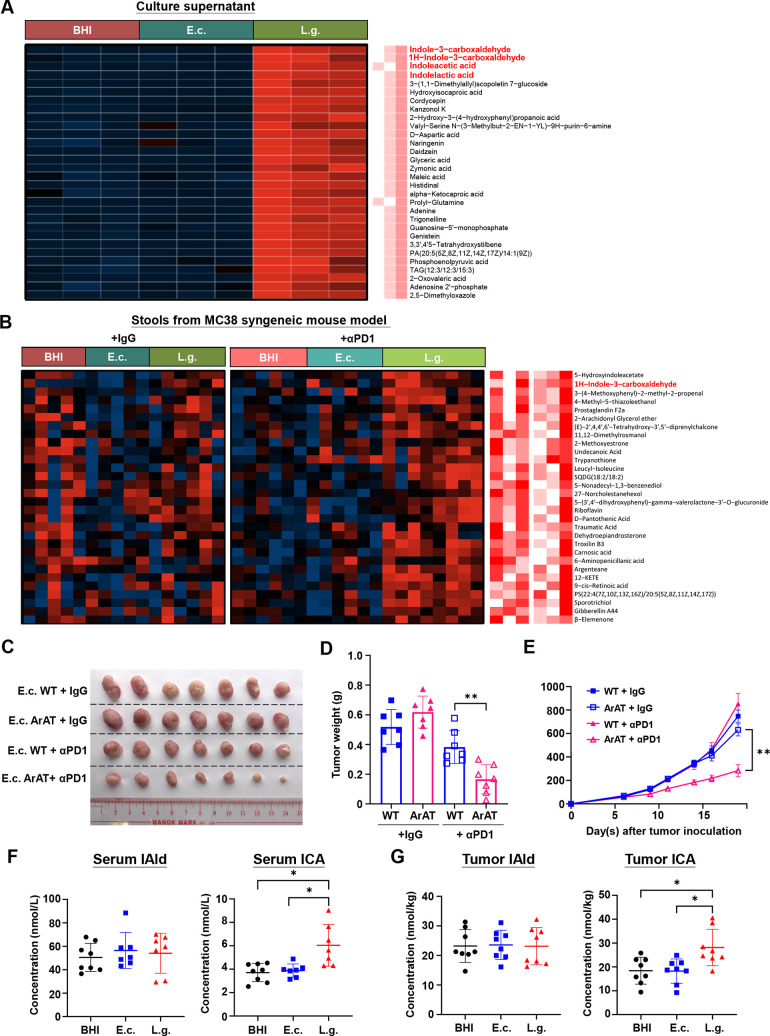
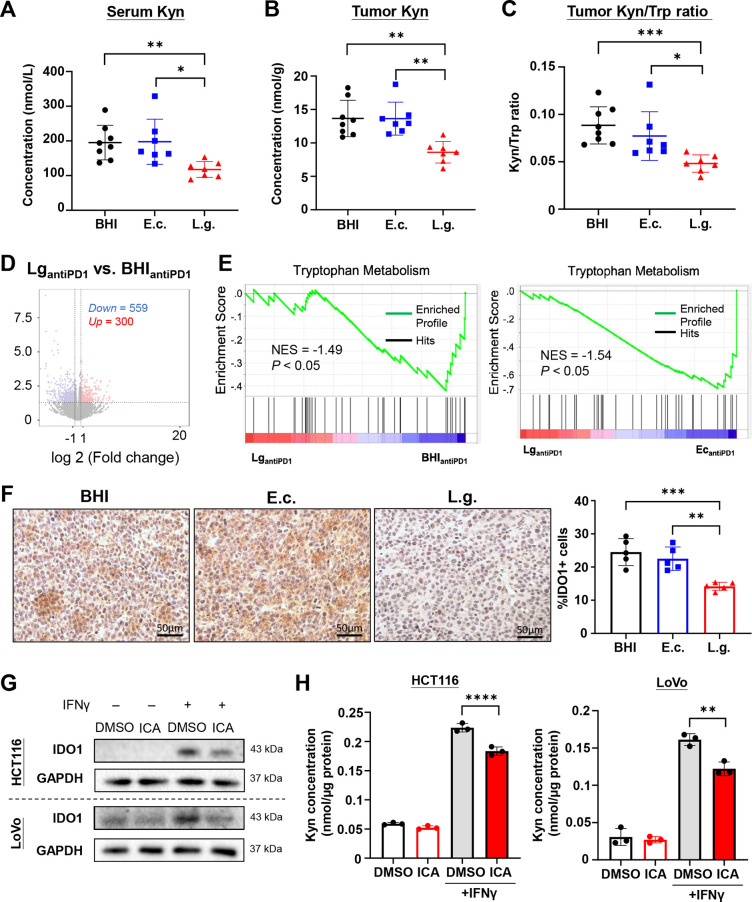
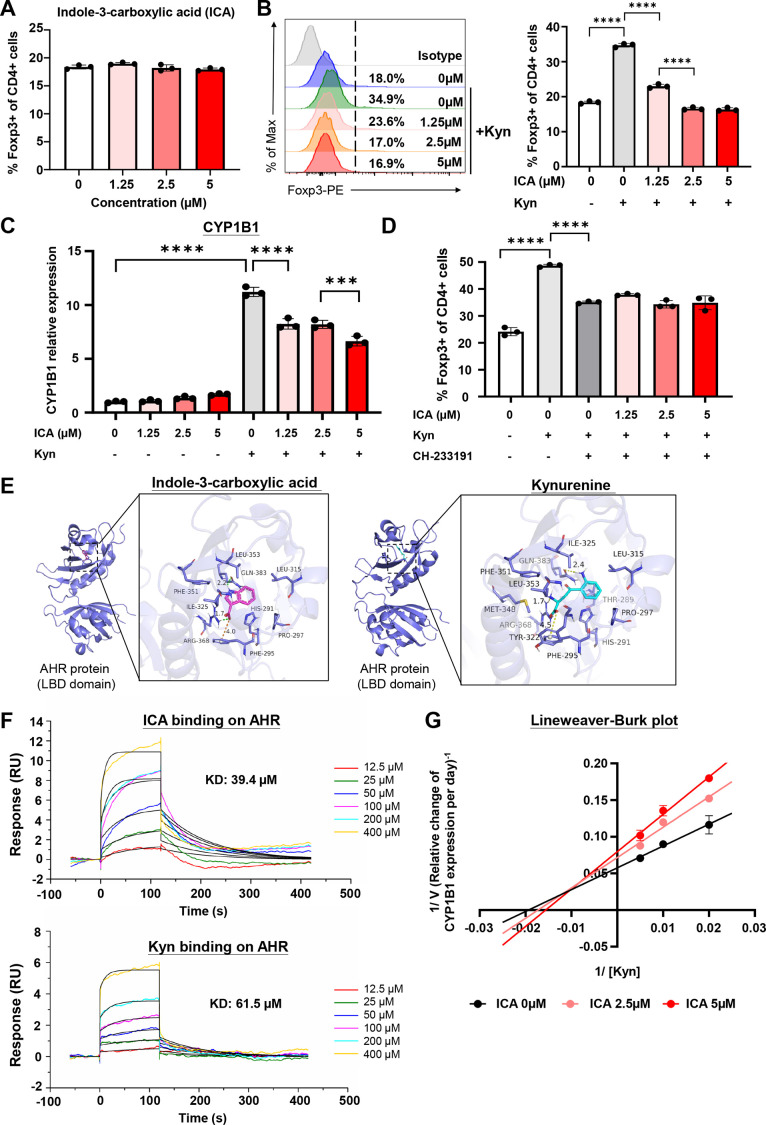
significantly improved anti-PD1 efficacy in two syngeneic mouse models with different microsatellite instability (MSI) statuses (MSI-high for MC38, MSI-low for CT26). Such effect was confirmed in CRC tumourigenesis model. synergised with anti-PD1 therapy by reducing Foxp3 CD25 regulatory T cell (Treg) intratumoural infiltration, and enhancing effector function of CD8 T cells. -derived indole-3-carboxylic acid (ICA) was identified as the functional metabolite. Mechanistically, ICA inhibited indoleamine 2,3-dioxygenase (IDO1) expression, therefore suppressing kynurenine (Kyn) production in tumours. ICA also competed with Kyn for binding site on aryl hydrocarbon receptor (AHR) and antagonised Kyn binding on CD4 T cells, thereby inhibiting Treg differentiation in vitro. ICA phenocopied effect and significantly improved anti-PD1 efficacy in vivo, which could be reversed by Kyn supplementation.
-derived ICA improved anti-PD1 efficacy in CRC through suppressing CD4+Treg differentiation and enhancing CD8+T cell function by modulating the IDO1/Kyn/AHR axis. is a potential adjuvant to augment anti-PD1 efficacy against CRC.
肠道微生物群是决定免疫治疗反应的关键因素。我们旨在探索益生菌的免疫调节作用及其在提高抗程序性细胞死亡蛋白 1(PD1)对结直肠癌(CRC)疗效中的作用。
在同基因小鼠模型和氧化偶氮甲烷/葡聚糖硫酸钠诱导的 CRC 模型中评估了对 PD1 反应的影响。通过多色流式细胞术鉴定免疫景观的变化,并通过免疫组织化学染色和体外功能测定进行验证。采用液相色谱-质谱法鉴定功能代谢物。
在具有不同微卫星不稳定性(MSI)状态(MSI-高的 MC38,MSI-低的 CT26)的两种同基因小鼠模型中,显著改善了抗 PD1 疗效。该效果在 CRC 肿瘤发生模型中得到了证实。与抗 PD1 治疗协同作用,减少 Foxp3 CD25 调节性 T 细胞(Treg)肿瘤内浸润,并增强 CD8 T 细胞的效应功能。鉴定出的吲哚-3-羧酸(ICA)是功能性代谢物。在机制上,ICA 抑制吲哚胺 2,3-双加氧酶(IDO1)的表达,从而抑制肿瘤中犬尿氨酸(Kyn)的产生。ICA 还与 Kyn 竞争芳香烃受体(AHR)的结合位点,并拮抗 Kyn 与 CD4 T 细胞的结合,从而抑制体外 Treg 的分化。ICA 模拟了的作用,并显著提高了体内抗 PD1 疗效,这可以通过 Kyn 补充来逆转。
益生菌衍生的 ICA 通过调节 IDO1/Kyn/AHR 轴抑制 CD4+Treg 分化并增强 CD8+T 细胞功能,改善 CRC 中抗 PD1 疗效。是增强抗 PD1 疗效治疗 CRC 的潜在佐剂。