
细胞色素P450酶在色氨酸代谢中的作用
The Engagement of Cytochrome P450 Enzymes in Tryptophan Metabolism.
作者信息
Haduch Anna, Bromek Ewa, Kuban Wojciech, Daniel Władysława Anna
机构信息
Department of Pharmacokinetics and Drug Metabolism, Maj Institute of Pharmacology, Polish Academy of Sciences, 31-343 Kraków, Poland.
出版信息
Metabolites. 2023 May 5;13(5):629. doi: 10.3390/metabo13050629.
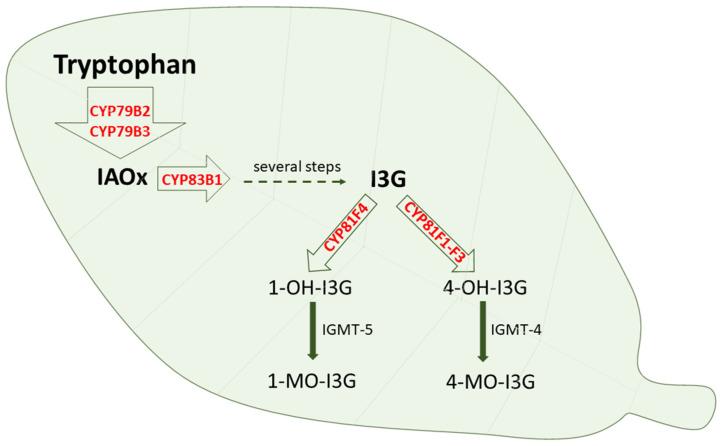
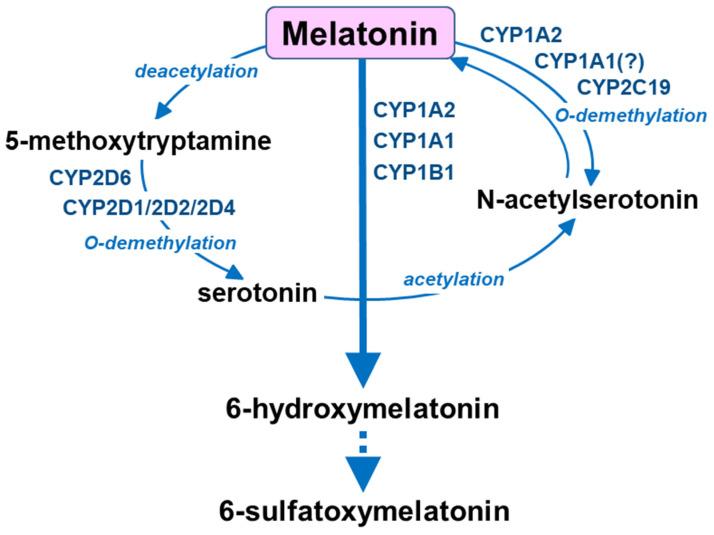
Tryptophan is metabolized along three main metabolic pathways, namely the kynurenine, serotonin and indole pathways. The majority of tryptophan is transformed via the kynurenine pathway, catalyzed by tryptophan-2,3-dioxygenase or indoleamine-2,3-dioxygenase, leading to neuroprotective kynurenic acid or neurotoxic quinolinic acid. Serotonin synthesized by tryptophan hydroxylase, and aromatic L-amino acid decarboxylase enters the metabolic cycle: serotonin → N-acetylserotonin → melatonin → 5-methoxytryptamine→serotonin. Recent studies indicate that serotonin can also be synthesized by cytochrome P450 (CYP), via the CYP2D6-mediated 5-methoxytryptamine O-demethylation, while melatonin is catabolized by CYP1A2, CYP1A1 and CYP1B1 via aromatic 6-hydroxylation and by CYP2C19 and CYP1A2 via O-demethylation. In gut microbes, tryptophan is metabolized to indole and indole derivatives. Some of those metabolites act as activators or inhibitors of the aryl hydrocarbon receptor, thus regulating the expression of CYP1 family enzymes, xenobiotic metabolism and tumorigenesis. The indole formed in this way is further oxidized to indoxyl and indigoid pigments by CYP2A6, CYP2C19 and CYP2E1. The products of gut-microbial tryptophan metabolism can also inhibit the steroid-hormone-synthesizing CYP11A1. In plants, CYP79B2 and CYP79B3 were found to catalyze N-hydroxylation of tryptophan to form indole-3-acetaldoxime while CYP83B1 was reported to form indole-3-acetaldoxime N-oxide in the biosynthetic pathway of indole glucosinolates, considered to be defense compounds and intermediates in the biosynthesis of phytohormones. Thus, cytochrome P450 is engaged in the metabolism of tryptophan and its indole derivatives in humans, animals, plants and microbes, producing biologically active metabolites which exert positive or negative actions on living organisms. Some tryptophan-derived metabolites may influence cytochrome P450 expression, affecting cellular homeostasis and xenobiotic metabolism.
色氨酸沿着三条主要代谢途径进行代谢,即犬尿氨酸途径、5-羟色胺途径和吲哚途径。大部分色氨酸通过犬尿氨酸途径进行转化,该途径由色氨酸-2,3-双加氧酶或吲哚胺-2,3-双加氧酶催化,生成具有神经保护作用的犬尿喹啉酸或具有神经毒性的喹啉酸。由色氨酸羟化酶和芳香族L-氨基酸脱羧酶合成的5-羟色胺进入代谢循环:5-羟色胺→N-乙酰-5-羟色胺→褪黑素→5-甲氧基色胺→5-羟色胺。最近的研究表明,细胞色素P450(CYP)也可以通过CYP2D6介导的5-甲氧基色胺O-去甲基化合成5-羟色胺,而褪黑素则通过CYP1A2、CYP1A1和CYP1B1进行芳香族6-羟基化以及通过CYP2C19和CYP1A2进行O-去甲基化而被分解代谢。在肠道微生物中,色氨酸被代谢为吲哚和吲哚衍生物。其中一些代谢产物可作为芳烃受体的激活剂或抑制剂,从而调节CYP1家族酶的表达、外源性物质代谢和肿瘤发生。以这种方式形成的吲哚会被CYP2A6、CYP2C19和CYP2E1进一步氧化为吲哚酚和靛类色素。肠道微生物色氨酸代谢产物还可以抑制类固醇激素合成酶CYP11A1。在植物中,发现CYP79B2和CYP79B3催化色氨酸的N-羟基化以形成吲哚-3-乙醛肟,而据报道CYP83B1在吲哚硫代葡萄糖苷的生物合成途径中形成吲哚-3-乙醛肟N-氧化物,吲哚硫代葡萄糖苷被认为是防御化合物和植物激素生物合成的中间体。因此,细胞色素P450参与了人类、动物、植物和微生物中色氨酸及其吲哚衍生物的代谢,产生对生物体具有正面或负面作用的生物活性代谢产物。一些色氨酸衍生的代谢产物可能会影响细胞色素P450的表达,从而影响细胞内稳态和外源性物质代谢。



 Zotero 插件