The Research Unit for General Practice, Copenhagen, Denmark.
Acta Obstet Gynecol Scand. 2023 Oct;102(10):1269-1280. doi: 10.1111/aogs.14670. Epub 2023 Sep 28.
Pain during pregnancy affects women's well-being, causes worry and is a risk factor for the child and the mother during labor. The aim was to investigate the relative importance of an extensive set of pregnancy-related physiological symptoms and psychosocial factors assessed in the first trimester compared with the occurrence of pregnancy-related pain symptoms later in the pregnancy.
Included were all women who booked an appointment for a first prenatal visit in one of 125 randomly selected general practitioner practices in Eastern Denmark from April 2015 to August 2016. These women answered an electronic questionnaire containing questions on the occurrence of five pregnancy-related pain symptoms: back pain, leg cramps, pelvic cavity pain, pelvic girdle pain and uterine contractions. The questionnaire also included sociodemographic questions and questions on chronic diseases, physical symptoms, mental health symptoms, lifestyle and reproductive background. The questionnaire was repeated in each trimester. The relative importance of this set of factors from the first trimester on the five pregnancy-related pain symptoms compared with the second and third trimesters was assessed in a dominance analysis.
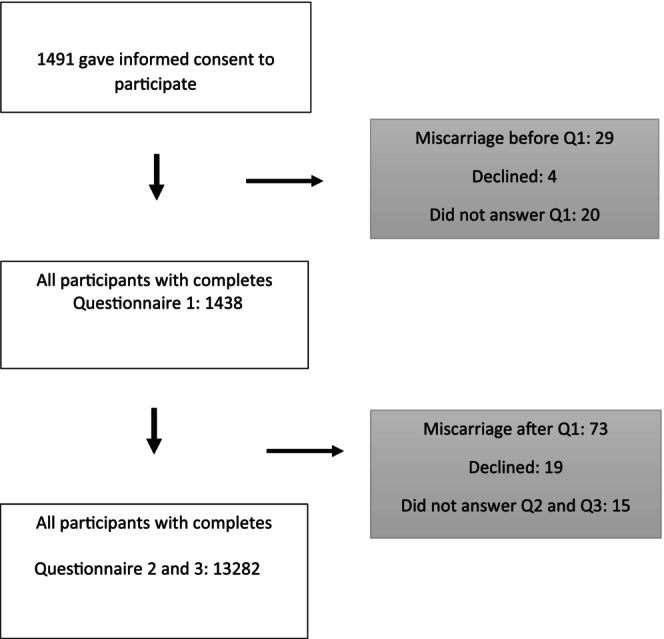
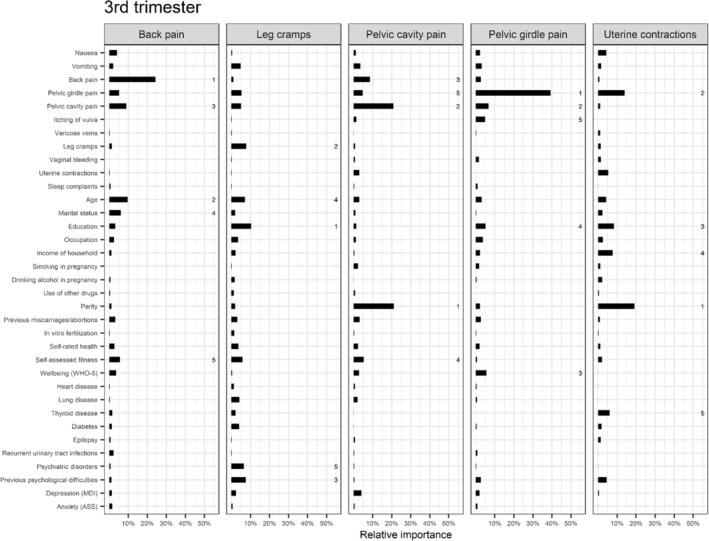
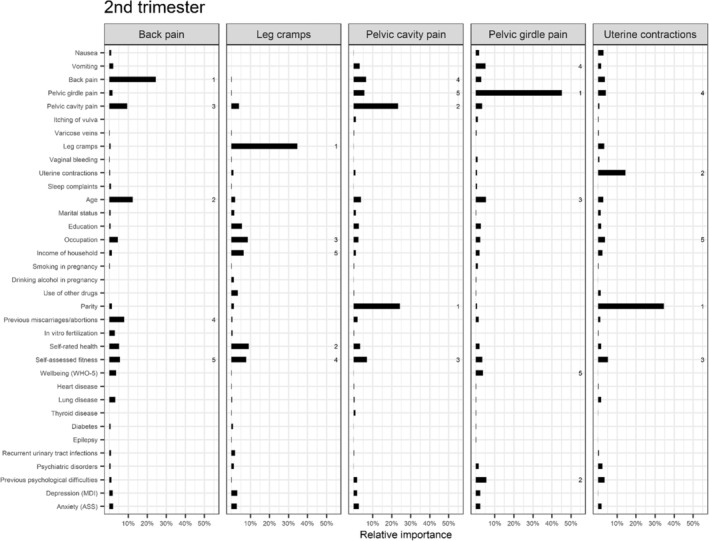
A total of 1491 women were included. The most important factor for pregnancy-related pain in the second trimester and third trimester is the presence of the corresponding pain in the first trimester. Parity was associated with pelvic cavity pain and uterine contractions in the following pregnancies. For back pain and pelvic cavity pain, the odds increased as the women's estimated low self-assessed fitness decreased and had low WHO-5 wellbeing scores.
When including physical risk factors, sociodemographic factors, psychological factors and clinical risk factors, women's experiences of pregnancy-related pain in the first trimester are the most important predictors for pain later in pregnancy. Beyond the expected positive effects of pregnancy-related pain, notably self-assessed fitness, age and parity were predictive for pain later in pregnancy.
怀孕期间的疼痛会影响女性的健康,引起担忧,并且是分娩期间母婴的风险因素。本研究旨在调查与妊娠相关的生理症状和心理社会因素在妊娠早期评估的广泛集合与妊娠后期妊娠相关疼痛症状发生的相对重要性。
本研究纳入了 2015 年 4 月至 2016 年 8 月期间在丹麦东部 125 个随机选择的全科医生诊所预约首次产前检查的所有女性。这些女性回答了一份电子问卷,其中包含五个与妊娠相关的疼痛症状(背痛、腿部痉挛、盆腔疼痛、骨盆带疼痛和子宫收缩)的发生情况。问卷还包括社会人口学问题以及慢性疾病、身体症状、心理健康症状、生活方式和生殖背景问题。该问卷在每个孕期重复进行。在优势分析中,评估了妊娠早期这组因素与第二和第三孕期的五个与妊娠相关的疼痛症状的相对重要性。
共纳入了 1491 名女性。对于第二和第三孕期与妊娠相关的疼痛,最重要的因素是在第一孕期存在相应的疼痛。在后续妊娠中,产次与盆腔疼痛和子宫收缩有关。对于背痛和盆腔疼痛,随着女性自我评估的健康状况降低和 WHO-5 健康状况评分降低,几率增加。
在包括身体风险因素、社会人口学因素、心理因素和临床风险因素时,女性在妊娠早期经历的与妊娠相关的疼痛是预测后期妊娠疼痛的最重要因素。除了与妊娠相关的疼痛的预期积极影响外,自我评估的健康状况、年龄和产次也是后期妊娠疼痛的预测因素。