Liu Ying, Jin Xiu, Gong Yingying, Ma Yingying, Du Beibei, Yang Linqing, Wang Yunfei, Zhu Weipei
Department of Obstetrics and Gynecology, The Second Affiliated Hospital of Soochow University, Suzhou, 215000, China.
Department of Gynecology, Affiliated Hospital of Jining Medical University, Shandong, 272000, China.
Infect Agent Cancer. 2023 Sep 29;18(1):54. doi: 10.1186/s13027-023-00531-w.
This study aimed to assess the value of an HPV E6/E7 mRNA assay and HPV 16 18/45 genotype assay combined with age stratification for triaging women negative for intraepithelial lesions or malignancy (NILM) cytology.
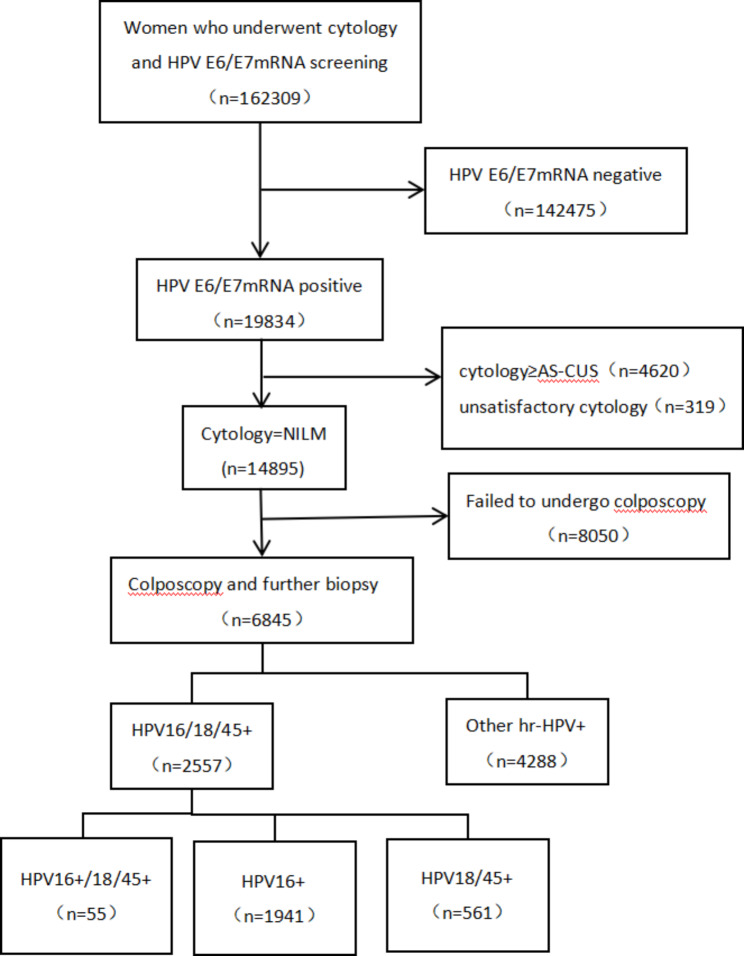
From January 2017 to December 2021, a total of 162,309 eligible women underwent cervical cancer screening at the Affiliated Hospital of Jining Medical University, China. Excluding those with negative HPV E6/E7 mRNA, abnormal and unsatisfactory cytology, and those who failed to undergo colposcopy, 6,845 women were ultimately included in our study. We analysed the triage guidance for different subtypes of HPV in the presence of NILM cytology.
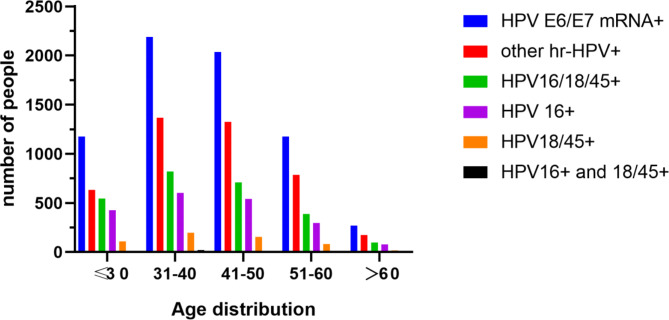
Among 162,309 women, 19,834 (12.2%) were positive for HPV E6/E7 mRNA. Of the 6,845 women included in the study, 1,941 (28.4%), 561 (8.2%), 55 (0.8%) and 4,288 (62.6%) tested positive for HPV 16, HPV 18/45, HPV16/18/45 or other HR-HPV genotypes, respectively. The proportions of LSIL+ (including LSIL, HSIL and ICC) and HSIL+ (including HSIL and ICC) pathological results in the HPV 16/18/45 + group were 57% and 34.1%, respectively, higher than 36.3% and 11% in the other HR-HPV + group (χ = 653.214, P < 0.001). The percentages of LSIL + and HSIL + in the HPV16 + group (61.3% and 42.8%, respectively) and HPV16+/18/45 + group (76.3% and 41.9%, respectively) were much higher than those in the HPV18 + group (40.6% and 13.1%, respectively) (P < 0.001). However, there was no significant difference in the percentage of histopathological results between the HPV16 + group and HPV16+/18/45 + groups (P > 0.05). The above results were consistent after stratification according to age.
The rate of histopathological abnormalities was still high for the other HR-HPV subtypes with NILM cytology, although the rate of histopathological abnormalities was much higher for the HPV 16/18/45 positive subtypes. Therefore, colposcopy should be performed in women with HPV E6/E7 mRNA positivity and NILM cytology, regardless of age and HPV genotype.
本研究旨在评估人乳头瘤病毒(HPV)E6/E7信使核糖核酸(mRNA)检测及HPV 16/18/45基因型检测联合年龄分层对上皮内瘤变或恶性肿瘤阴性(NILM)细胞学检查的女性进行分流的价值。
2017年1月至2021年12月,共有162309名符合条件的女性在中国济宁医学院附属医院接受宫颈癌筛查。排除HPV E6/E7 mRNA检测阴性、细胞学检查异常及不满意者,以及未接受阴道镜检查者,最终162309名女性中的6845名被纳入本研究。我们分析了NILM细胞学检查情况下不同HPV亚型的分流指导。
在162309名女性中,19834名(12.2%)HPV E6/E7 mRNA检测呈阳性。在纳入研究的6845名女性中,分别有1941名(28.4%)、561名(8.2%)、55名(0.8%)和4288名(62.6%)HPV 16、HPV 18/45、HPV16/18/45或其他高危型HPV(HR-HPV)基因型检测呈阳性。HPV 16/18/45阳性组中低度鳞状上皮内病变(LSIL)+(包括LSIL、高度鳞状上皮内病变(HSIL)和浸润性宫颈癌(ICC))和HSIL+(包括HSIL和ICC)病理结果的比例分别为57%和34.1%,高于其他HR-HPV阳性组中的36.3%和11%(χ=653.214,P<0.001)。HPV16阳性组(分别为61.3%和42.8%)和HPV16+/18/45阳性组(分别为76.3%和41.9%)中LSIL+和HSIL+的百分比远高于HPV18阳性组(分别为40.6%和13.1%)(P<0.001)。然而,HPV16阳性组和HPV16+/18/45阳性组之间组织病理学结果的百分比无显著差异(P>0.05)。按年龄分层后上述结果一致。
对于NILM细胞学检查的其他HR-HPV亚型,组织病理学异常率仍然很高,尽管HPV 16/18/45阳性亚型的组织病理学异常率更高。因此,对于HPV E6/E7 mRNA阳性且NILM细胞学检查的女性,无论年龄和HPV基因型如何,均应进行阴道镜检查。