Wen Bijun, Farooqui Amber, Bourdon Celine, Tarafdar Nawar, Ngari Moses, Chimwezi Emmanuel, Thitiri Johnstone, Mwalekwa Laura, Walson Judd L, Voskuijl Wieger, Berkley James A, Bandsma Robert H J
Department of Nutritional Sciences, Faculty of Medicine, University of Toronto, Toronto, Canada.
Department of Translational medicine, Hospital for Sick Children, Toronto, Canada.
Commun Med (Lond). 2023 Sep 29;3(1):128. doi: 10.1038/s43856-023-00355-0.
Children admitted to hospital with complicated severe malnutrition (CSM) have high mortality despite compliance with standard WHO management guidelines. Limited data suggests a relationship between intestinal dysfunction and poor prognosis in CSM, but this has not been explicitly studied. This study aimed to evaluate the role of intestinal disturbances in CSM mortality.
A case-control study nested within a randomized control trial was conducted among children hospitalized with CSM in Kenya and Malawi. Children who died (cases, n = 68) were compared with those who were discharged, propensity matched to the cases on age, HIV and nutritional status (controls, n = 68) on fecal metabolomics that targeted about 70 commonly measured metabolites, and enteropathy markers: fecal myeloperoxidase (MPO), fecal calprotectin, and circulating intestinal fatty acid binding protein (I-FABP).
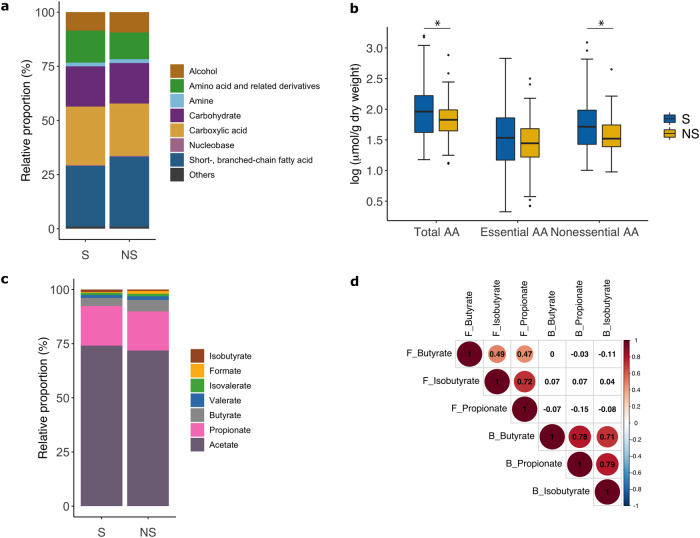
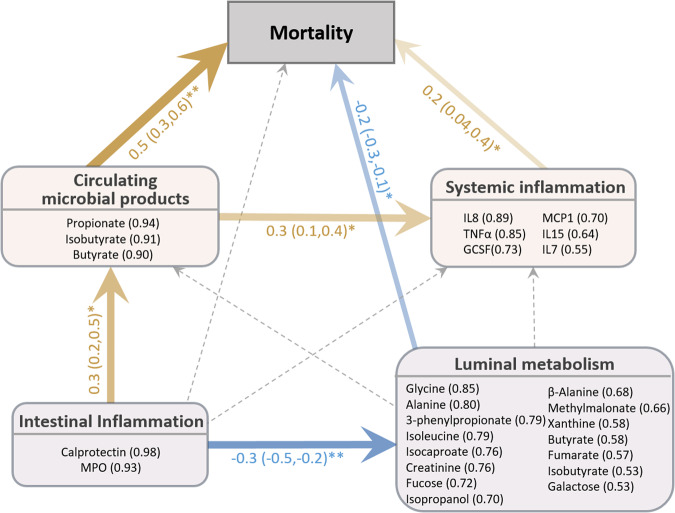
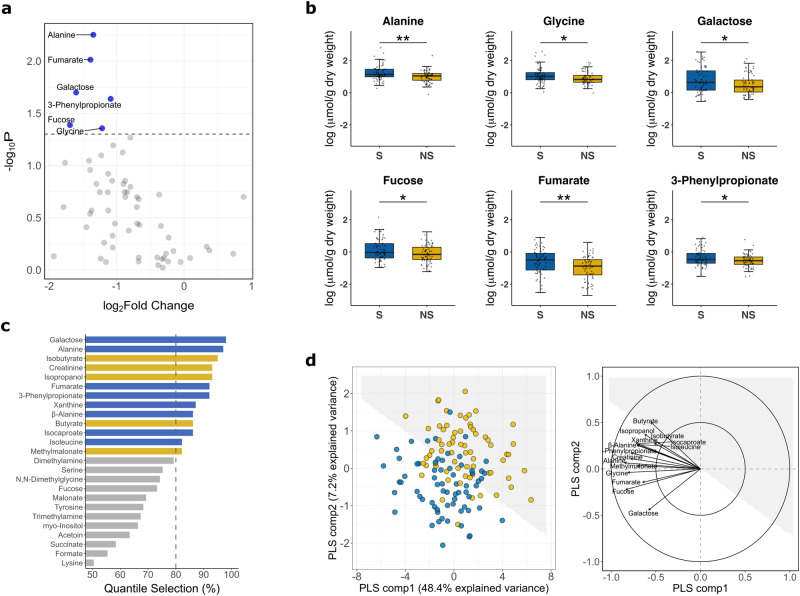
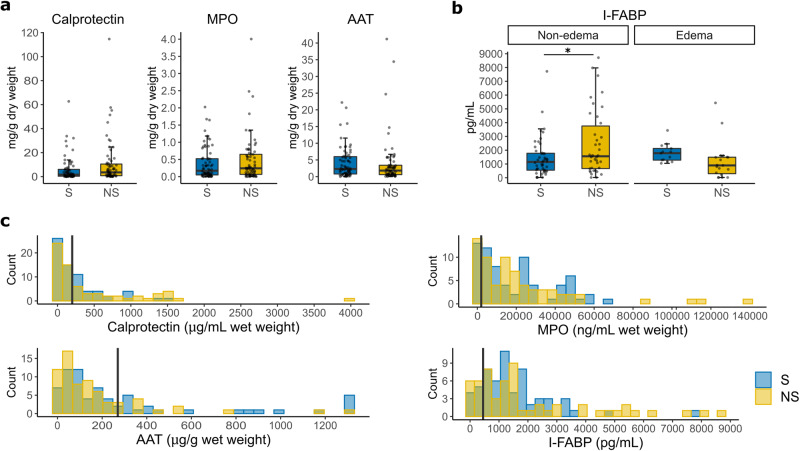
The fecal metabolomes of cases show specific reductions in amino acids, monosaccharides, and microbial fermentation products, when compared to controls. SCFA levels did not differ between groups. The overall fecal metabolomics signature moderately differentiates cases from controls (AUC = 0.72). Enteropathy markers do not differ between groups overall, although serum I-FABP is elevated in cases in a sensitivity analysis among non-edematous children. Integrative analysis with systemic data suggests an indirect role of intestinal inflammation in the causal path of mortality.
Intestinal disturbances appear to have an indirect association with acute mortality. Findings of the study improve our understanding of pathophysiological pathways underlying mortality of children with CSM.
尽管遵循世界卫生组织的标准管理指南,但因复杂严重营养不良(CSM)入院的儿童死亡率仍很高。有限的数据表明肠道功能障碍与CSM预后不良之间存在关联,但尚未对此进行明确研究。本研究旨在评估肠道紊乱在CSM死亡率中的作用。
在肯尼亚和马拉维对因CSM住院的儿童进行了一项嵌套于随机对照试验的病例对照研究。将死亡儿童(病例组,n = 68)与出院儿童进行比较,根据年龄、艾滋病毒和营养状况与病例组进行倾向匹配(对照组,n = 68),检测粪便代谢组学,其中针对约70种常见测量代谢物以及肠病标志物:粪便髓过氧化物酶(MPO)、粪便钙卫蛋白和循环肠脂肪酸结合蛋白(I-FABP)。
与对照组相比,病例组的粪便代谢组显示氨基酸、单糖和微生物发酵产物有特定减少。两组间短链脂肪酸水平无差异。总体粪便代谢组学特征可适度区分病例组和对照组(AUC = 0.72)。尽管在非水肿儿童的敏感性分析中病例组血清I-FABP升高,但总体上两组间肠病标志物无差异。与全身数据的综合分析表明肠道炎症在死亡因果路径中起间接作用。
肠道紊乱似乎与急性死亡率存在间接关联。该研究结果增进了我们对CSM儿童死亡潜在病理生理途径的理解。