Division of Infectious Diseases, Department of Medicine, Emory University School of Medicine, 49 Jesse Hill Jr. Drive, Atlanta, GA, 30303, USA.
Division of Infectious Diseases, Department of Medicine, University of California, San Francisco, CA, USA.
Crit Care. 2020 Jun 1;24(1):278. doi: 10.1186/s13054-020-02989-1.
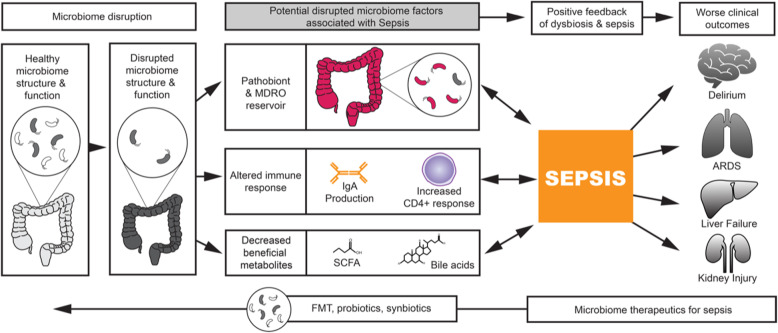
The gut microbiome regulates a number of homeostatic mechanisms in the healthy host including immune function and gut barrier protection. Loss of normal gut microbial structure and function has been associated with diseases as diverse as Clostridioides difficile infection, asthma, and epilepsy. Recent evidence has also demonstrated a link between the gut microbiome and sepsis. In this review, we focus on three key areas of the interaction between the gut microbiome and sepsis. First, prior to sepsis onset, gut microbiome alteration increases sepsis susceptibility through several mechanisms, including (a) allowing for expansion of pathogenic intestinal bacteria, (b) priming the immune system for a robust pro-inflammatory response, and (c) decreasing production of beneficial microbial products such as short-chain fatty acids. Second, once sepsis is established, gut microbiome disruption worsens and increases susceptibility to end-organ dysfunction. Third, there is limited evidence that microbiome-based therapeutics, including probiotics and selective digestive decontamination, may decrease sepsis risk and improve sepsis outcomes in select patient populations, but concerns about safety have limited uptake. Case reports of a different microbiome-based therapy, fecal microbiota transplantation, have shown correlation with gut microbial structure restoration and decreased inflammatory response, but these results require further validation. While much of the evidence linking the gut microbiome and sepsis has been established in pre-clinical studies, clinical evidence is lacking in many areas. To address this, we outline a potential research agenda for further investigating the interaction between the gut microbiome and sepsis.
肠道微生物组调节健康宿主的许多体内平衡机制,包括免疫功能和肠道屏障保护。正常肠道微生物结构和功能的丧失与艰难梭菌感染、哮喘和癫痫等多种疾病有关。最近的证据还表明,肠道微生物组与脓毒症之间存在联系。在这篇综述中,我们重点关注肠道微生物组与脓毒症相互作用的三个关键领域。首先,在脓毒症发作之前,肠道微生物组的改变通过几种机制增加了脓毒症的易感性,包括:(a)允许致病性肠道细菌的扩张;(b)为强烈的促炎反应启动免疫系统;(c)减少有益微生物产物(如短链脂肪酸)的产生。其次,一旦发生脓毒症,肠道微生物组的破坏会加重并增加对终末器官功能障碍的易感性。第三,有有限的证据表明,基于微生物组的治疗方法,包括益生菌和选择性消化道去污染,可能会降低某些患者人群的脓毒症风险并改善脓毒症的结局,但对安全性的担忧限制了其应用。不同的基于微生物组的治疗方法(粪便微生物移植)的病例报告表明与肠道微生物结构的恢复和炎症反应的降低有关,但这些结果需要进一步验证。虽然将肠道微生物组与脓毒症联系起来的大部分证据已经在临床前研究中得到证实,但在许多领域都缺乏临床证据。为了解决这个问题,我们概述了一个潜在的研究议程,以进一步研究肠道微生物组与脓毒症之间的相互作用。