Stanford School of Medicine, Palo Alto, CA, USA.
Johns Hopkins Bloomberg School of Public Health, Baltimore, MD, USA.
JNCI Cancer Spectr. 2023 Oct 31;7(6). doi: 10.1093/jncics/pkad081.
The UK National Health Service's Predict is a clinical tool widely used to estimate the prognosis of early-stage breast cancer. The performance of Predict for a second primary breast cancer is unknown.
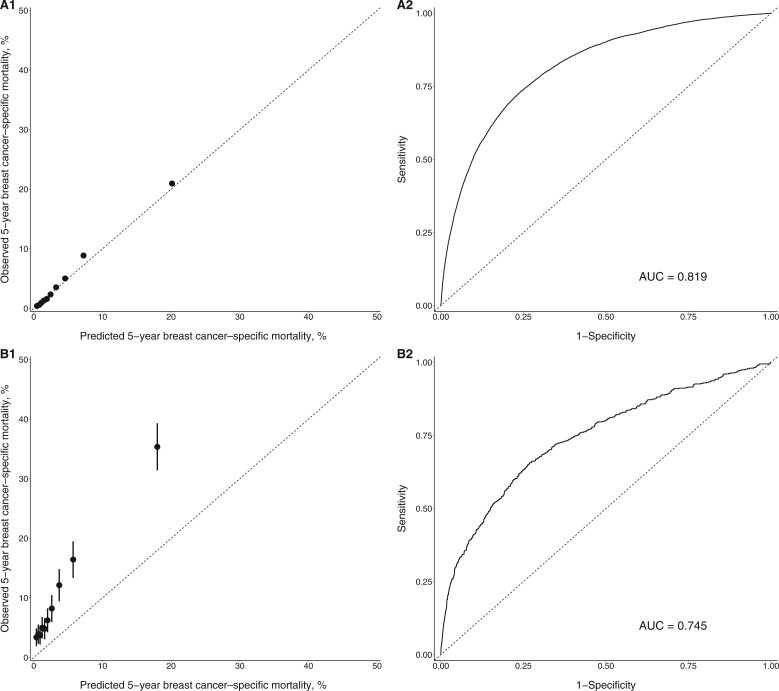
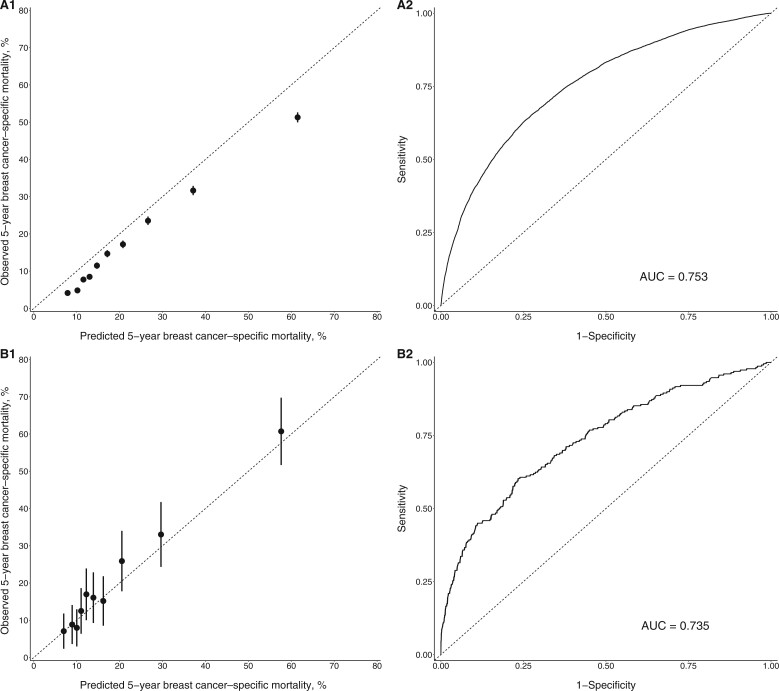
Women 18 years of age or older diagnosed with a first or second invasive breast cancer between 2000 and 2013 and followed for at least 5 years were identified from the US Surveillance, Epidemiology, and End Results (SEER) database. Model calibration of Predict was evaluated by comparing predicted and observed 5-year breast cancer-specific mortality separately by estrogen receptor status for first vs second breast cancer. Receiver operating characteristic curves and areas under the curve were used to assess model discrimination. Model performance was also evaluated for various races and ethnicities.
The study population included 6729 women diagnosed with a second breast cancer and 357 204 women with a first breast cancer. Overall, Predict demonstrated good discrimination for first and second breast cancers (areas under the curve ranging from 0.73 to 0.82). Predict statistically significantly underestimated 5-year breast cancer mortality for second estrogen receptor-positive breast cancers (predicted-observed = ‒6.24%, 95% CI = ‒6.96% to ‒5.49%). Among women with a first estrogen receptor-positive cancer, model calibration was good (predicted-observed = ‒0.22%, 95% CI = ‒0.29% to ‒0.15%), except in non-Hispanic Black women (predicted-observed = ‒2.33%, 95% CI = ‒2.65% to ‒2.01%) and women 80 years of age or older (predicted-observed = ‒3.75%, 95% CI = ‒4.12% to ‒3.41%). Predict performed well for second estrogen receptor-negative cancers overall (predicted-observed = ‒1.69%, 95% CI = ‒3.99% to 0.16%) but underestimated mortality among those who had previously received chemotherapy or had a first cancer with more aggressive tumor characteristics. In contrast, Predict overestimated mortality for first estrogen receptor-negative cancers (predicted-observed = 4.54%, 95% CI = 4.27% to 4.86%).
The Predict tool underestimated 5-year mortality after a second estrogen receptor-positive breast cancer and in certain subgroups of women with a second estrogen receptor-negative breast cancer.
英国国家医疗服务体系的 Predict 是一种广泛用于估计早期乳腺癌预后的临床工具。Predict 对第二原发性乳腺癌的预测性能尚不清楚。
从美国监测、流行病学和最终结果(SEER)数据库中确定了 2000 年至 2013 年间诊断为第一或第二浸润性乳腺癌且至少随访 5 年的年龄在 18 岁或以上的女性。通过比较雌激素受体状态下第一和第二乳腺癌的预测和观察到的 5 年乳腺癌特异性死亡率,评估 Predict 的模型校准。使用接收者操作特征曲线和曲线下面积来评估模型区分度。还评估了模型在不同种族和族裔中的性能。
该研究人群包括 6729 名诊断为第二原发性乳腺癌的女性和 357204 名患有第一原发性乳腺癌的女性。总体而言,Predict 对第一和第二乳腺癌具有良好的区分能力(曲线下面积范围为 0.73 至 0.82)。Predict 对第二雌激素受体阳性乳腺癌的 5 年乳腺癌死亡率的预测值显著低估(预测值-观察值=‒6.24%,95%CI=‒6.96%至‒5.49%)。在患有第一雌激素受体阳性癌症的女性中,模型校准良好(预测值-观察值=‒0.22%,95%CI=‒0.29%至‒0.15%),但在非西班牙裔黑人女性(预测值-观察值=‒2.33%,95%CI=‒2.65%至‒2.01%)和 80 岁或以上的女性(预测值-观察值=‒3.75%,95%CI=‒4.12%至‒3.41%)中除外。Predict 总体上对第二雌激素受体阴性癌症的预测效果良好(预测值-观察值=‒1.69%,95%CI=‒3.99%至 0.16%),但低估了先前接受过化疗或第一癌症具有更具侵袭性肿瘤特征的患者的死亡率。相比之下,Predict 高估了第一雌激素受体阴性癌症的死亡率(预测值-观察值=4.54%,95%CI=4.27%至 4.86%)。
Predict 工具低估了第二雌激素受体阳性乳腺癌和第二雌激素受体阴性乳腺癌某些亚组的 5 年死亡率。