Division of Neurosurgery, National University Hospital, Singapore.
Clinical Research Unit, Khoo Teck Puat Hospital, Singapore.
Eur Stroke J. 2024 Mar;9(1):189-199. doi: 10.1177/23969873231202392. Epub 2023 Sep 29.
High-quality epidemiological data on hemorrhagic stroke (HS) and its subtypes, intracerebral hemorrhage (ICH) and subarachnoid hemorrhage (SAH), remains limited in Asian ethnicities. We investigated the trends in HS incidence and 30-day mortality from 2005 to 2019 in a multi-ethnic Asian population from a national registry.
Data on all stroke cases from the Singapore Stroke Registry from 2005 to 2019 were collected. Cases were defined using centrally adjudicated review of diagnosis codes. Death outcomes were obtained by linkage with the national death registry. Incidence (per 100,000 people) and 30-day mortality (per 100 people) were measured as crude and age-standardized rates. Trends were analyzed using linear regression.
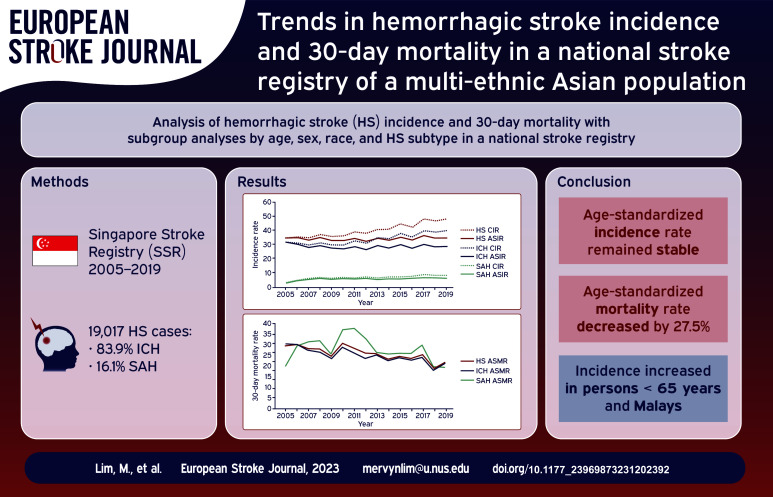
We analyzed 19,017 cases of HS (83.9% ICH; 16.1% SAH). From 2005 to 2019, age-standardized incidence rates (ASIR) for HS remained stable from 34.4 to 34.5. However, age-standardized mortality rates (ASMR) decreased significantly from 29.5 to 21.4 ( < 0.001). For ICH, ASIR remained stable while ASMR decreased from 30.4 to 21.3 ( < 0.001); for SAH, ASIR increased from 2.7 to 6.0 ( = 0.006) while ASMR remained stable. In subgroup analyses, HS incidence increased significantly in persons <65 years (from 18.1 to 19.6) and Malays (from 39.5 to 49.7).
From 2005 to 2019, ASIR of HS remained stable while ASMR decreased. Decreasing ASMR reflects improvements in the overall management of HS, consistent with global trends.
Population health efforts to address modifiable risk factors for HS in specific demographic subgroups may be warranted to reduce incidence and mortality of HS.
在亚洲人群中,高质量的出血性中风(HS)及其亚型——脑内出血(ICH)和蛛网膜下腔出血(SAH)的流行病学数据仍然有限。我们从国家登记处调查了多民族亚洲人群中 2005 年至 2019 年 HS 发病率和 30 天死亡率的趋势。
收集了 2005 年至 2019 年来自新加坡中风登记处的所有中风病例数据。病例使用诊断代码的集中审查进行定义。通过与国家死亡登记处的链接获得死亡结果。发病率(每 10 万人)和 30 天死亡率(每 100 人)分别以粗率和年龄标准化率进行测量。使用线性回归分析趋势。
我们分析了 19017 例 HS(83.9%ICH;16.1%SAH)。从 2005 年到 2019 年,HS 的年龄标准化发病率(ASIR)保持稳定,从 34.4 到 34.5。然而,年龄标准化死亡率(ASMR)从 29.5 显著下降到 21.4( < 0.001)。对于 ICH,ASIR 保持稳定,而 ASMR 从 30.4 下降到 21.3( < 0.001);对于 SAH,ASIR 从 2.7 增加到 6.0( = 0.006),而 ASMR 保持稳定。在亚组分析中,65 岁以下人群(从 18.1 增加到 19.6)和马来人(从 39.5 增加到 49.7)HS 的发病率显著增加。
从 2005 年到 2019 年,HS 的 ASIR 保持稳定,而 ASMR 下降。ASMR 的下降反映了 HS 整体管理的改善,与全球趋势一致。
针对特定人群中 HS 的可改变危险因素,开展人群健康工作可能有助于降低 HS 的发病率和死亡率。