Federal Center for Animal Health, Vladimir, Russia.
Agricultural Research Council-Onderstepoort Veterinary Institute, Onderstepoort, South Africa.
BMC Res Notes. 2023 Sep 30;16(1):247. doi: 10.1186/s13104-023-06502-z.
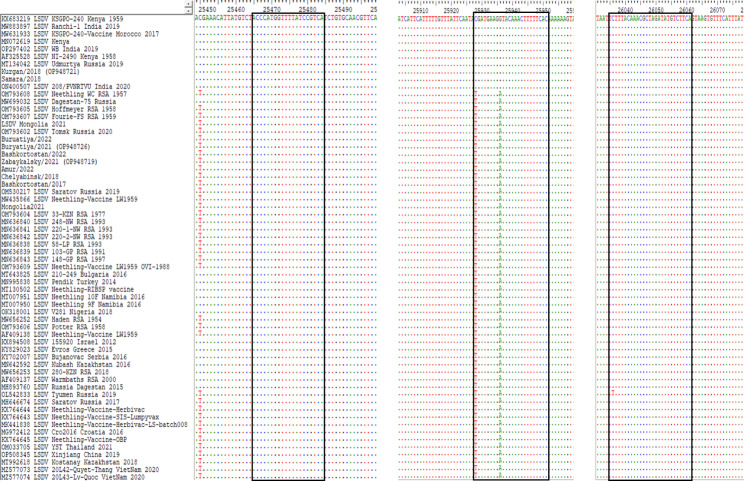
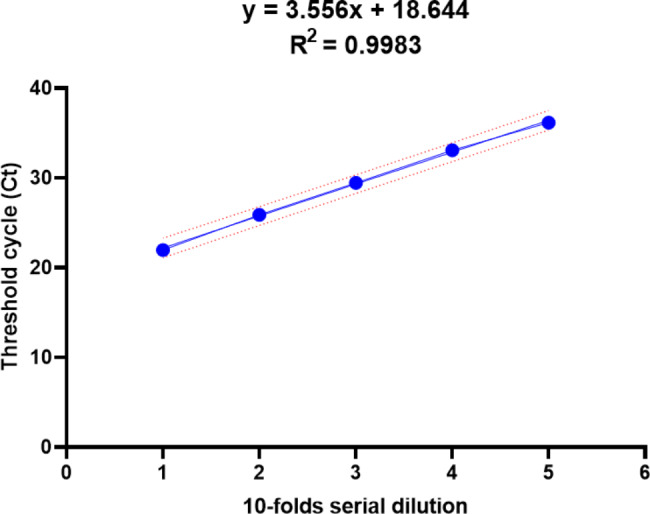
Lumpy skin disease (LSD) outbreaks in Southeast and South Asia are attributed to different lineages of LSD virus (LSDV). Variants belonging to the novel recombinant cluster 2.5 circulate in China and Thailand, while a Kenyan sheep and goat pox (KSGP) strain from cluster 1.1 circulates in India, Pakistan, and Bangladesh. The clusters representing these circulating strains are vastly different. However, if their distribution encroaches into each other's ranges, it will be impossible to differentiate between them due to the lack of suitable molecular tools. Thus, fit-for-purpose molecular tools are in demand to effectively and timeously diagnose and investigate the epidemiology of LSDVs in a region. These could significantly contribute to the phylogenetic delineation of LSDVs and the development of preventive measures against transboundary spillovers. This work aimed to develop a real-time polymerase chain reaction assay targeting open reading frame LW032, capable of specifically detecting KSGP-related isolates and recombinant LSDV strains containing the KSGP backbone. The analytical specificity was proven against the widest possible panel of recombinant vaccine-like LSDV strains known to date. The amplification efficiency was 91.08%, and the assay repeatability had a cycle threshold variation of 0.56-1.1 over five repetitions across three runs. This KSGP-specific assay is reliable and fast and is recommended for use in LSDV epidemiological studies where the accurate detection of KSGP genetic signatures is a priority, particularly in regions where KSGP-like and other lineages are circulating.
块状皮肤病(LSD)在东南亚和南亚的爆发归因于 LSD 病毒(LSDV)的不同谱系。属于新型重组簇 2.5 的变体在中国和泰国传播,而来自簇 1.1 的肯尼亚绵羊和山羊痘(KSGP)株在印度、巴基斯坦和孟加拉国传播。代表这些循环株的簇有很大的不同。然而,如果它们的分布范围相互侵犯,由于缺乏合适的分子工具,将无法区分它们。因此,需要合适的分子工具来有效地及时诊断和调查该地区 LSDV 的流行病学。这将极大地有助于 LSDV 的系统发育划分以及制定针对跨界溢出的预防措施。本工作旨在开发针对开放阅读框 LW032 的实时聚合酶链反应检测方法,该方法能够特异性检测与 KSGP 相关的分离株和包含 KSGP 骨架的重组 LSDV 株。分析特异性已被证明针对迄今为止已知的最广泛的重组疫苗样 LSDV 株进行检测。扩增效率为 91.08%,该测定法在三个运行的五个重复中具有 0.56-1.1 的循环阈值变化的可重复性。这种 KSGP 特异性检测方法可靠且快速,建议在 LSDV 流行病学研究中使用,尤其是在 KSGP 样和其他谱系循环的地区,需要优先准确检测 KSGP 的遗传特征。