Iwashita Yuki, Umemoto George, Fujioka Shinsuke, Arahata Hajime, Dotsu Yuriko, Oike Asami, Tsuboi Yoshio
Swallowing Disorders Center, Fukuoka University Hospital, Fukuoka, Japan.
Department of Neurology, Neuro-Muscular Center, NHO Omuta National Hospital, Fukuoka, Japan.
Front Neurol. 2023 Sep 13;14:1259327. doi: 10.3389/fneur.2023.1259327. eCollection 2023.
To evaluate the swallowing function in the advanced stages of progressive supranuclear palsy (PSP) and clarify the factors that lead to adjustment of food consistency and discontinuation of oral intake.
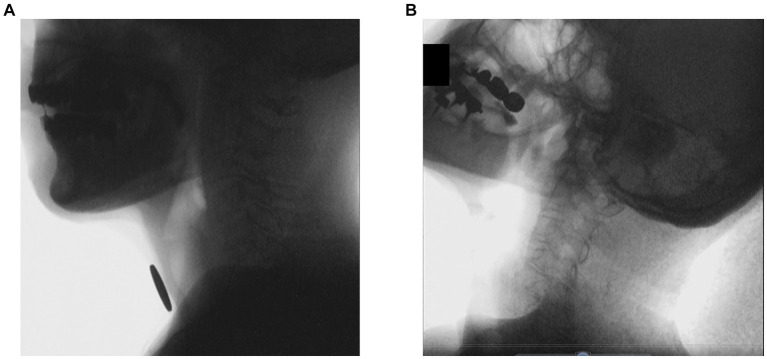
A total of 56 patients with PSP were recruited. Based on medical records, information about the basic attributes, clinical features (including axial rigidity and dementia), food intake, the results of a videofluoroscopic swallowing study (VFSS), and the timing of nasogastric tube transition and gastrostomy were extracted. From the VFSS images, the presence or absence of aspiration and retrocollis were assessed.
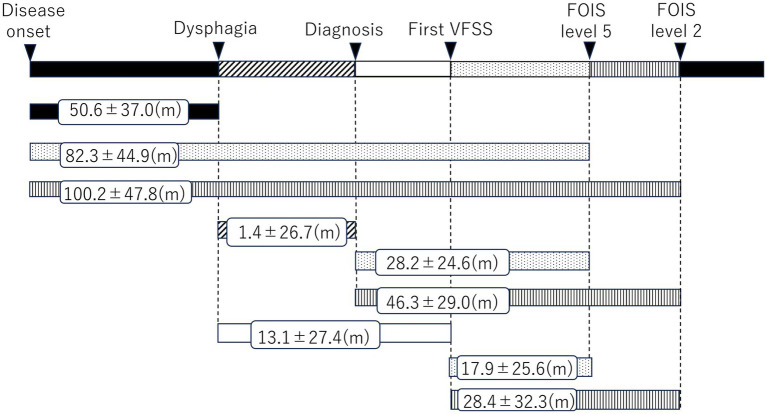
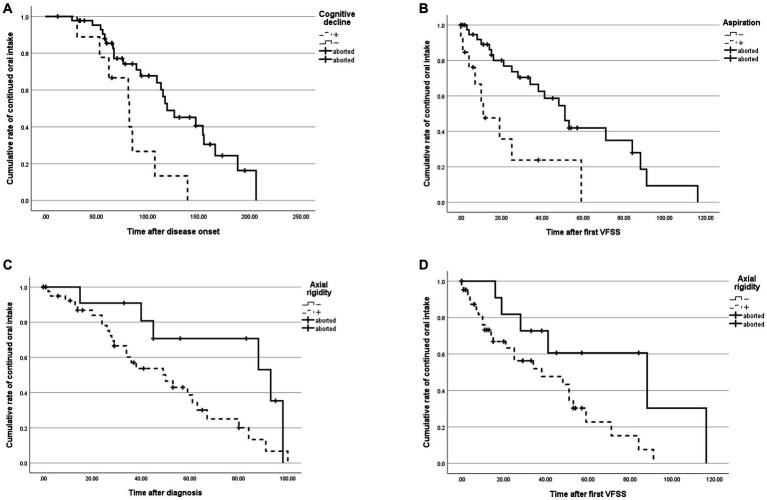
The average age at the onset, diagnosis, and the final follow-up examination were 67.6 ± 6.4 years, 71.6 ± 5.8 years, and 75.4 ± 5.6 years, respectively. The average duration of illness was 64.6 ± 42.8 months. Twenty-four individuals (42.9%) were continuing oral intake, while 32 were tube-fed, among whom 16 (50.0%) underwent gastrostomy tube placement. There were significant differences in the duration from the disease onset to tube feeding between the patients with and without cognitive decline at the time of the diagnosis ( < 0.01) and in the duration from the initial VFSS to tube feeding between the patients with and without aspiration on the initial VFSS ( < 0.01). There were significant differences in the duration from the diagnosis to tube feeding and from the initial VFSS to tube feeding between patients with and without axial rigidity at the time of the diagnosis ( < 0.05 and < 0.05, respectively). Additionally, there was a significant association between axial rigidity and retrocollis ( < 0.01).
Cognitive decline, axial rigidity and retrocollis, which are associated with the deterioration of dysphagia in PSP, are the highest risk factors for the discontinuation of oral intake. The early identification of these factors associated with the progression of dysphagia can contribute to the improvement of patient care and management.
评估进行性核上性麻痹(PSP)晚期的吞咽功能,并阐明导致食物质地调整和经口进食中断的因素。
共招募了56例PSP患者。根据病历,提取有关基本属性、临床特征(包括轴性强直和痴呆)、食物摄入、视频荧光吞咽造影检查(VFSS)结果以及鼻饲管过渡和胃造口术时间的信息。从VFSS图像中评估误吸和颈后缩的有无。
发病、诊断及最后一次随访检查时的平均年龄分别为67.6±6.4岁、71.6±5.8岁和75.4±5.6岁。平均病程为64.6±42.8个月。24例(42.9%)患者继续经口进食,32例接受管饲,其中16例(50.0%)接受了胃造口管置入。诊断时伴有和不伴有认知功能下降的患者从疾病发作到管饲的时间存在显著差异(<0.01),初次VFSS时有和无误吸的患者从初次VFSS到管饲的时间存在显著差异(<0.01)。诊断时伴有和不伴有轴性强直的患者从诊断到管饲的时间以及从初次VFSS到管饲的时间存在显著差异(分别为<0.05和<0.05)。此外,轴性强直与颈后缩之间存在显著关联(<0.01)。
认知功能下降、轴性强直和颈后缩与PSP吞咽困难的恶化相关,是经口进食中断的最高风险因素。早期识别这些与吞咽困难进展相关的因素有助于改善患者护理和管理。