Morii Wataru, Kasai Koki, Nakamura Takako, Hayashi Daisuke, Hara Monami, Naito Tatsuhiko, Sonehara Kyuto, Fukuie Tatsuki, Saito-Abe Mayako, Yang Limin, Yamamoto-Hanada Kiwako, Narita Masami, Maruo Kazushi, Okada Yukinori, Noguchi Emiko, Ohya Yukihiro
Department of Medical Genetics, Faculty of Medicine, University of Tsukuba, Tsukuba, Japan.
Department of Statistical Genetics, Osaka University Graduate School of Medicine, Suita, Japan.
J Allergy Clin Immunol Glob. 2023 Feb 20;2(2):100086. doi: 10.1016/j.jacig.2023.100086. eCollection 2023 May.
Allergic diseases are some of the most common diseases worldwide. Genome-wide association studies (GWASs) have been conducted to elucidate the genetic factors of allergic diseases. However, no GWASs for allergen component sensitization have been performed.
We sought to detect genetic variants associated with differences in immune responsiveness against allergen components.
The participants of the present study were recruited from the Tokyo Children's Health, Illness, and Development study, and allergen component-specific IgE level at age 9 years was measured by means of allergen microarray immunoassays. We performed GWASs for allergen component sensitization against each allergen (single allergen component sensitization, number of allergen components analyzed, n = 31), as well as against allergen protein families (allergen protein group sensitization, number of protein groups analyzed, n = 16).
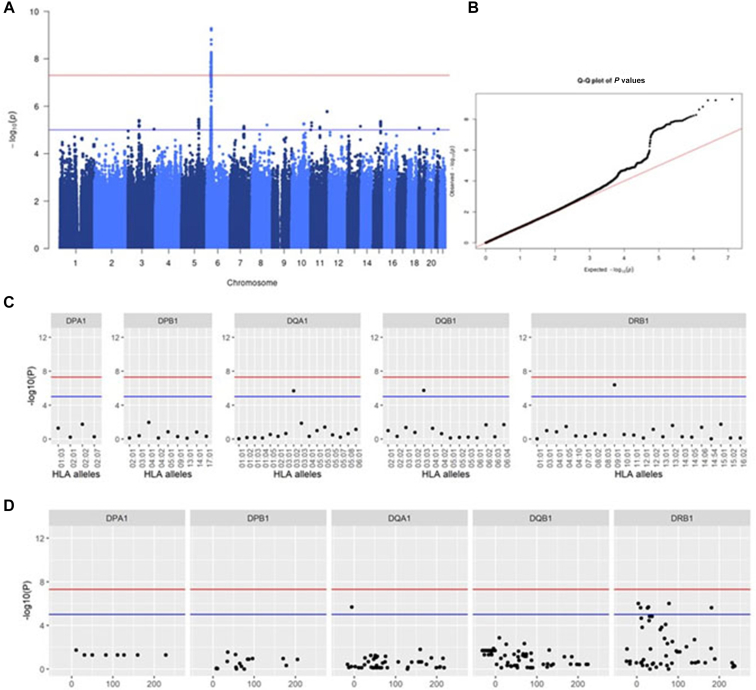
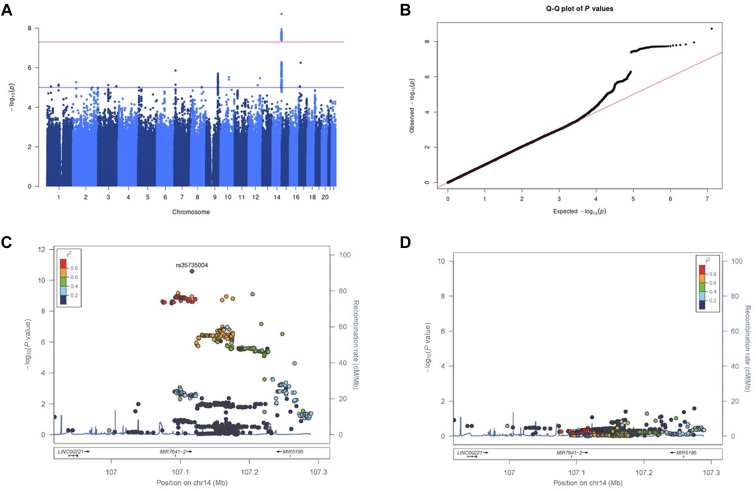
We performed GWAS on 564 participants of the Tokyo Children's Health, Illness, and Development study and found associations between Amb a 1 sensitization and the immunoglobulin heavy-chain variable gene on chromosome 14 and between Phl p 1 sensitization and the class II region on chromosome 6 ( < 5.0 × 10). A GWAS-significant association was also observed between the class II region and profilin sensitization ( < 5.0 × 10).
Our data provide the first demonstration of genetic risk for allergen component sensitization and show that this genetic risk is related to immune response genes including immunoglobulin heavy-chain variable gene and .
过敏性疾病是全球最常见的疾病之一。全基因组关联研究(GWAS)已被用于阐明过敏性疾病的遗传因素。然而,尚未进行过针对过敏原成分致敏的GWAS研究。
我们试图检测与针对过敏原成分的免疫反应性差异相关的基因变异。
本研究的参与者来自东京儿童健康、疾病与发育研究,通过过敏原微阵列免疫测定法测量9岁时的过敏原成分特异性IgE水平。我们针对每种过敏原进行了过敏原成分致敏的GWAS研究(单一过敏原成分致敏,分析的过敏原成分数量,n = 31),以及针对过敏原蛋白家族的研究(过敏原蛋白组致敏,分析的蛋白组数量,n = 16)。
我们对东京儿童健康、疾病与发育研究的564名参与者进行了GWAS研究,发现Amb a 1致敏与14号染色体上的免疫球蛋白重链可变基因之间以及Phl p 1致敏与6号染色体上的II类区域之间存在关联(P < 5.0×10)。在II类区域与肌动蛋白结合蛋白致敏之间也观察到了GWAS显著关联(P < 5.0×10)。
我们的数据首次证明了过敏原成分致敏的遗传风险,并表明这种遗传风险与包括免疫球蛋白重链可变基因等免疫反应基因有关。