Hernández-Vásquez Akram, Carrillo Morote Brenda Noemí, Azurin Gonzales Victoria Del Carmen, Turpo Cayo Efraín Y, Azañedo Diego
Centro de Excelencia en Investigaciones Económicas y Sociales en Salud, Vicerrectorado de Investigación, Universidad San Ignacio de Loyola, Lima, Perú Universidad San Ignacio de Loyola Centro de Excelencia en Investigaciones Económicas y Sociales en Salud Vicerrectorado de Investigación Universidad San Ignacio de Loyola Lima Peru.
Facultad de Ciencias de la Salud, Universidad Científica del Sur, Lima, Perú. Universidad Científica del Sur Facultad de Ciencias de la Salud Universidad Científica del Sur Lima Peru.
Arch Peru Cardiol Cir Cardiovasc. 2023 Jun 30;4(2):48-54. doi: 10.47487/apcyccv.v4i2.296. eCollection 2023 Apr-Jun.
To perform a spatial analysis of arterial hypertension in the Peruvian adult population to identify geographic patterns with a higher concentration of cases.
A spatial analysis was conducted using data from the Demographic and Family Health Survey (ENDES) 2022. A sample of 29,422 adults was included, and the global Moran's index and Getis-Ord Gi* analysis were used to evaluate spatial autocorrelation and cluster concentration.
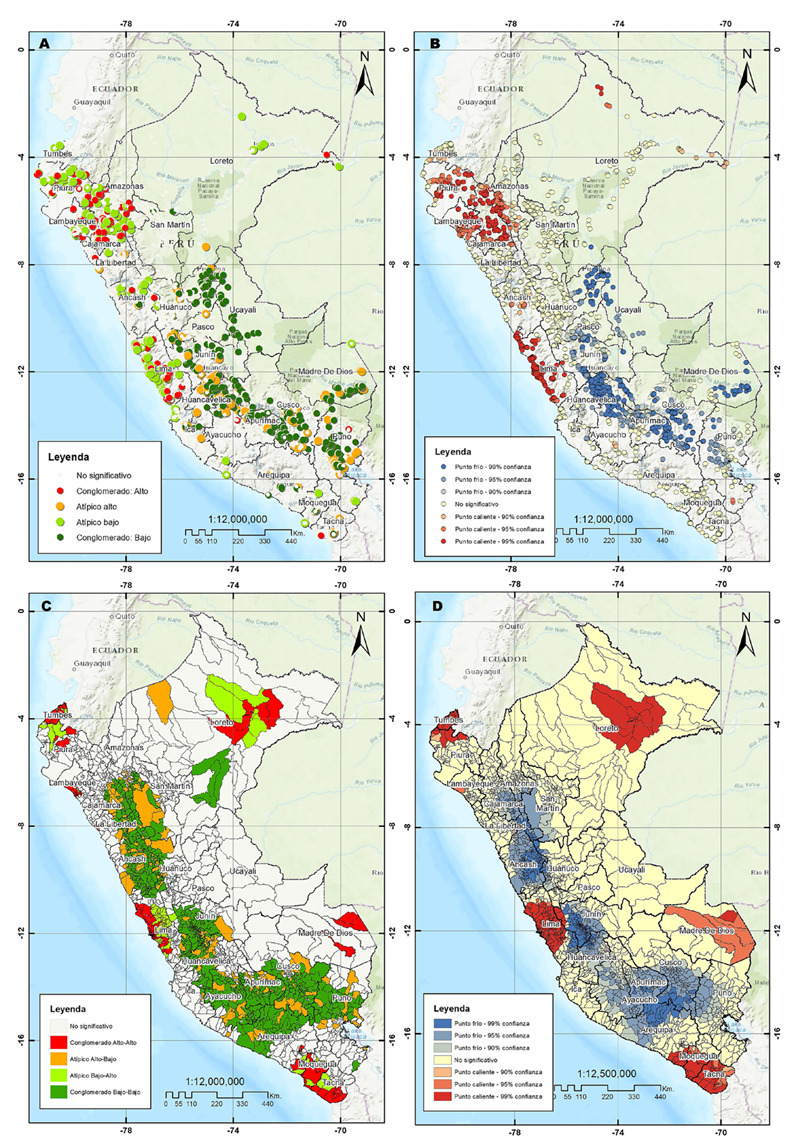
The age-standardized prevalence of arterial hypertension was 19.2%. Clusters with a high concentration of arterial hypertension were observed in departments along the Peruvian coast such as Tumbes, Piura, Lambayeque, La Libertad, Ancash, and Lima, as well as in the northern regions of the Highlands. Clusters were also found in the regions of Loreto and Madre de Dios in the Peruvian jungle.
This study revealed geographic patterns of arterial hypertension in Peru, with a higher concentration of cases along the Peruvian coast and in certain regions of the Highlands and Jungle. These findings highlight the need to develop strategies for the prevention and control of the disease, especially in the areas identified as high-prevalence clusters.
对秘鲁成年人口中的动脉高血压进行空间分析,以确定病例集中程度较高的地理模式。
利用2022年人口与家庭健康调查(ENDES)的数据进行空间分析。纳入了29422名成年人样本,并使用全局莫兰指数和Getis-Ord Gi*分析来评估空间自相关性和聚类集中度。
动脉高血压的年龄标准化患病率为19.2%。在秘鲁沿海的通贝斯、皮斯科、兰巴耶克、拉利伯塔德、安卡什和利马等省份,以及高地的北部地区,观察到了动脉高血压高集中的聚类。在秘鲁丛林的洛雷托和马德雷德迪奥斯地区也发现了聚类。
本研究揭示了秘鲁动脉高血压的地理模式,病例在秘鲁沿海以及高地和丛林的某些地区更为集中。这些发现凸显了制定该疾病预防和控制策略的必要性,特别是在被确定为高患病率聚类的地区。