
“健康生活”的研究结果,一项基于社区的随机对照参与式干预措施,旨在预防新移民母婴对子肥胖。
Results from "Live Well", a randomized controlled community-based participatory intervention to prevent obesity in new immigrant mother-child dyads.
机构信息
Gerald J. and Dorothy R. Friedman School of Nutrition Science and Policy, Tufts University, Boston, MA, USA.
Department of Behavioral and Social Sciences, Center for Health Promotion and Health Equity, Brown University School of Public Health, Providence, RI, USA.
出版信息
BMC Public Health. 2023 Oct 2;23(1):1893. doi: 10.1186/s12889-023-16727-z.
BACKGROUND
Upon arrival, the prevalence of overweight and obesity is lower in new immigrants than their native counterparts in the U.S. With longer residency in the U.S., these differences converge over time, followed by higher prevalence among immigrants than native U.S. residents. Results from the Live Well project in the Greater Boston area demonstrate the viability of utilizing a culturally adapted, community-based participatory research (CBPR) approach to reduce weight gain among newly immigrated mother-child dyads.
METHODS
Haitian, Latina, and Brazilian mother-child dyads (n = 390), new to the U.S. (fewer than 10 years) were enrolled in a one- to two-year long CBPR lifestyle intervention that targeted dietary and physical activity behaviors. Attendance was recorded to establish dose. Demographics, anthropometrics, and relevant covariates were collected from participants at baseline, 6, 12, 18, and 24 months. Body Mass Index (BMI) was calculated using objectively measured height and weight. Linear mixed regression models were used to assess change in BMI and BMI z-score of mothers and children respectively.
RESULTS
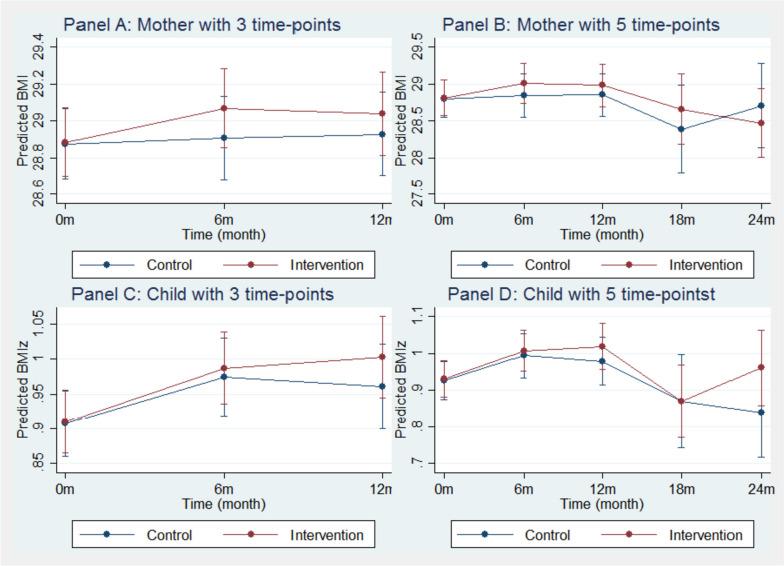
At baseline, nearly 75% of mothers and 50% of children were either overweight or obese (BMI ≥ 25.0 and BMI z-score ≥ 85 percentile, respectively). Only 20% of mothers attended all 12 intervention sessions in year 1. Using intent-to-treat analyses, no significant time, intervention, or time × intervention effects were observed for weight change of mothers or children at follow-up. Mothers in the highest quantile (those who attended all 12 intervention sessions) had significant reductions in BMI at 18 months (1.76 units lower, 95%CI: -3.14, -0.37) and 24 months (2.61 units, 95%CI -3.92, -1.29) compared to mothers in the lower quantiles, including those with no exposure. Such dose effects on BMI z-scores were not noted for children.
CONCLUSIONS
Findings from Live Well demonstrate the viability of utilizing a CBPR approach to address overweight and obesity among immigrant mothers. Given the higher-than-expected prevalence of overweight and obesity among mother-child dyads by ~ 6 years of U.S. residency, and lower maternal participation rates in the intervention, additional research is necessary to identify the optimal intervention length, retention strategies, and approach to jointly support healthy maternal and child weight.
背景
新移民抵达时的超重和肥胖患病率低于其在美国的本地同龄人。随着在美国居住时间的延长,这些差异会随着时间的推移而趋同,随后移民的患病率高于美国本地居民。大波士顿地区 Live Well 项目的结果表明,利用文化适应的社区参与式研究 (CBPR) 方法来减少新移民母婴对子的体重增加是可行的。
方法
新移民到美国(不到 10 年)的海地、拉丁裔和巴西母婴对子(n=390)参加了为期一到两年的 CBPR 生活方式干预,该干预针对饮食和身体活动行为。记录出勤率以确定剂量。在基线、6、12、18 和 24 个月时从参与者那里收集人口统计学、人体测量学和相关协变量数据。使用客观测量的身高和体重计算体重指数 (BMI)。使用线性混合回归模型分别评估母亲和儿童的 BMI 和 BMI z 分数的变化。
结果
在基线时,近 75%的母亲和 50%的儿童超重或肥胖(BMI≥25.0 和 BMI z 分数≥85 百分位,分别)。只有 20%的母亲参加了第一年的所有 12 次干预课程。采用意向治疗分析,在随访时,母亲和儿童的体重变化没有观察到时间、干预或时间与干预的显著作用。在最高四分位数(参加所有 12 次干预课程的母亲)的母亲在 18 个月(低四分位数的母亲 BMI 降低 1.76 个单位,95%CI:-3.14,-0.37)和 24 个月(2.61 个单位,95%CI:-3.92,-1.29)时 BMI 显著降低,而低四分位数(包括无暴露的母亲)的母亲则没有。对于儿童,BMI z 分数没有观察到这种剂量效应。
结论
Live Well 的研究结果表明,利用 CBPR 方法来解决移民母亲的超重和肥胖问题是可行的。考虑到在美国居住 6 年左右时母婴对子超重和肥胖的患病率高于预期,以及母亲参与干预的比例较低,需要进一步研究以确定最佳的干预长度、保留策略和共同支持母婴健康体重的方法。


 Zotero 插件