Department of Anesthesiology and Pain Medicine, University of Washington School of Medicine, Seattle, Washington, USA.
Medical College of Georgia at Augusta University, Augusta University/University of Georgia Medical Partnership, Athens, Georgia, USA.
Paediatr Anaesth. 2023 Dec;33(12):1083-1090. doi: 10.1111/pan.14753. Epub 2023 Oct 4.
The United States currently faces an epidemic of opioid misuse which extends to adolescent surgical populations. Opioid prescriptions after surgery are associated with persistent opioid use and serve as a reservoir for diversion. However, it is unclear what proportion of opioid prescriptions are surgical, and little is known about trends in opioid prescription rates associated with surgery in adolescents in the United States. This study aims to describe national trends in postsurgical opioid prescription rates over time among adolescents in the United States.
We conducted a population-based cross-sectional analysis of data captured in the Medical Expenditure Panel Survey (MEPS) from 2015 to 2020. MEPS classified adolescents 10-19 years of age (n = 26 909) as having a surgical procedure if they had any inpatient, outpatient, or emergency department visit during which a surgical procedure was performed.
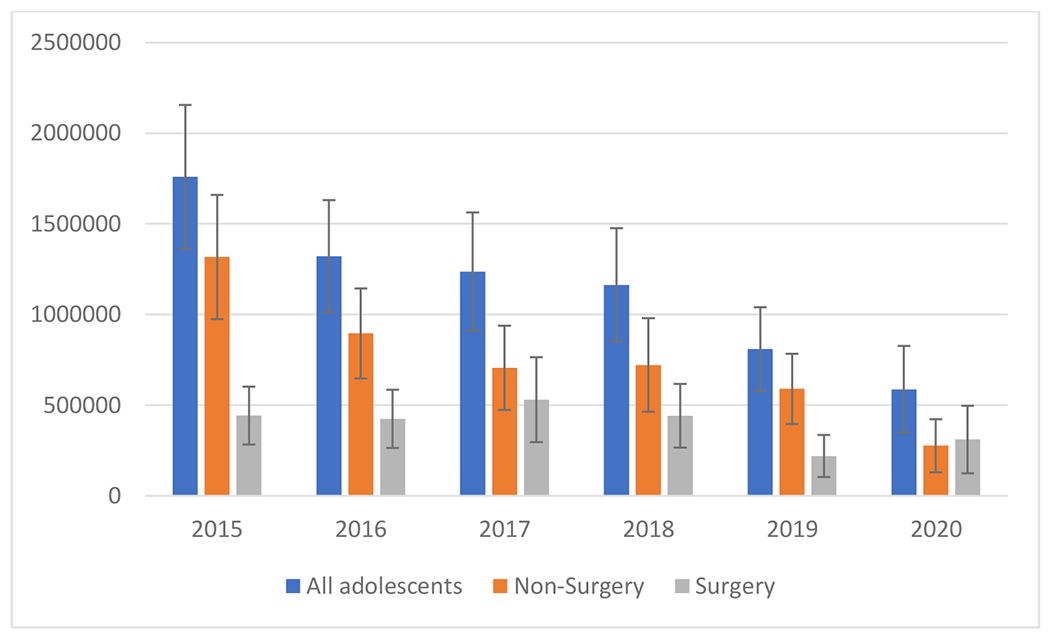
Mean age (SD) of the sample was 14.4 (0.01) years. Sociodemographic characteristics were representative of the USA adolescent population. In total, 4.7% of adolescents underwent a surgical procedure. The surgery rate remained stable between 2015 (4.3%): and 2020 (4.4%) and was lower among minority populations. The combined rate of opioid prescribing for surgical and nonsurgical indications significantly decreased from 4.1% in 2015 to 1.4% in 2020 among all adolescents, an estimated difference of 2.7% (95% confidence interval (CI): 1.7%-3.7%, p < .0001). However, opioid prescribing for surgery remained relatively stable (1% in 2015 vs. 0.8% in 2020).
Opioid prescription rates associated with surgery remained stable between 2015 and 2020 in the United States, despite significant decreases in prescribing among nonsurgical populations. Surgery is now a leading source of medical prescribed opioids among adolescents. Secondary findings included a stable trend in surgery utilization between 2015 and 2020, as well as continued racial disparities, both in terms of surgery utilization and opioid prescribing.
The large number of adolescents being prescribed opioids for surgery in the USA each year, suggests there is a need for national guidelines aimed at adolescent opioid use, similar to the recent CDC guidelines aimed at adult opioid use.
美国目前正面临阿片类药物滥用的流行,这种情况已经蔓延到青少年手术人群。手术后开具的阿片类药物处方与持续使用阿片类药物有关,并且是药物转移的来源。然而,目前尚不清楚手术相关的阿片类药物处方的比例是多少,也很少有关于美国青少年手术相关阿片类药物处方率的趋势的信息。本研究旨在描述美国青少年手术后阿片类药物处方率随时间的变化趋势。
我们对 2015 年至 2020 年期间医疗支出调查(MEPS)中捕获的数据进行了基于人群的横断面分析。MEPS 将 10-19 岁的青少年(n=26909)归类为接受过手术,如果他们在任何住院、门诊或急诊就诊期间接受过手术。
样本的平均年龄(标准差)为 14.4(0.01)岁。社会人口统计学特征代表了美国青少年人群。共有 4.7%的青少年接受了手术。手术率在 2015 年(4.3%)和 2020 年(4.4%)之间保持稳定,并且在少数族裔人群中较低。手术和非手术指征的阿片类药物联合处方率在所有青少年中从 2015 年的 4.1%显著下降到 2020 年的 1.4%,估计差异为 2.7%(95%置信区间:1.7%-3.7%,p<0.0001)。然而,手术相关的阿片类药物处方率保持相对稳定(2015 年为 1%,2020 年为 0.8%)。
尽管非手术人群的处方量显著减少,但 2015 年至 2020 年间,美国与手术相关的阿片类药物处方率保持稳定。手术现在是青少年医疗处方阿片类药物的主要来源。次要发现包括 2015 年至 2020 年间手术利用的稳定趋势,以及在手术利用和阿片类药物处方方面持续存在的种族差异。
美国每年有大量青少年因手术而开具阿片类药物,这表明需要制定国家指南来规范青少年阿片类药物的使用,类似于最近针对成人阿片类药物使用的疾病预防控制中心指南。