Quadram Institute Bioscience, Norwich Research Park, NR4 7UQ, Norwich, UK.
Norwich Medical School, University of East Anglia (UEA), Norwich, UK.
Microb Genom. 2023 Oct;9(10). doi: 10.1099/mgen.0.001106.
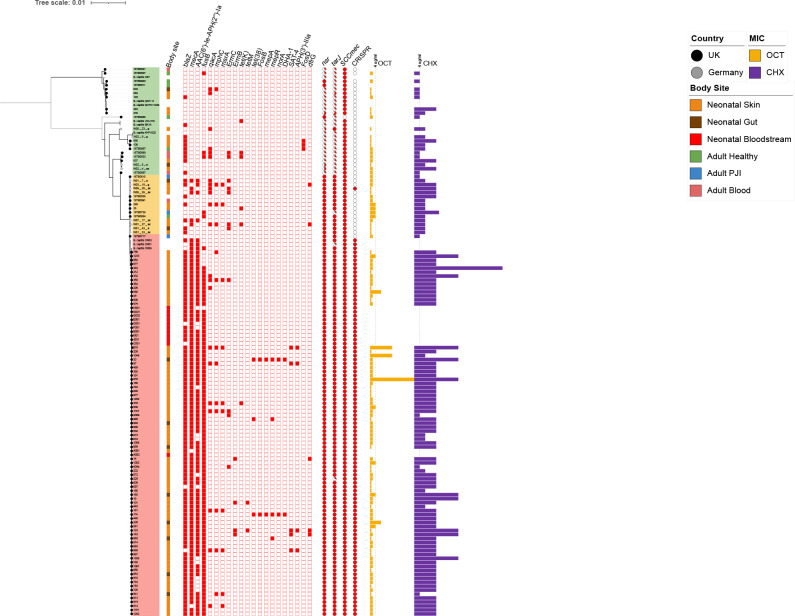
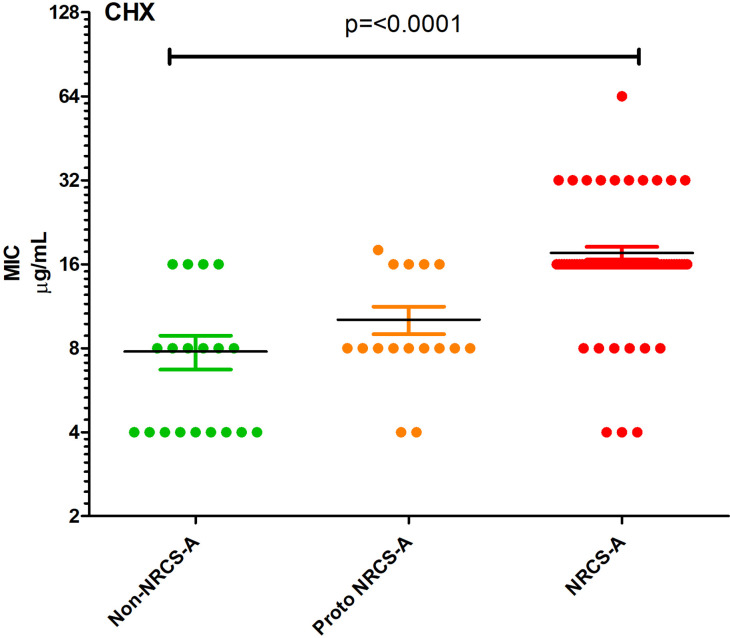
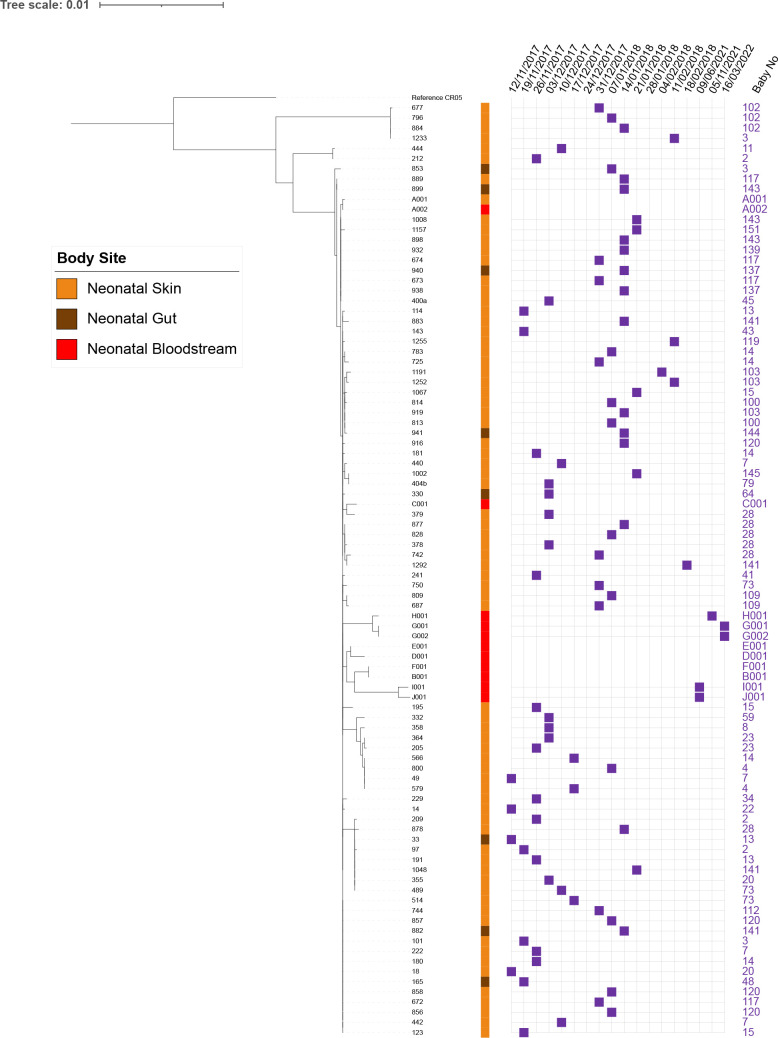
is a frequent cause of late-onset sepsis in neonates admitted to Neonatal Intensive Care Units (NICU). One clone of , NRCS-A has been isolated from NICUs globally although the reasons for the global success of this clone are not well understood.We analysed a collection of colonising babies admitted to two NICUs, one in the UK and one in Germany as well as corresponding pathological clinical isolates. Genome analysis identified a population structure of three groups; non-NRCS-A isolates, NRCS-A isolates, and a group of 'proto NRCS-A' - isolates closely related to NRCS-A but not associated with neonatal infection. All bloodstream isolates belonged to the NRCS-A group and were indistinguishable from strains carried on the skin or in the gut. NRCS-A isolates showed increased tolerance to chlorhexidine and antibiotics relative to the other as well as enhanced ability to grow at higher pH values. Analysis of the pangenome of 138 isolates identified characteristic and genes in both the NRCS-A and proto groups. A CRISPR-cas system was only seen in NRCS-A isolates which also showed enrichment of genes for metal acquisition and transport.We found evidence for transmission of NRCS-A within NICU, with related isolates shared between babies and multiple acquisitions by some babies. Our data show NRCS-A strains commonly colonise uninfected babies in NICU representing a potential reservoir for potential infection. This work provides more evidence that adaptation to survive in the gut and on skin facilitates spread of NRCS-A, and that metal acquisition and tolerance may be important to the biology of NRCS-A. Understanding how NRCS-A survives in NICUs can help develop infection control procedures against this clone.
是导致新生儿重症监护病房(NICU)新生儿晚发性败血症的常见原因。尽管目前还不太清楚这种克隆在全球范围内成功的原因,但已经从全球的 NICU 中分离出了一种 ,NRCS-A。我们分析了两组 NICU 住院婴儿的定植菌,一组来自英国,一组来自德国,以及相应的病理临床分离株。基因组分析确定了三个群体的种群结构;非-NRCS-A 分离株、NRCS-A 分离株和一组“原 NRCS-A” - 与 NRCS-A 密切相关但与新生儿感染无关的分离株。所有血流感染分离株均属于 NRCS-A 组,与皮肤或肠道携带的菌株无法区分。与其他 相比,NRCS-A 分离株对洗必泰和抗生素的耐受性增强,并且能够在更高的 pH 值下生长。对 138 株分离株的泛基因组分析确定了 NRCS-A 和原 NRCS-A 组中都存在特征性的 和 基因。只有在 NRCS-A 分离株中才发现了 CRISPR-cas 系统,而 NRCS-A 分离株还表现出对金属获取和运输的基因富集。我们发现了 NRCS-A 菌株在 NICU 内传播的证据,婴儿之间共享相关的分离株,并且一些婴儿多次获得。我们的数据表明,NRCS-A 菌株通常定植于 NICU 中未感染的婴儿,这代表了潜在感染的潜在储库。这一工作提供了更多证据表明,适应在肠道和皮肤上生存有助于 NRCS-A 的传播,并且金属获取和耐受性可能对 NRCS-A 的生物学特性很重要。了解 NRCS-A 如何在 NICU 中存活可以帮助开发针对这种克隆的感染控制程序。