Division of Epidemiology, Department of Population Health, NYU Grossman School of Medicine, New York, New York, USA.
Department of Epidemiology, Mailman School of Public Health, Columbia University, New York, New York, USA.
Environ Health Perspect. 2023 Oct;131(10):107001. doi: 10.1289/EHP11538. Epub 2023 Oct 4.
Living in neighborhoods with higher levels of walkability has been associated with a reduced risk of obesity and higher levels of physical activity. Obesity has been linked to increased risk of 13 cancers in women. However, long-term prospective studies of neighborhood walkability and risk for obesity-related cancer are scarce.
We evaluated the association between long-term average neighborhood walkability and obesity-related cancer risk in women.
The New York University Women's Health Study (NYUWHS) is a prospective cohort with 14,274 women recruited between 1985 and 1991 in New York City and followed over nearly three decades. We geocoded residential addresses for each participant throughout follow-up and calculated an average annual measure of neighborhood walkability across years of follow-up using data on population density and accessibility to destinations associated with geocoded residential addresses. We used ICD-9 codes to characterize first primary obesity-related cancers and employed Cox proportional hazards models to assess the association between average neighborhood walkability and risk of overall and site-specific obesity-related cancers.
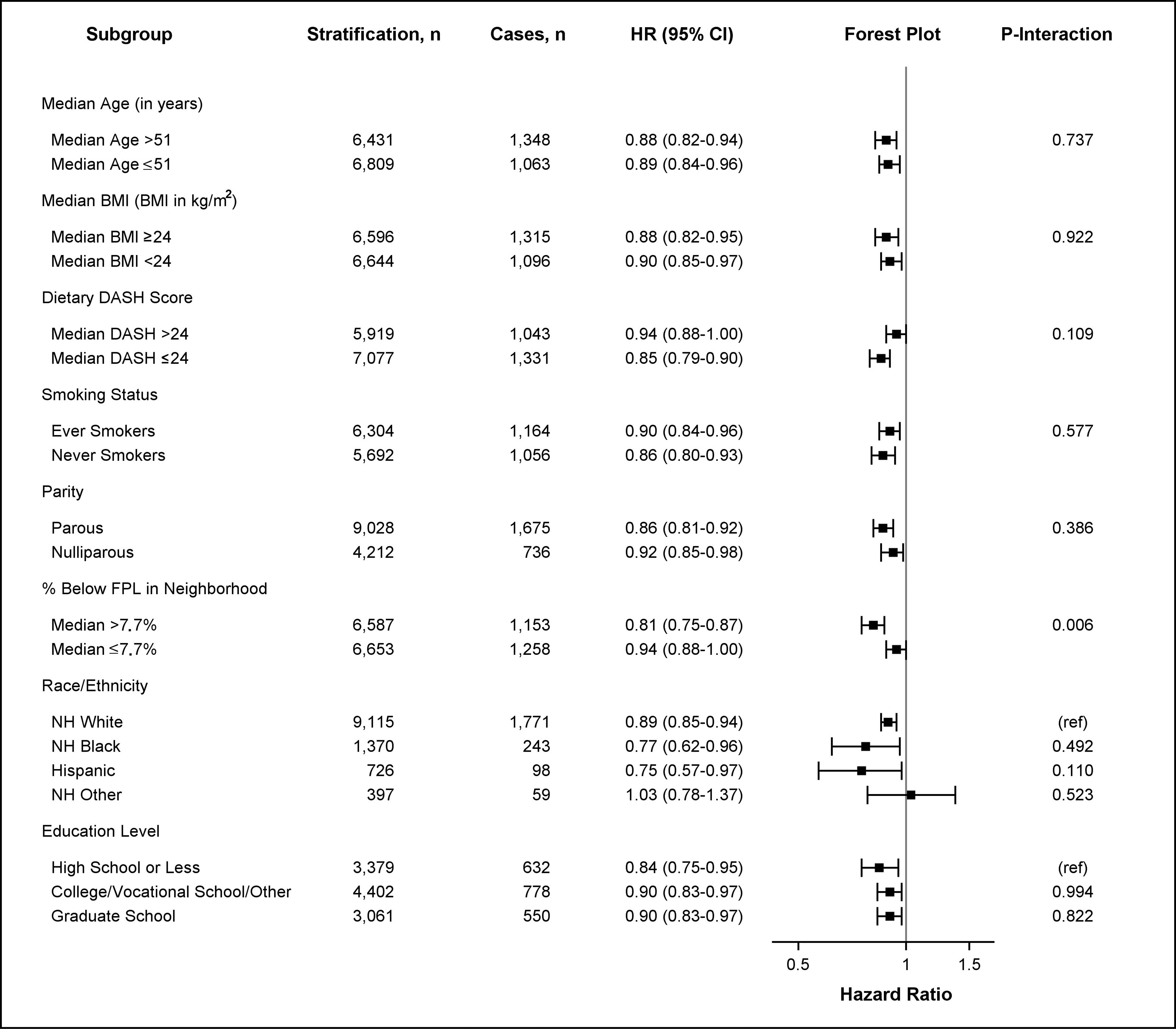
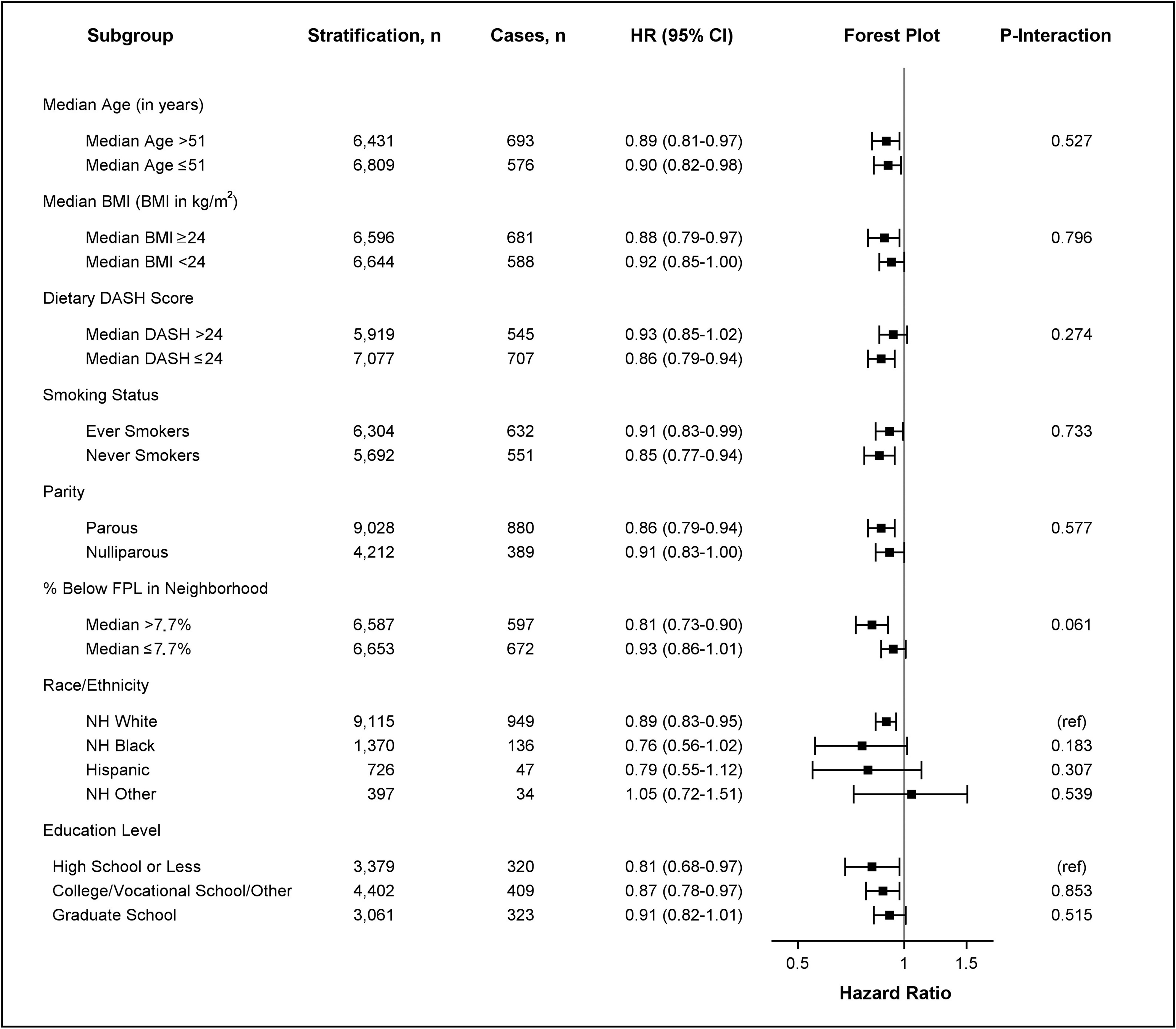
Residing in neighborhoods with a higher walkability level was associated with a reduced risk of overall and site-specific obesity-related cancers. The hazards ratios associated with a 1-standard deviation increase in average annual neighborhood walkability were 0.88 (95% CI: 0.85, 0.93) for overall obesity-related cancer, 0.89 (95% CI: 0.84, 0.95) for postmenopausal breast cancer, 0.82 (95% CI: 0.68, 0.99) for ovarian cancer, 0.87 (95% CI: 0.76, 0.99) for endometrial cancer, and 0.68 (95% CI: 0.49, 0.94) for multiple myeloma, adjusting for potential confounders at both the individual and neighborhood level. The association between neighborhood walkability and risk of overall obesity-related cancer was stronger among women living in neighborhoods with higher levels of poverty compared with women living in areas with lower poverty levels ().
Our study highlights a potential protective role of neighborhood walkability in preventing obesity-related cancers in women. https://doi.org/10.1289/EHP11538.
生活在步行友好型社区与肥胖风险降低和更高水平的身体活动有关。肥胖与女性 13 种癌症的风险增加有关。然而,关于邻里步行能力与肥胖相关癌症风险的长期前瞻性研究很少。
我们评估了女性长期平均邻里步行能力与肥胖相关癌症风险之间的关系。
纽约大学女性健康研究(NYUWHS)是一项前瞻性队列研究,1985 年至 1991 年期间在纽约市招募了 14274 名女性,并进行了近 30 年的随访。我们对每个参与者的居住地址进行地理编码,并使用人口密度和与地理编码居住地址相关的目的地可达性数据,计算出多年随访期间的平均年度邻里步行能力指标。我们使用 ICD-9 代码来描述第一原发性肥胖相关癌症,并采用 Cox 比例风险模型来评估平均邻里步行能力与总体和特定部位肥胖相关癌症风险之间的关系。
居住在步行能力较高的社区与总体和特定部位肥胖相关癌症的风险降低有关。与平均年度邻里步行能力增加一个标准差相关的风险比分别为:总体肥胖相关癌症为 0.88(95%CI:0.85,0.93)、绝经后乳腺癌为 0.89(95%CI:0.84,0.95)、卵巢癌为 0.82(95%CI:0.68,0.99)、子宫内膜癌为 0.87(95%CI:0.76,0.99)和多发性骨髓瘤为 0.68(95%CI:0.49,0.94),调整了个体和邻里层面的潜在混杂因素。在居住在贫困程度较高社区的女性中,邻里步行能力与总体肥胖相关癌症风险之间的关联比居住在贫困程度较低社区的女性更强()。
我们的研究强调了邻里步行能力在预防女性肥胖相关癌症方面的潜在保护作用。https://doi.org/10.1289/EHP11538.