Department of Medicine, Division of Epidemiology, Vanderbilt Epidemiology Center, Vanderbilt University School of Medicine, Vanderbilt-Ingram Cancer Center, Vanderbilt University Medical Center, Nashville, TN 37232, USA.
Division of Epidemiology, Herbert Wertheim School of Public Health and Human Longevity Science, University of California-San Diego, La Jolla, CA 92093, USA.
EBioMedicine. 2023 Nov;97:104818. doi: 10.1016/j.ebiom.2023.104818. Epub 2023 Oct 2.
No study has examined the associations between peripheral saturated long-chain fatty acids (LCFAs) and conversion from mild cognitive impairment (MCI) to Alzheimer's disease (AD). This study aimed to examine whether circulating saturated LCFAs are associated with both risks of incident MCI from cognitively normal (CN) participants and incident AD progressed from MCI in the Alzheimer's Disease Neuroimaging Initiative (ADNI) cohort.
We conducted analysis of data from older adults aged 55-90 years who were recruited at 63 sites across the USA and Canada. We examined associations between circulating saturated LCFAs (i.e., C14:0, C16:0, C18:0, C20:0) and risk for incident MCI in CN participants, and incident AD progressed from MCI.
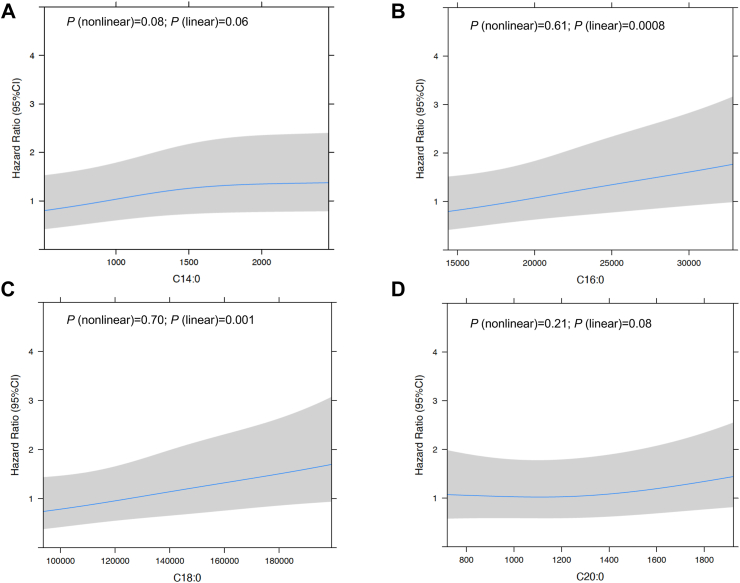
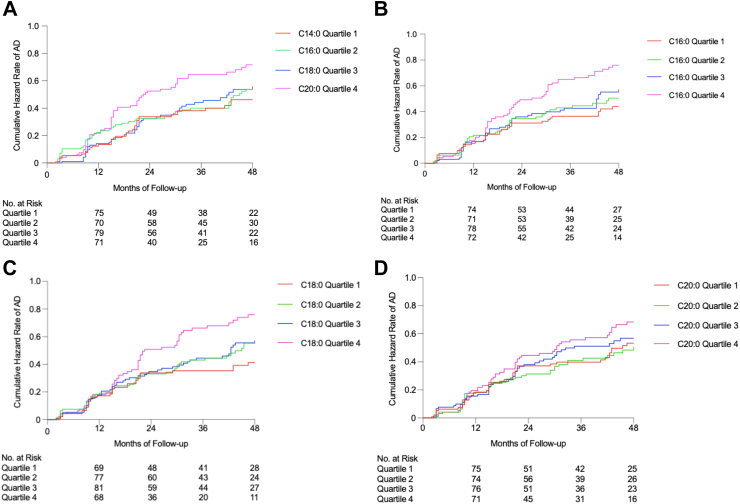
829 participants who were enrolled in ADNI-1 had data on plasma saturated LCFAs, of which 618 AD-free participants were included in our analysis (226 with normal cognition and 392 with MCI; 60.2% were men). Cox proportional-hazards models were used to account for time-to-event/censor with a 48-month follow-up period for the primary analysis. Other than C20:0, saturated LCFAs were associated with an increased risk for AD among participants with MCI at baseline (Hazard ratios (HRs) = 1.3 to 2.2, P = 0.0005 to 0.003 in fully-adjusted models). No association of C20:0 with risk of AD among participants with MCI was observed. No associations were observed between saturated LCFAs and risk for MCI among participants with normal cognition.
Saturated LCFAs are associated with increased risk of progressing from MCI to AD. This finding holds the potential to facilitate precision prevention of AD among patients with MCI.
National Institutes of Health.
目前尚无研究探讨外周饱和长链脂肪酸(LCFA)与轻度认知障碍(MCI)向阿尔茨海默病(AD)转化之间的关系。本研究旨在检验循环饱和 LCFAs 是否与来自认知正常(CN)参与者的 MCI 发病风险以及从 ADNI 队列中的 MCI 进展为 AD 的发病风险相关。
我们对来自美国和加拿大 63 个地点的 55-90 岁老年人进行了数据分析。我们检验了循环饱和 LCFAs(即 C14:0、C16:0、C18:0、C20:0)与 CN 参与者中发生 MCI 的风险以及从 MCI 进展为 AD 的风险之间的关系。
在 ADNI-1 中登记的 829 名参与者具有血浆饱和 LCFAs 的相关数据,其中 618 名无 AD 参与者纳入我们的分析(60.2%为男性,226 名认知正常,392 名 MCI)。采用 Cox 比例风险模型来考虑随时间变化的事件/删失,主要分析的随访期为 48 个月。除 C20:0 外,基线时患有 MCI 的参与者的饱和 LCFAs 与 AD 的发病风险增加相关(在完全调整的模型中,风险比(HR)为 1.3 至 2.2,P 值为 0.0005 至 0.003)。未观察到 C20:0 与 MCI 参与者发生 AD 的风险之间存在关联。在认知正常的参与者中,饱和 LCFAs 与 MCI 的发病风险之间没有关联。
饱和 LCFAs 与从 MCI 进展为 AD 的风险增加相关。这一发现有可能促进对 MCI 患者的 AD 进行精准预防。
美国国立卫生研究院。