Zhang Man, Dai Zhenlin, Chen Xiao, Qin Deqiang, Zhu Guoyuan, Zhu Tao, Chen Gang, Ding Yishu, Wu Guoxing, Gao Xi
College of Plant Protection, Yunnan Agricultural University, Kunming, Yunnan, China.
Yunan Tobacco Company Chuxiong Prefecture Company, Chuxiong, China.
Front Physiol. 2023 Sep 18;14:1248354. doi: 10.3389/fphys.2023.1248354. eCollection 2023.
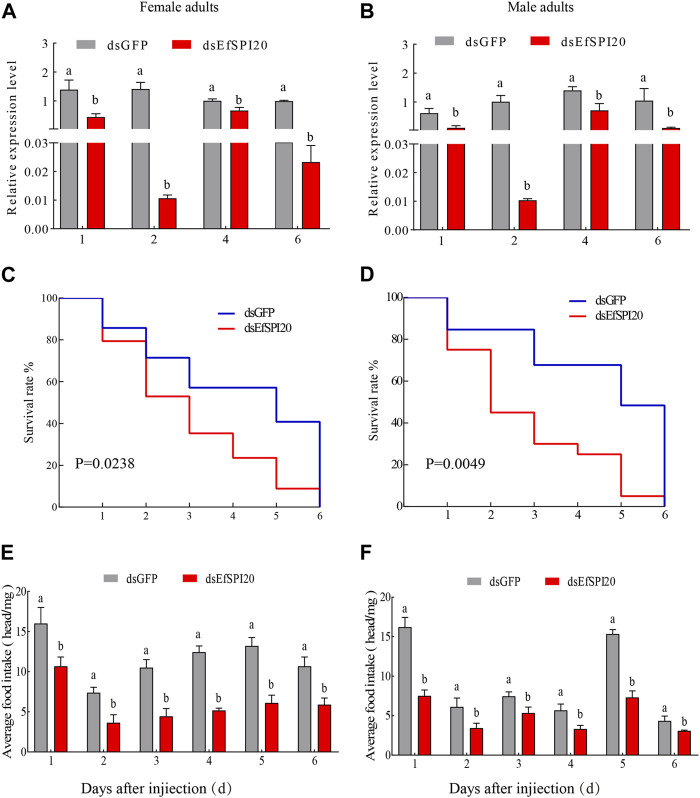
The predatory natural enemy plays a crucial role in agricultural ecosystems due to its effective pest control measures and defensive venom. Predator venom contains serine protease inhibitors (SPIs), which are the primary regulators of serine protease activity and play key roles in digestion, development, innate immunity, and other physiological regulatory processes. However, the regulation mechanism of SPIs in the salivary glands of predatory natural enemies is still unknown. In this study, we sequenced the transcriptome of salivary gland and identified 38 SPIs genes named . Through gene structure, multiple sequence alignment and phylogenetic tree analysis, real-time quantitative PCR (RT-PCR) expression profiles of different developmental stages and different tissues were analyzed. RNAi technology was used to explore the gene function of . The results showed that these 38 EfSPIs genes contained 8 SPI domains, which were serpin, TIL, Kunitz, Kazal, Antistasin, Pacifastin, WAP and A2M. The expression profile results showed that the expression of different types of EfSPIs genes was different at different developmental stages and different tissues. Most of the EfSPIs genes were highly expressed in the egg stage. The , and genes of the Pacifastin subfamily and the gene of the A2M subfamily were highly expressed in the nymphal and adult stages, which was consistent with the RT-qPCR verification results. These five genes are positively correlated with each other and have a synergistic effect on , and they were highly expressed in salivary glands. After interfering with the expression of the gene, the survival rate and predatory amount of male and female adults were significantly decreased. Taken together, we speculated some EfSPIs may inhibit trypsin, chymotrypsin, and elastase, and some EfSPIs may be involved in autoimmune responses. was essential for the predation and digestion of , and the functions of other EfSPIs were discussed. Our findings provide valuable insights into the diversity of EfSPIs in and the potential functions of regulating their predation, digestion and innate immunity, which may be of great significance for developing new pest control strategies.
捕食性天敌因其有效的害虫控制措施和防御性毒液在农业生态系统中发挥着至关重要的作用。捕食者毒液含有丝氨酸蛋白酶抑制剂(SPIs),它们是丝氨酸蛋白酶活性的主要调节因子,在消化、发育、先天免疫和其他生理调节过程中发挥关键作用。然而,捕食性天敌唾液腺中SPIs的调控机制仍然未知。在本研究中,我们对唾液腺进行了转录组测序,并鉴定出38个名为 的SPIs基因。通过基因结构、多序列比对和系统发育树分析,分析了不同发育阶段和不同组织的实时定量PCR(RT-PCR)表达谱。利用RNAi技术探索了 的基因功能。结果表明,这38个EfSPIs基因包含8个SPI结构域,分别为丝氨酸蛋白酶抑制剂、TIL、Kunitz、Kazal、抗凝血酶、Pacifastin、WAP和A2M。表达谱结果表明,不同类型的EfSPIs基因在不同发育阶段和不同组织中的表达存在差异。大多数EfSPIs基因在卵期高表达。Pacifastin亚家族的 、 和 基因以及A2M亚家族的 基因在若虫和成虫阶段高表达,这与RT-qPCR验证结果一致。这五个基因相互呈正相关,对 具有协同作用,且在唾液腺中高表达。干扰 基因的表达后,雌雄成虫的存活率和捕食量均显著降低。综上所述,我们推测一些EfSPIs可能抑制胰蛋白酶、糜蛋白酶和弹性蛋白酶,一些EfSPIs可能参与自身免疫反应。 对 的捕食和消化至关重要,并讨论了其他EfSPIs的功能。我们的研究结果为 中EfSPIs的多样性及其调节捕食、消化和先天免疫的潜在功能提供了有价值的见解,这可能对开发新的害虫控制策略具有重要意义。