
等速肌力训练对前交叉韧带重建运动员膝关节肌力、本体感觉和平衡能力的影响:一项随机对照试验。
Effect of isokinetic muscle strength training on knee muscle strength, proprioception, and balance ability in athletes with anterior cruciate ligament reconstruction: a randomised control trial.
作者信息
Wang Kun, Cheng Liang, Wang Bingcheng, He Benxiang
机构信息
Post-Doctoral Scientific Research Workstation of Affiliated Sport Hospital, Chengdu Sport University, Chengdu, China.
School of Sports Medicine and Health, Chengdu Sport University, Chengdu, China.
出版信息
Front Physiol. 2023 Sep 19;14:1237497. doi: 10.3389/fphys.2023.1237497. eCollection 2023.
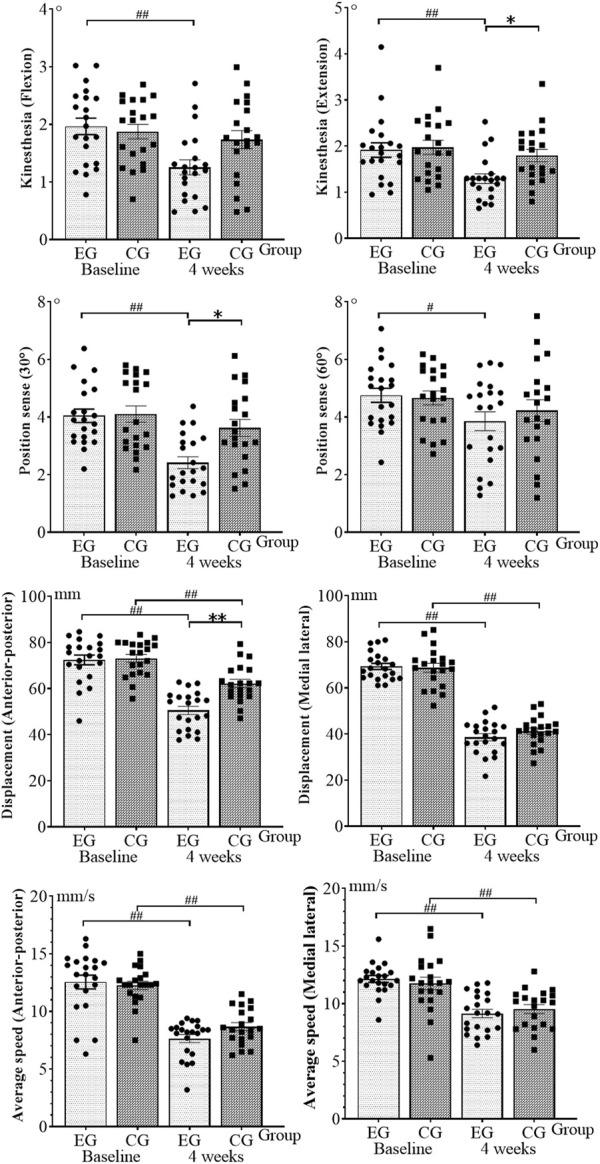
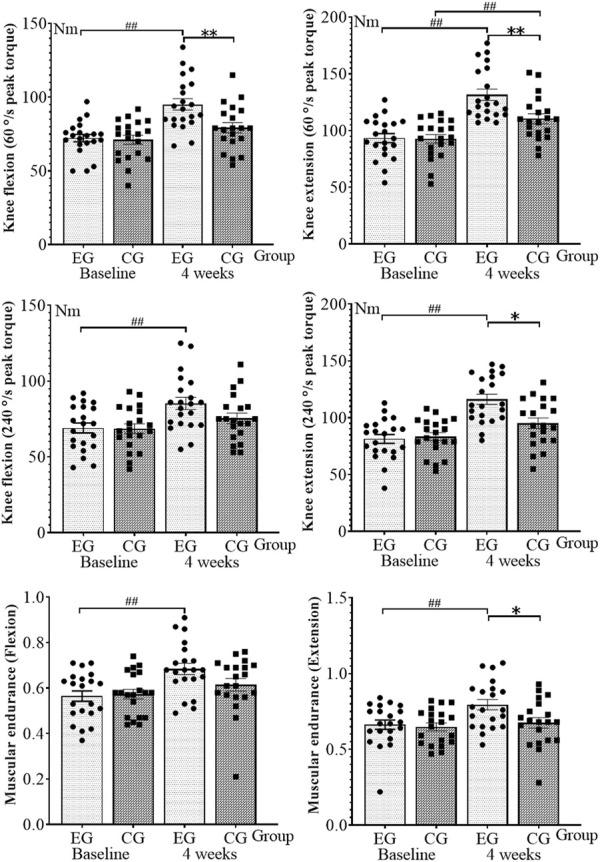
This study aimed to investigate the effects of regular isokinetic muscle strength training on knee muscle strength, proprioception, and balance ability in athletes after anterior cruciate ligament (ACL) reconstruction. Forty-one athletes who underwent ACL reconstruction were randomly divided into the experimental ( = 21) and control ( = 20) groups. The experimental group used an isokinetic muscle strength tester for 4 weeks (five times/ week) of knee flexion and extension isokinetic muscle strength training. The control group used the knee joint trainer (pneumatic resistance) for the same exercise regimen as the experimental group. 1) Four weeks when compared with the baseline. Experimental group: the knee flexion and extension PT (60°/s and 240°/s) increased by 31.7%, 40.3%, 23.4%, and 42.9% ( < 0.01), and the flexion muscular endurance increased by 21.4% and 19.7% ( < 0.01). The flexion and extension kinaesthesia and the 30° and 60° position sense decreased by 36.2%, 32.3%, 40.0%, and 18.9% ( < 0.05). The anterior-posterior and medial-lateral displacement and speed decreased by 30.2%, 44.2%, 38.4%, and 24.0% ( < 0.05). Control group: the knee peak torque (60°/s) increased by 18.8% ( < 0.01). The anterior-posterior and medial-lateral displacement and speed decreased by 14.9%, 40.0%, 26.8%, and 19.5% ( < 0.01). 2) After 4 weeks, compared with the control group, the knee flexion and extension peak torque (60°/s), extension, peak torque (240°/s), and extension muscular endurance of the treatment group increased to varying degrees ( < 0.05). However, the kinaesthesia, 30° position sense, and anterior-posterior displacement decreased to varying degrees ( < 0.05). Adding regular isokinetic muscle strength training to rehabilitation training further improved the knee flexion and extensor strength and extensor endurance of athletes with ACL reconstruction, as well as enhanced the kinaesthesia and 30° position sense and the balance between the anterior and posterior directions. However, the treatment had limited effects on knee flexion kinaesthesia and muscle endurance.
本研究旨在探讨定期等速肌力训练对前交叉韧带(ACL)重建术后运动员膝关节肌力、本体感觉和平衡能力的影响。41例行ACL重建术的运动员被随机分为实验组(n = 21)和对照组(n = 20)。实验组使用等速肌力测试仪进行为期4周(每周5次)的膝关节屈伸等速肌力训练。对照组使用膝关节训练器(气动阻力),训练方案与实验组相同。1)与基线相比4周时。实验组:膝关节屈伸PT(60°/s和240°/s)分别提高31.7%、40.3%、23.4%和42.9%(P < 0.01),屈曲肌肉耐力提高21.4%和19.7%(P < 0.01)。屈伸动觉以及30°和60°位置觉分别下降36.2%、32.3%、40.0%和18.9%(P < 0.05)。前后向和内外侧位移及速度分别下降30.2%、44.2%、38.4%和24.0%(P < 0.05)。对照组:膝关节峰值扭矩(60°/s)提高18.8%(P < 0.01)。前后向和内外侧位移及速度分别下降14.9%、40.0%、26.8%和19.5%(P < 0.01)。2)4周后,与对照组相比,治疗组膝关节屈伸峰值扭矩(60°/s)、伸展峰值扭矩(240°/s)和伸展肌肉耐力均有不同程度提高(P < 0.05)。然而,动觉、30°位置觉和前后向位移均有不同程度下降(P < 0.05)。在康复训练中增加定期等速肌力训练,进一步改善了ACL重建术后运动员的膝关节屈伸肌力和伸肌耐力,增强了动觉、30°位置觉以及前后方向的平衡能力。然而,该治疗对膝关节屈曲动觉和肌肉耐力的影响有限。
 Zotero 插件