Department of Public Health and Mortality Studies, International Institute for Population Sciences, Mumbai, Maharashtra, India.
Department of Biostatistics and Epidemiology, International Institute for Population Sciences, Mumbai, Maharashtra, India.
PLoS One. 2023 Oct 5;18(10):e0292353. doi: 10.1371/journal.pone.0292353. eCollection 2023.
The reductions in mortality levels among children under five years are observed in most populations, including populations that were lagging the progress in the past. However, the reduction is not uniform across ages during childhood. The mortality declines within the first month have shown relatively slow progress. Early initiation of breastfeeding and discarding pre-lacteal feed protects the newborn from acquiring infection and, thereby, reduces mortality. This paper assesses the change in the prevalence of early initiation of breastfeeding and pre-lacteal feed along with their associated factors, and their association with neonatal mortality in India.
We used data from the three rounds of National Family Health Surveys conducted during 2005-06, 2015-16 and 2019-21 in India. We used bivariate and multivariate analyses to examine prevalence rates, risk factors, and relationships between breastfeeding practices, including early initiation of breastfeeding and pre-lacteal feed, and neonatal mortality.
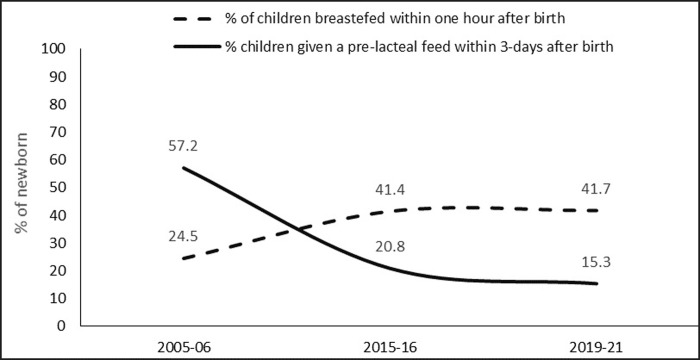
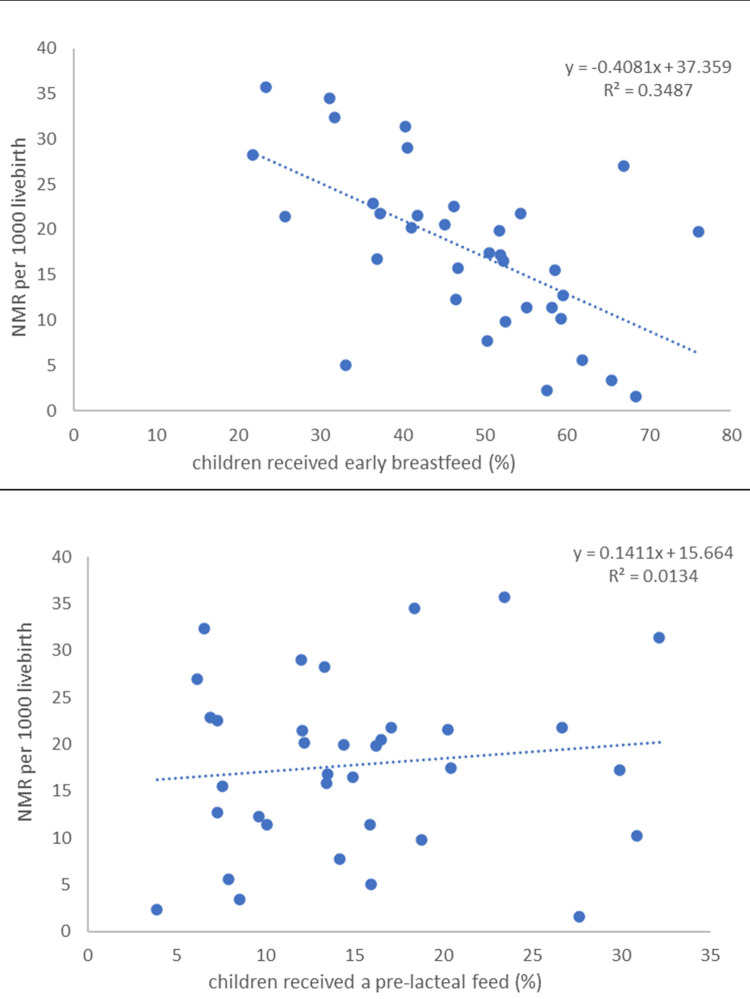
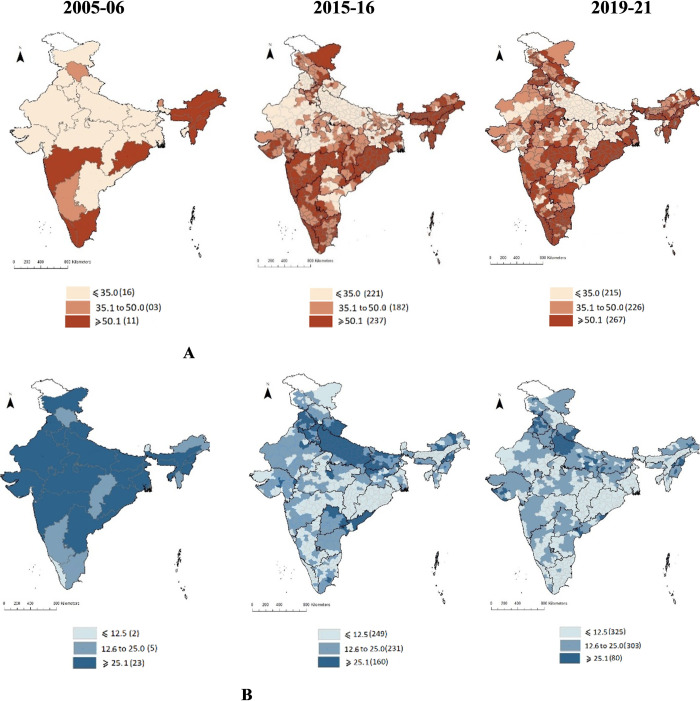
Early initiation of breastfeeding within one hour after birth increased rapidly from 25% in 2005-06 to 42% in 2019-21, and the pre-lacteal feeding practice declined from 57% in 2005-06 to 15% in 2019-21. Pre-lacteal feed is lower in states/districts where early breastfeeding initiation is predominant and vice versa. The role of health professionals during pregnancy and the first two days after delivery significantly improved breastfeeding practice. Further, the findings suggest that an early breastfeeding initiation is associated with lower neonatal mortality, whereas pre-lacteal feed is not harmful compared to late breastfeeding initiation.
Prevalence of pre-lacteal feed reduced, and initiation of early breastfeeding increased considerably after the launch of the National Rural Health Mission in India. However, after 2015-16, early breastfeeding initiation has stagnated, and the decline in pre-lacteal feed has slowed down. The future program needs special attention to emphasize the availability and accessibility of breastfeeding advisers and observers in health facilities to help mitigate adverse neonatal outcomes.
五岁以下儿童死亡率的降低在大多数人群中都有观察到,包括过去进展滞后的人群。然而,在儿童时期,死亡率的降低并不是在所有年龄段都均匀的。新生儿在出生后的第一个月内的死亡率下降速度相对较慢。早期开始母乳喂养和摒弃开奶前喂养可以保护新生儿免受感染,从而降低死亡率。本文评估了印度早期开始母乳喂养和开奶前喂养的流行率及其相关因素的变化,以及它们与新生儿死亡率的关系。
我们使用了印度在 2005-06 年、2015-16 年和 2019-21 年进行的三轮全国家庭健康调查的数据。我们使用了双变量和多变量分析来检查母乳喂养实践的流行率、危险因素,以及包括早期开始母乳喂养和开奶前喂养在内的母乳喂养实践与新生儿死亡率之间的关系。
新生儿出生后一小时内开始母乳喂养的比例从 2005-06 年的 25%迅速增加到 2019-21 年的 42%,开奶前喂养的比例从 2005-06 年的 57%下降到 2019-21 年的 15%。在早期母乳喂养启动为主的州/地区,开奶前喂养的比例较低,反之亦然。在怀孕期间和分娩后的头两天,卫生专业人员的作用显著改善了母乳喂养的实践。此外,研究结果表明,早期开始母乳喂养与较低的新生儿死亡率相关,而与晚开始母乳喂养相比,开奶前喂养并没有危害。
印度启动国家农村卫生使命后,开奶前喂养的流行率降低,早期母乳喂养的启动率显著增加。然而,在 2015-16 年之后,早期母乳喂养的启动率停滞不前,开奶前喂养的下降速度也放缓。未来的项目需要特别关注,强调在卫生设施中提供和可及母乳喂养顾问和观察员,以帮助减轻不良新生儿结局的风险。