Duke Human Vaccine Institute, Duke University, Durham, NC, United States.
Medical Scientist Training Program, Duke University, Durham, NC, United States.
Front Immunol. 2021 Jan 21;11:595297. doi: 10.3389/fimmu.2020.595297. eCollection 2020.
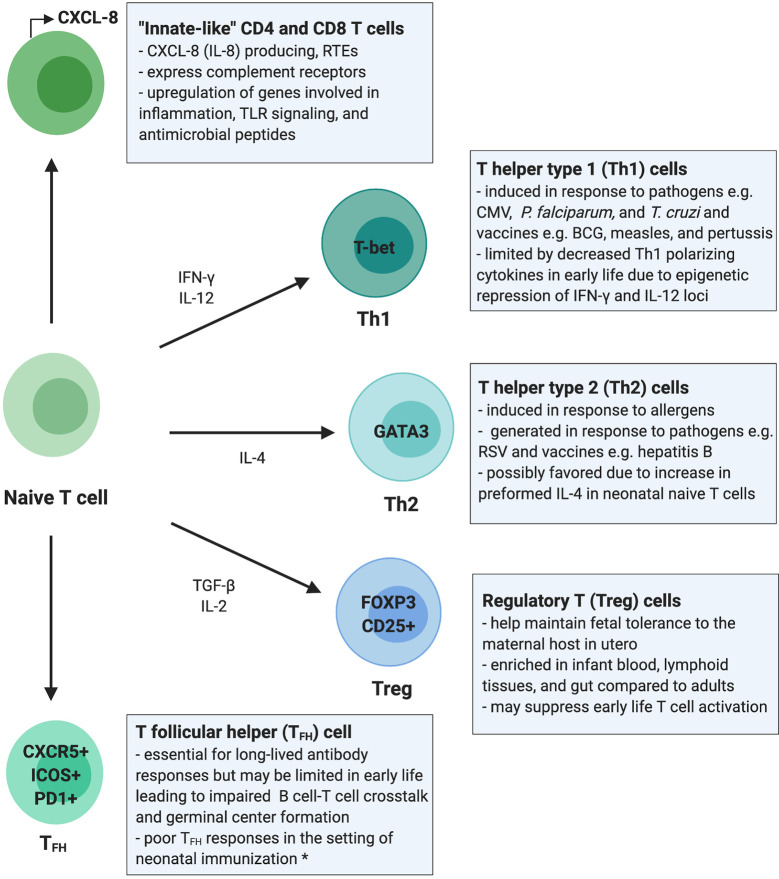
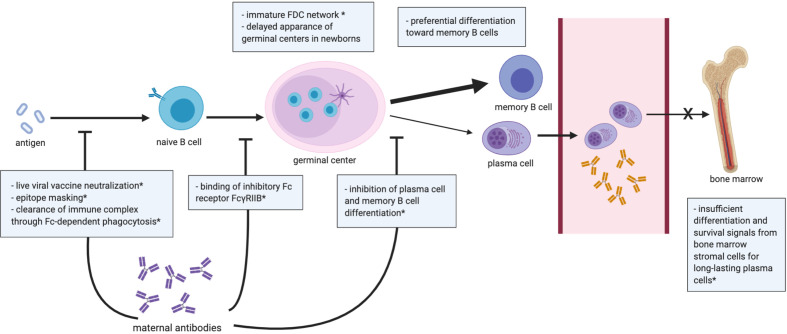
Infants are capable of mounting adaptive immune responses, but their ability to develop long-lasting immunity is limited. Understanding the particularities of the neonatal adaptive immune system is therefore critical to guide the design of immune-based interventions, including vaccines, in early life. In this review, we present a thorough summary of T cell, B cell, and humoral immunity in early life and discuss infant adaptive immune responses to pathogens and vaccines. We focus on the differences between T and B cell responses in early life and adulthood, which hinder the generation of long-lasting adaptive immune responses in infancy. We discuss how knowledge of early life adaptive immunity can be applied when developing vaccine strategies for this unique period of immune development. In particular, we emphasize the use of novel vaccine adjuvants and optimization of infant vaccine schedules. We also propose integrating maternal and infant immunization strategies to ensure optimal neonatal protection through passive maternal antibody transfer while avoiding hindering infant vaccine responses. Our review highlights that the infant adaptive immune system is functionally distinct and uniquely regulated compared to later life and that these particularities should be considered when designing interventions to promote pediatric health.
婴儿能够产生适应性免疫反应,但他们产生持久免疫力的能力有限。因此,了解新生儿适应性免疫系统的特点对于指导包括疫苗在内的免疫干预措施在生命早期的设计至关重要。在这篇综述中,我们全面总结了生命早期的 T 细胞、B 细胞和体液免疫,并讨论了婴儿对病原体和疫苗的适应性免疫反应。我们重点讨论了生命早期和成年期 T 细胞和 B 细胞反应之间的差异,这些差异阻碍了婴儿产生持久的适应性免疫反应。我们讨论了在为这一独特的免疫发育时期开发疫苗策略时,如何应用早期适应性免疫的知识。特别是,我们强调使用新型疫苗佐剂和优化婴儿疫苗接种时间表。我们还提出整合母婴免疫策略,通过被动母体抗体转移来确保新生儿的最佳保护,同时避免阻碍婴儿的疫苗反应。我们的综述强调,与生命后期相比,婴儿适应性免疫系统在功能上是不同的,并且受到独特的调节,在设计促进儿童健康的干预措施时应考虑这些特点。