Kanematsu Ryo, Mizuno Masaki, Inoue Tomoo, Takahashi Toshiyuki, Endo Toshiki, Shigekawa Seiji, Muto Jun, Umebayashi Daisuke, Mitsuhara Takafumi, Hida Kazutoshi, Hanakita Junya
Fujieda Heisei Memorial Hospital, Fujieda, Japan.
Department of Minimum-Invasive Neurospinal Surgery, Mie University, Tsu city, Japan.
Neurospine. 2023 Sep;20(3):766-773. doi: 10.14245/ns.2346386.193. Epub 2023 Sep 30.
The impact of adjuvant radiotherapy on overall survival (OS) and progression-free survival (PFS) of patients with grade II spinal cord astrocytomas remains controversial. Additionally, the relationship between progression and clinical deterioration after radiotherapy has not been well investigated.
This study included 53 patients with grade II intramedullary spinal cord astrocytomas treated by either subtotal, partial resection or open biopsy. Their clinical performance status was assessed immediately before operation and 1, 6, 12, 24, and 60 months after surgery by Karnofsky Performance Scale (KPS). Patients with and without adjuvant radiotherapy were compared.
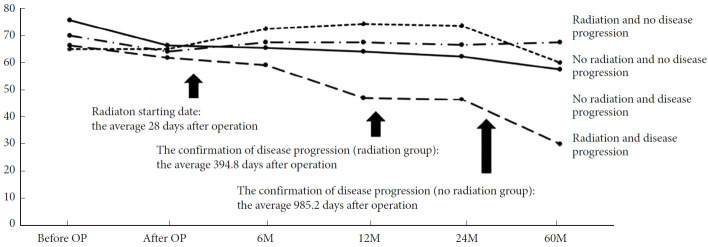
The groups with and without radiation comprised 23 and 30 patients with a mean age of 50.3 ± 22.6 years (range, 2-88 years). The mean overall disease progression rate was 47.1% during a mean follow-up period of 48.4 ± 39.8 months (range, 2.5-144.5 months). In the radiation group, 11 patients (47.8%) presented with progressive disease, whereas 14 patients (46.7%) presented with progressive disease in the group without radiation. There were no significant differences in OS or PFS among patients with or without adjuvant radiotherapy. KPS in both groups, especially radiation group, gradually decreased after operation and deteriorated before the confirmation of disease progression.
Adjuvant radiotherapy did not show effectiveness regarding PFS or OS in patients with grade II spinal cord astrocytoma according to classical classification based on pathohistological findings.
辅助放疗对Ⅱ级脊髓星形细胞瘤患者总生存期(OS)和无进展生存期(PFS)的影响仍存在争议。此外,放疗后病情进展与临床恶化之间的关系尚未得到充分研究。
本研究纳入了53例接受次全切除、部分切除或开放活检治疗的Ⅱ级脊髓髓内星形细胞瘤患者。术前及术后1、6、12、24和60个月通过卡氏功能状态量表(KPS)评估其临床功能状态。对接受和未接受辅助放疗的患者进行比较。
接受放疗和未接受放疗的两组分别有23例和30例患者,平均年龄为50.3±22.6岁(范围2 - 88岁)。在平均48.4±39.8个月(范围2.5 - 144.5个月)的随访期内,总体疾病进展率平均为47.1%。放疗组有11例患者(47.8%)出现疾病进展,而未放疗组有14例患者(46.7%)出现疾病进展。接受或未接受辅助放疗的患者在OS或PFS方面无显著差异。两组患者的KPS,尤其是放疗组,术后逐渐下降,并在疾病进展确认前恶化。
根据基于病理组织学结果的经典分类,辅助放疗对Ⅱ级脊髓星形细胞瘤患者的PFS或OS未显示出有效性。