Cardiometabolic Medicine Center, Fuwai Hospital, National Center for Cardiovascular Diseases Chinese Academy of Medical Sciences and Peking Union Medical College Beijing China.
State Key Laboratory of Cardiovascular Disease Beijing China.
J Am Heart Assoc. 2023 Oct 17;12(20):e030625. doi: 10.1161/JAHA.123.030625. Epub 2023 Oct 7.
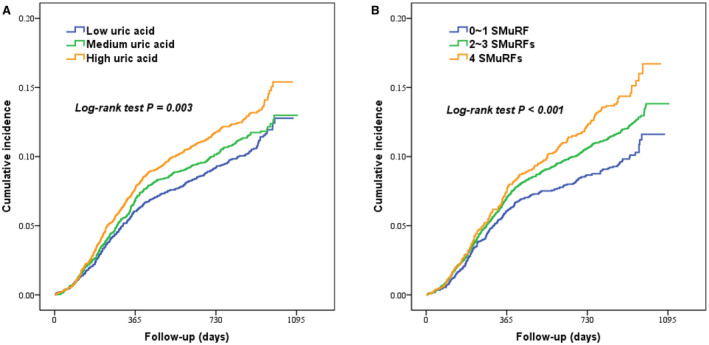
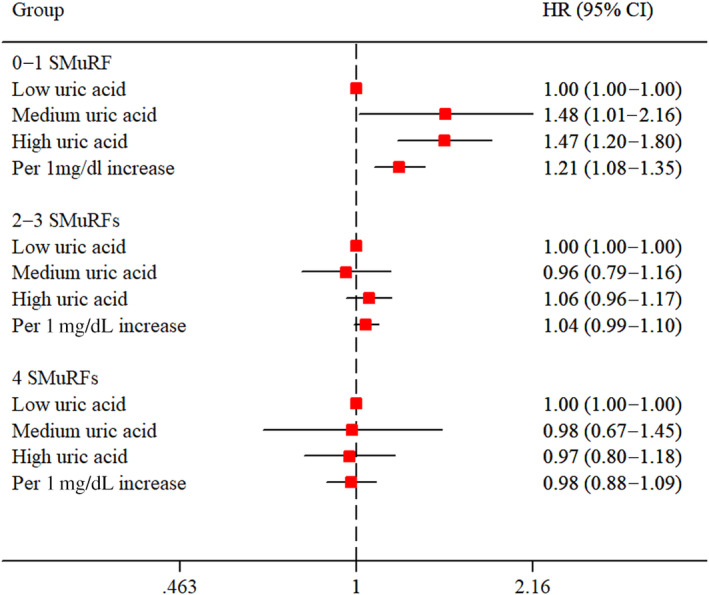
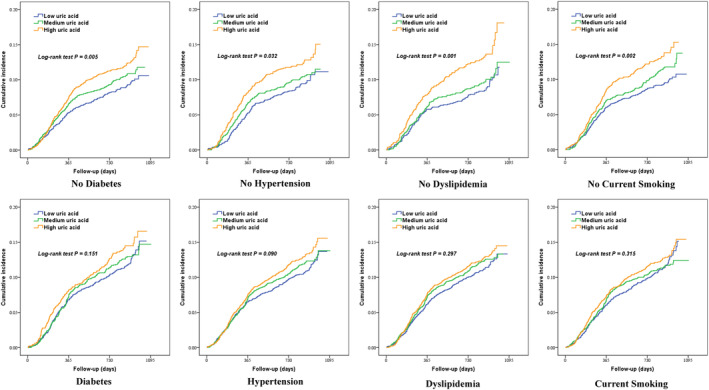
Background Serum uric acid (UA) is correlated closely with traditional cardiovascular risk factors, which might interfere with the action of UA, in patients with coronary artery disease. We performed this study to evaluate the prognostic effect of UA levels in individuals with different numbers of standard modifiable cardiovascular risk factors (SMuRFs). Methods and Results In this prospective study, we consecutively enrolled 10 486 patients with coronary artery disease. They were stratified into 3 groups according to the tertiles of UA concentrations and, within each UA tertile, further classified into 3 groups by the number of SMuRFs (0-1 versus 2-3 versus 4). The primary end point was major adverse cardiovascular and cerebrovascular events (MACCEs), including death, myocardial infarction, stroke, and unplanned revascularization. Over a median follow-up of 2.4 years, 1233 (11.8%) MACCEs were recorded. Patients with high UA levels developed significantly higher risk of MACCEs than those with low UA levels. In addition, UA levels were positively associated with MACCEs as a continuous variable. More importantly, in patients with 0 to 1 SMuRF, the risks of MACCEs were significantly higher in the high-UA-level group (adjusted hazard ratio [HR], 1.469 [95% CI, 1.197-1.804]) and medium-UA-level group (adjusted HR, 1.478 [95% CI, 1.012-2.160]), compared with the low-UA-level group, whereas no significant association was found between UA levels and the risk of MACCEs in participants with 2 to 3 or 4 SMuRFs. Conclusions In patients with coronary artery disease who received evidence-based secondary prevention therapies, elevated UA levels might affect the prognosis of individuals with 0 to 1 SMuRF but not that of individuals with ≥2 SMuRFs.
血清尿酸(UA)与传统心血管危险因素密切相关,这可能会干扰冠心病患者 UA 的作用。我们进行这项研究是为了评估 UA 水平在具有不同数量标准可修正心血管危险因素(SMuRFs)的个体中的预后影响。
在这项前瞻性研究中,我们连续纳入了 10486 名冠心病患者。他们根据 UA 浓度的三分位值分为 3 组,在每个 UA 三分位值内,根据 SMuRFs 的数量(0-1、2-3 和 4)进一步分为 3 组。主要终点是主要不良心血管和脑血管事件(MACCEs),包括死亡、心肌梗死、卒中和计划外血运重建。中位随访 2.4 年后,记录了 1233 例(11.8%)MACCEs。UA 水平高的患者发生 MACCEs 的风险明显高于 UA 水平低的患者。此外,UA 水平与 MACCEs 呈连续变量相关。更重要的是,在具有 0 到 1 个 SMuRF 的患者中,高 UA 水平组(调整后的危险比 [HR],1.469 [95%置信区间,1.197-1.804])和中 UA 水平组(调整后的 HR,1.478 [95%置信区间,1.012-2.160])的 MACCEs 风险明显高于低 UA 水平组,而在具有 2 到 3 个或 4 个 SMuRF 的患者中,UA 水平与 MACCEs 风险之间没有显著关联。
在接受循证二级预防治疗的冠心病患者中,UA 水平升高可能会影响具有 0 到 1 个 SMuRF 的个体的预后,但不会影响具有≥2 个 SMuRF 的个体的预后。