Kramer Ueli, Temes Christina M, Frankenburg Frances R, Glass Isabel V, Zanarini Mary C
Department of Psychiatry, Institute of Psychotherapy and General Psychiatry Service, University of Lausanne, Place Chauderon 18, CH-1003, Lausanne, Switzerland.
Massachusetts General Hospital, Harvard Medical School, Boston, USA.
Borderline Personal Disord Emot Dysregul. 2023 Oct 9;10(1):30. doi: 10.1186/s40479-023-00236-x.
The utilization of Social Security Disability Insurance (SSDI) is frequent in patients with borderline personality disorder (BPD) and may represent a meaningful marker of a patient's symptom severity, poor psychosocial functioning, and/or inner suffering. Over 24 years of prospective follow-up, the present study aims to describe the course of SSDI and assess the role of clinically relevant predictors.
A total of 290 inpatients with BPD were interviewed at baseline and 12 consecutive follow-up waves, each separated by two years, after index hospitalization. Included were also 72 inpatients with other personality disorders. Surviving patients were reinterviewed. A series of interviews and self-report measures were used to assess psychosocial functioning and treatment history, axis I and II disorders, and childhood/adult adversity.
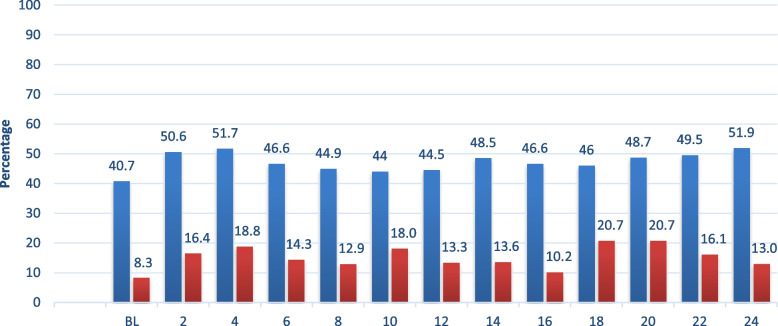
Results show that rates of SSDI utilization were relatively stable over 24 years of follow-up (on average, 47.2% of the patients with BPD were on SSDI). Patients with BPD were three times more likely to be on SSDI than patients with other PDs. Patients with BPD displayed flexibility in their usage of SSDI. By 24 years, 46% of patients remitted, out of which 85% experienced recurrence and 50% of the patients had a new onset over time. In multivariate analyses, four variables were found to predict SSDI status in patients with BPD over time. These variables were: age 26 or older, lower IQ, severity of non-sexual childhood abuse, and presence of PTSD.
The results of this study suggest that a combination of a demographic factors, childhood adversity, natural endowment, and comorbidity are significant predictors of receiving SSDI over time. On a group level, there is a relative stability of SSDI usage over time, but on the individual level, the present study found a high fluctuation in receiving SSDI over 24 months of prospective follow-up.
边缘型人格障碍(BPD)患者经常使用社会保障残疾保险(SSDI),这可能是患者症状严重程度、心理社会功能不佳和/或内心痛苦的一个有意义的指标。在24年的前瞻性随访中,本研究旨在描述SSDI的使用过程并评估临床相关预测因素的作用。
共有290例BPD住院患者在基线时接受访谈,并在首次住院后的12个连续随访期(每次间隔两年)接受访谈。还纳入了72例患有其他人格障碍的住院患者。对存活患者进行再次访谈。使用一系列访谈和自我报告测量方法来评估心理社会功能和治疗史、轴I和轴II障碍以及童年/成人期逆境。
结果显示,在24年的随访中,SSDI的使用率相对稳定(平均而言,47.2%的BPD患者使用SSDI)。BPD患者使用SSDI的可能性是其他人格障碍患者的三倍。BPD患者在SSDI的使用上表现出灵活性。到24年时,46%的患者缓解,其中85%经历复发,50%的患者随时间出现新发病例。在多变量分析中,发现四个变量可预测BPD患者随时间的SSDI状态。这些变量是:26岁或以上、智商较低、非性虐待童年的严重程度以及创伤后应激障碍(PTSD)的存在。
本研究结果表明,人口统计学因素、童年逆境、天赋和共病的综合作用是随时间推移接受SSDI的重要预测因素。在群体层面,SSDI的使用随时间相对稳定,但在个体层面,本研究发现在24个月的前瞻性随访中接受SSDI存在高度波动。