Schroeder Philip, Mandla Ravi, Huerta-Chagoya Alicia, Alkanak Ahmed, Nagy Dorka, Szczerbinski Lukasz, Madsen Jesper G S, Cole Joanne B, Porneala Bianca, Westerman Kenneth, Li Josephine H, Pollin Toni I, Florez Jose C, Gloyn Anna L, Cebola Inês, Manning Alisa, Leong Aaron, Udler Miriam, Mercader Josep M
Programs in Metabolism and Medical & Population Genetics, Broad Institute of Harvard and MIT, Cambridge, MA, USA.
Center for Genomic Medicine, Massachusetts General Hospital, Boston, MA, USA.
medRxiv. 2023 Sep 29:2023.09.28.23296244. doi: 10.1101/2023.09.28.23296244.
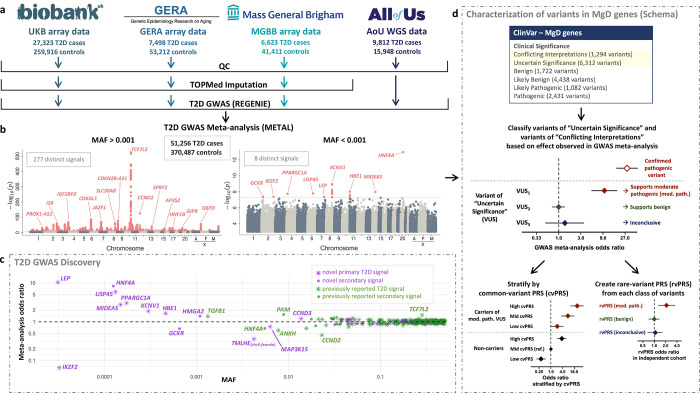
We meta-analyzed array data imputed with the TOPMed reference panel and whole-genome sequence (WGS) datasets and performed the largest, rare variant (minor allele frequency as low as 5×10) GWAS meta-analysis of type 2 diabetes (T2D) comprising 51,256 cases and 370,487 controls. We identified 52 novel variants at genome-wide significance (<5 × 10), including 8 novel variants that were either rare or ancestry-specific. Among them, we identified a rare missense variant in p.Arg114Trp (OR=8.2, 95% confidence interval [CI]=4.6-14.0, = 1.08×10), previously reported as a variant implicated in Maturity Onset Diabetes of the Young (MODY) with incomplete penetrance. We demonstrated that the diabetes risk in carriers of this variant was modulated by a T2D common variant polygenic risk score (cvPRS) (carriers in the top PRS tertile [OR=18.3, 95%CI=7.2-46.9, =1.2×10] vs carriers in the bottom PRS tertile [OR=2.6, 95% CI=0.97-7.09, = 0.06]. Association results identified eight variants of intermediate penetrance (OR>5) in monogenic diabetes (MD), which in aggregate as a rare variant PRS were associated with T2D in an independent WGS dataset (OR=4.7, 95% CI=1.86-11.77], = 0.001). Our data also provided support evidence for 21% of the variants reported in ClinVar in these MD genes as benign based on lack of association with T2D. Our work provides a framework for using rare variant imputation and WGS analyses in large-scale population-based association studies to identify large-effect rare variants and provide evidence for informing variant pathogenicity.
我们对采用TOPMed参考面板推算的阵列数据和全基因组序列(WGS)数据集进行了荟萃分析,并对2型糖尿病(T2D)开展了规模最大的罕见变异(次要等位基因频率低至5×10)全基因组关联研究(GWAS)荟萃分析,纳入了51256例病例和370487例对照。我们在全基因组显著性水平(<5×10)上鉴定出52个新变异,其中包括8个罕见或特定祖先的新变异。其中,我们在p.Arg114Trp中鉴定出一个罕见的错义变异(比值比[OR]=8.2,95%置信区间[CI]=4.6 - 14.0,=1.08×10),该变异先前被报道为与不完全外显的青年发病型成年糖尿病(MODY)相关的变异。我们证明,该变异携带者的糖尿病风险受到T2D常见变异多基因风险评分(cvPRS)的调节(PRS三分位数最高组的携带者[OR=18.3,95%CI=7.2 - 46.9,=1.2×10]与PRS三分位数最低组的携带者[OR=2.6,95%CI=0.97 - 7.09,=0.06])。关联结果在单基因糖尿病(MD)中鉴定出8个中等外显率(OR>5)的变异,这些变异作为一个罕见变异PRS在一个独立的WGS数据集中与T2D相关(OR=4.7,95%CI=1.86 - 11.77,=0.001)。我们的数据还基于与T2D缺乏关联,为ClinVar中报道的这些MD基因中21%的变异为良性提供了支持证据。我们的工作为在大规模基于人群的关联研究中使用罕见变异推算和WGS分析以鉴定具有大效应的罕见变异并为变异致病性提供信息提供了一个框架。