Woo Seung-Hwa, Choi Joon Hyuk, Mo Yun Jeong, Lee Yun-Il, Jeon Won Bae, Lee Young-Sam
Department of New Biology, DGIST, Daegu, 42988, Republic of Korea.
Division of Biotechnology, DGIST, Daegu, 42988, Republic of Korea.
Heliyon. 2023 Sep 15;9(9):e20201. doi: 10.1016/j.heliyon.2023.e20201. eCollection 2023 Sep.
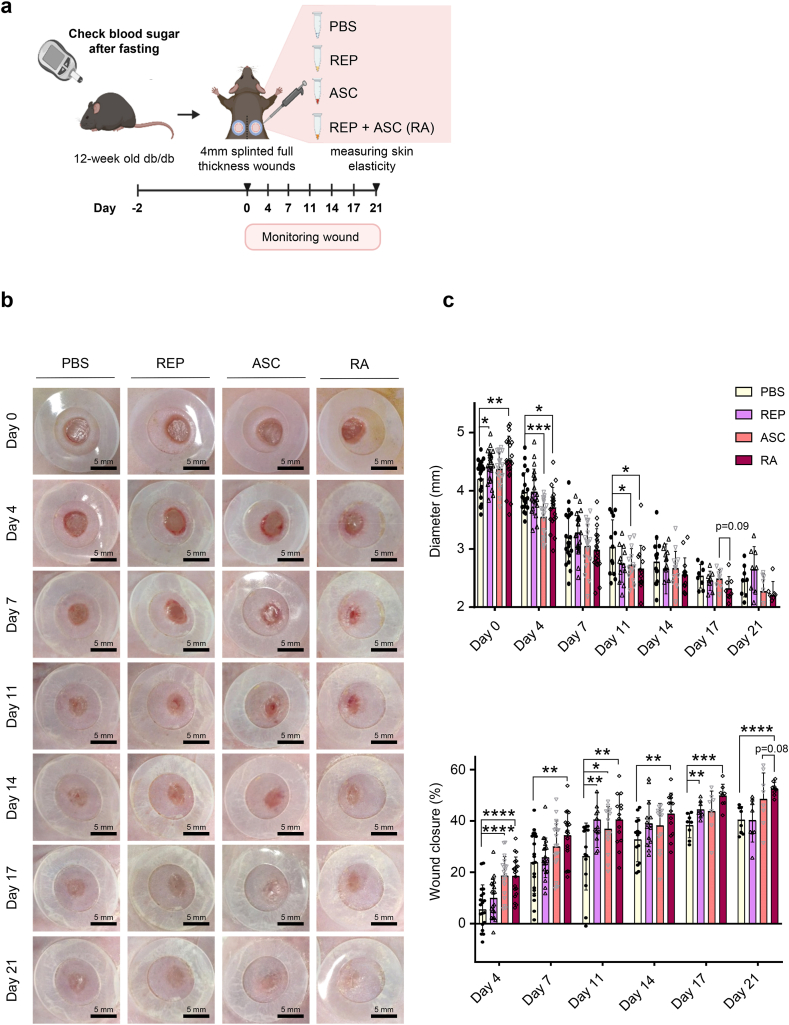
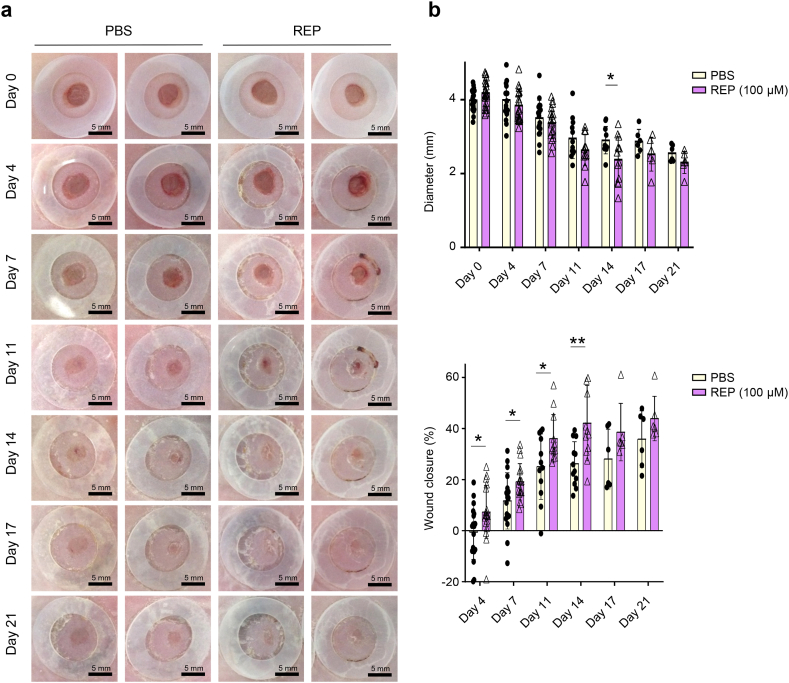
Impaired cutaneous wound healing is a major complication in patients with diabetes mellitus (DM), leading to increased amputation and mortality rates in affected patients. Adipose-derived stem cells (ASCs) are widely used seed cells for promoted tissue regeneration to improve wound closure under diabetic conditions. However, ASCs-based therapies remain limited due to difficulties in maintaining cell quality during transplantation. To overcome this problem, extracellular matrix mimetic biomaterials have been developed for use in biomedical engineering field, including tissue engineering and regenerative medicine. Herein, a biosynthesized arginine-glycine-aspartate amino acid residues (RGD motif, known as a cell adhesion motif)-containing elastin-like polypeptides (REPs) improved the efficacy of ASCs in enhancing wound closure and skin elasticity in diabetic wounds by promoting the expression of angiogenic growth factors. Therefore, REPs can be used as potential supplements to stem cell-based therapeutic approach to accelerate diabetic wound repair.
皮肤伤口愈合受损是糖尿病患者的主要并发症,会导致受影响患者的截肢率和死亡率上升。脂肪来源干细胞(ASC)是广泛用于促进组织再生以改善糖尿病条件下伤口闭合的种子细胞。然而,由于移植过程中维持细胞质量存在困难,基于ASC的治疗方法仍然有限。为克服这一问题,已开发出细胞外基质模拟生物材料用于生物医学工程领域,包括组织工程和再生医学。在此,一种生物合成的含精氨酸-甘氨酸-天冬氨酸氨基酸残基(RGD基序,一种细胞粘附基序)的弹性样多肽(REP)通过促进血管生成生长因子的表达,提高了ASC在增强糖尿病伤口愈合和皮肤弹性方面的功效。因此,REP可作为基于干细胞治疗方法的潜在补充物,以加速糖尿病伤口修复。