Maurizi L, Iordachescu L, Kirstein I V, Nielsen A H, Vollertsen J
Department of the Built Environment, Aalborg University, 9220, Aalborg, Denmark.
Alfred-Wegener-Institute Helmholtz Centre for Polar and Marine Research, Biologische Anstalt Helgoland, Helgoland, Germany.
Heliyon. 2023 Sep 13;9(9):e20119. doi: 10.1016/j.heliyon.2023.e20119. eCollection 2023 Sep.
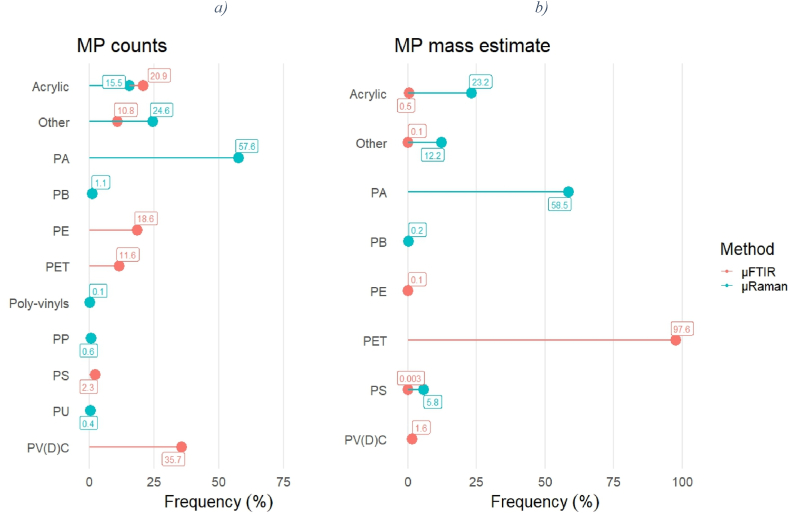
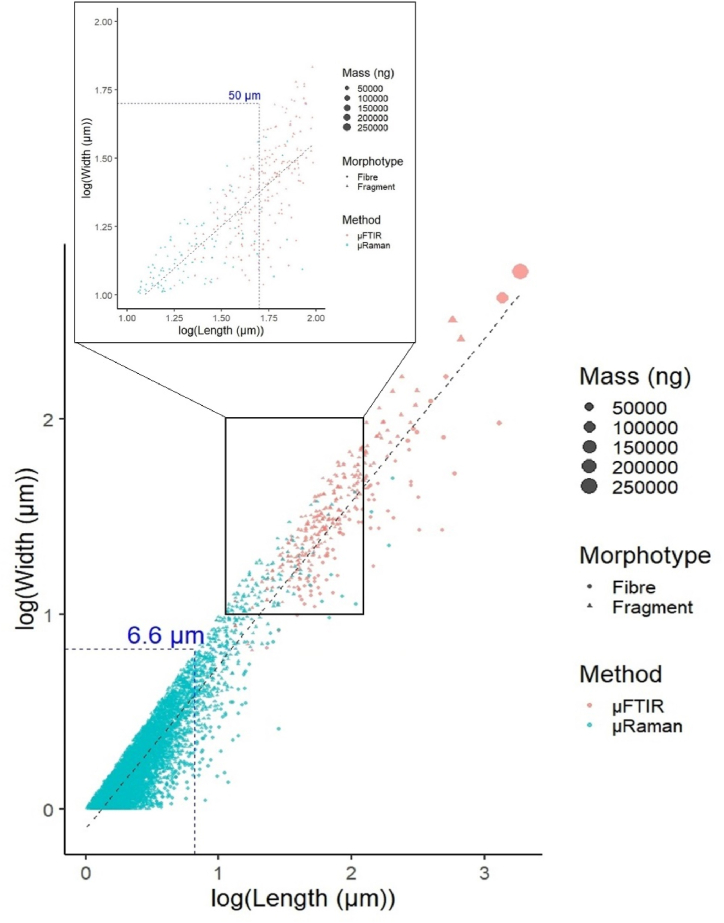
The water treatment for microplastics (MP) at a Danish groundwater-based waterworks was assessed by Fourier-Transform IR micro-spectroscopy (μFTIR) (nominal size limit 6.6 μm) and compared to results from Raman micro-spectroscopy (μRaman) (nominal size limit 1.0 μm) on the same sample set. The MP abundance at the waterworks' inlet and outlet was quantified as MP counts per cubic metre (N/m) and estimated MP mass per cubic metre (μg/m). The waterworks' MP removal efficiency was found to be higher when analysing by μFTIR (counts: 78.14 ± 49.70%, mass: 98.73 ± 11.10%) and less fluctuating than when using μRaman (counts: 43.2%, mass: 75.1%). However, both techniques pointed to a value of ∼80% for the counts' removal efficiency of MPs >6.6 μm. Contrarily to what was shown by μRaman, no systematic leaking of MPs from the plastic elements of the facility could be identified for the μFTIR dataset, either from the counts (inlet 31.86 ± 17.17 N/m, outlet 4.98 ± 2.09 N/m) or mass estimate (inlet 76.30 ± 106.30 μg/m, outlet 2.81 ± 2.78 μg/m). The estimation of human MP intake from drinking water calculated from the μFTIR data (5 N/(year·capita)) proved to be approximately 332 times lower than that calculated from the μRaman dataset, although in line with previous studies employing μFTIR. By merging the MP length datasets from the two techniques, it could be shown that false negatives became prevalent in the μFTIR dataset already below 50 μm. Further, by fitting the overall frequency of the MP length ranges with a power function, it could be shown that μFTIR missed approximately 95.7% of the extrapolated MP population (1-1865.9 μm). Consequently, relying on only μFTIR may have led to underestimating the MP content of the investigated drinking water, as most of the 1-50 μm MP would have been missed.
通过傅里叶变换红外显微光谱法(μFTIR)(标称尺寸极限为6.6μm)对丹麦一家以地下水为水源的自来水厂中微塑料(MP)的水处理情况进行了评估,并与拉曼显微光谱法(μRaman)(标称尺寸极限为1.0μm)对同一组样品的检测结果进行了比较。自来水厂进水口和出水口的微塑料丰度以每立方米微塑料数量(N/m)和每立方米微塑料估计质量(μg/m)进行量化。通过μFTIR分析时,自来水厂的微塑料去除效率更高(数量:78.14±49.70%,质量:98.73±11.10%),且波动比使用μRaman时小(数量:43.2%,质量:75.1%)。然而,两种技术都表明,对于尺寸大于6.6μm的微塑料,数量去除效率约为80%。与μRaman的结果相反,对于μFTIR数据集,无论是从数量(进水口31.86±17.17 N/m,出水口4.98±2.09 N/m)还是质量估计(进水口76.30±106.30μg/m,出水口2.81±2.78μg/m)来看,都未发现设施塑料部件中有微塑料系统性泄漏。根据μFTIR数据计算得出的饮用水中人类微塑料摄入量估计值(5 N/(年·人均)),虽与之前使用μFTIR的研究结果一致,但证明比根据μRaman数据集计算得出的结果低约332倍。通过合并两种技术的微塑料长度数据集可以发现,在μFTIR数据集中,尺寸低于50μm时就已普遍出现假阴性情况。此外,通过用幂函数拟合微塑料长度范围的总体频率可以发现,μFTIR遗漏了大约95.7%的外推微塑料群体(1 - 1865.9μm)。因此,仅依靠μFTIR可能会导致低估所研究饮用水中的微塑料含量,因为大部分1 - 50μm的微塑料都会被遗漏。