Chootong Rattanaporn, Pethyabarn Wasuntaraporn, Sono Supinya, Choosong Thitiworn, Choomalee Kittisakdi, Ayae Maimoonah, Wisan Punnisa, Kantalak Phappim
Department of Family and Preventive Medicine.
Department of Emergency Medicine, Faculty of Medicine.
Ann Med Surg (Lond). 2023 Sep 7;85(10):4816-4823. doi: 10.1097/MS9.0000000000001250. eCollection 2023 Oct.
The hypertensive crisis is characterized by poorly controlled hypertension, which can lead to unfavorable outcomes and high utilization. The purpose of this study was to examine the prevalence, clinical characteristics, and factors associated with hypertensive emergency.
This cross-sectional study collected data from the hospital information system that included patients greater than or equal to 18 years who were diagnosed with hypertensive crisis (blood pressure ≥180 and/or 120 mmHg) and receiving care from the primary care unit and emergency department from 2020 to 2022. The prevalence and clinical characteristics of these patients were examined. Multiple logistic regression analysis was used to analyze factors associated with hypertensive emergency.
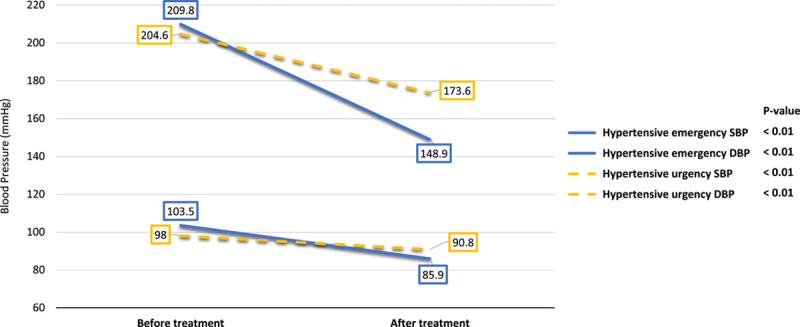
Among 3329 patients with hypertension, 17.33% had a hypertensive crisis (16.64 vs. 0.69%, urgency and emergency types). Most patients were female (63.6%), with a median age of 66 years. Almost half the patients (42.2%) with hypertensive crisis presented without specific symptoms, and the most common presenting symptom was vertigo/dizziness (27.7%). The initial and after treatment blood pressures were 203/98 and 174/91 mmHg. In the hypertensive emergency, the most common end-organ damage was ischemic stroke (33.3%), hemorrhagic stroke (25%), and acute heart failure (20.8%). An oral angiotensin-converting enzyme (57.5%) was the most commonly administered medication. Multiple logistic regression was performed but did not reveal any statistically significant.
Our result revealed a high prevalence of hypertensive crises; most were of hypertensive urgency. The most common presenting symptom was vertigo/dizziness. There was no factor significantly associated with the hypertensive emergency in this study. Further studies should explore the cause of the hypertensive crisis to improve care delivery to patients with hypertension.
高血压急症的特征是高血压控制不佳,这可能导致不良后果和高利用率。本研究的目的是检查高血压急症的患病率、临床特征及相关因素。
这项横断面研究从医院信息系统收集数据,该系统纳入了2020年至2022年期间年龄大于或等于18岁、被诊断为高血压急症(血压≥180和/或120 mmHg)且在初级保健单位和急诊科接受治疗的患者。对这些患者的患病率和临床特征进行了检查。采用多因素logistic回归分析来分析与高血压急症相关的因素。
在3329例高血压患者中,17.33%发生了高血压急症(急症和紧急类型分别为16.64%和0.69%)。大多数患者为女性(63.6%),中位年龄为66岁。几乎一半(42.2%)的高血压急症患者没有特定症状,最常见的症状是眩晕/头晕(27.7%)。初始血压和治疗后血压分别为203/98 mmHg和174/91 mmHg。在高血压急症中,最常见的靶器官损害是缺血性卒中(33.3%)、出血性卒中(25%)和急性心力衰竭(20.8%)。口服血管紧张素转换酶抑制剂(57.5%)是最常用的药物。进行了多因素logistic回归分析,但未发现任何具有统计学意义的结果。
我们的结果显示高血压急症的患病率较高;大多数为高血压急症。最常见的症状是眩晕/头晕。本研究中没有发现与高血压急症显著相关的因素。进一步的研究应探索高血压急症的病因,以改善对高血压患者的护理。