Zink Joël I, Zeneli Liridon, Windhab Erich J
Laboratory of Food Process Engineering, Department of Health Science and Technology, ETH Zurich, Schmelzbergstrasse 9, Zurich, 8092, Switzerland.
Curr Res Food Sci. 2023 Sep 4;7:100580. doi: 10.1016/j.crfs.2023.100580. eCollection 2023.
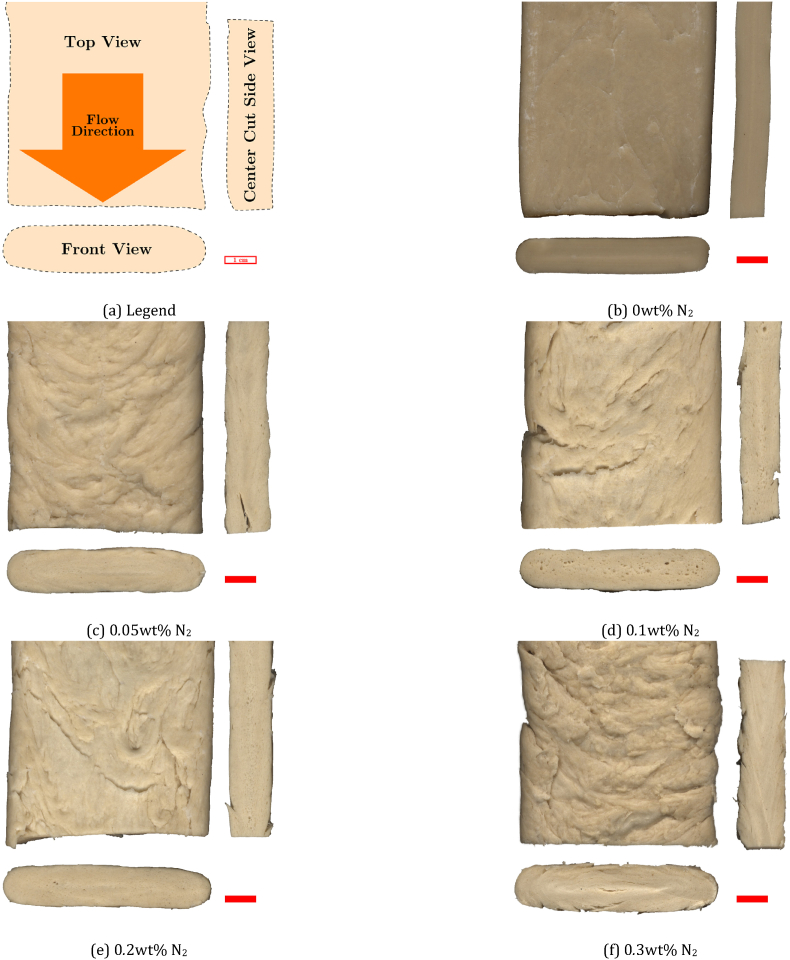
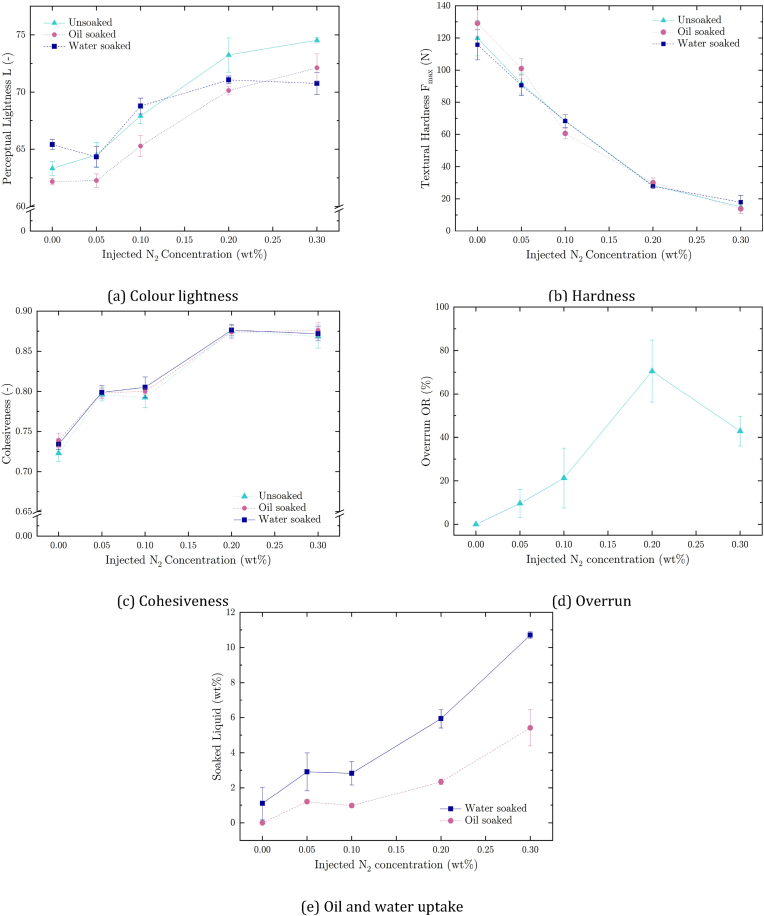
Meat-like foods based on plant protein sources are supposed to be a solution for a more sustainable sustenance of the world population while also having a great potential to reduce the impact on climate change. However, the transition from animal-based products to more climate-friendly alternatives can only be accomplished when consumers' acceptance of plant-based alternatives is high. This article introduces a novel micro-foaming process for texturized High-Moisture Meat Analogues (HMMA) conferring enhanced structural properties and a new way to tailor the mechanical, appearance and textural characteristics of such products. First, the impact of nitrogen injection and subsequent foaming on processing pressures, temperatures and mechanical energy were assessed using soy protein concentrate and injecting nitrogen fractions in a controlled manner in the range of 0 wt% to 0.3 wt% into the hot protein melt. Direct relationships between related extrusion parameters and properties of extruded HMMAs were established. Furthermore, optimized processing parameters for stable manufacturing conditions were identified. Secondly, so produced HMMA foams were systematically analyzed using colourimetry, texture analysis, X-ray micro-tomography (XRT) and by performing water and Preprint submitted to Innovative Food Science and Emerging Technologies June 17, 2023 oil absorption tests. These measurements revealed that perceived lightness, textural hardness, cohesiveness and overrun can be tailored by adapting the injected N concentrations provided that the gas holding capacity of the protein matrix is high enough. Moreover, the liquid absorption properties of the foamed HMMA were greatly optimized. XRT measurements showed that the porosity at the center of the extrudate strands was the highest. The largest porosity of 53% was achieved with 0.2 wt% N injection, whilst 0.3 wt% N lead to destructuration of the HMMA foam structure through limited gas dispersion and wall slip layer formation. The latter can, nonetheless, be improved by adapting the processing parameters. All in all, this novel extrusion microfoaming process opens new possibilities to enhance the structural properties of plant-based HMMA and ultimately, consumers' acceptance.
基于植物蛋白来源的类肉食品被认为是实现世界人口更可持续营养供应的一种解决方案,同时在减少对气候变化的影响方面也具有巨大潜力。然而,只有当消费者对植物性替代品的接受度很高时,才能实现从动物性产品向更环保替代品的转变。本文介绍了一种用于结构化高水分肉模拟物(HMMA)的新型微发泡工艺,该工艺赋予其增强的结构性能,并提供了一种定制此类产品机械、外观和质地特性的新方法。首先,使用大豆浓缩蛋白并以0 wt%至0.3 wt%的可控范围内将氮气分数注入热蛋白熔体中,评估了氮气注入和随后的发泡对加工压力、温度和机械能的影响。建立了相关挤出参数与挤出HMMA性能之间的直接关系。此外,还确定了稳定制造条件下的优化加工参数。其次,使用比色法、质地分析、X射线显微断层扫描(XRT)以及进行水和吸油试验,对如此生产的HMMA泡沫进行了系统分析。这些测量结果表明,只要蛋白质基质的气体保持能力足够高,通过调整注入的氮浓度,可以调整感知的亮度、质地硬度、内聚性和膨胀率。此外,发泡HMMA的液体吸收性能得到了极大优化。XRT测量表明,挤出物股线中心的孔隙率最高。注入0.2 wt%的氮气时,最大孔隙率达到53%,而注入0.3 wt%的氮气会因气体分散有限和形成壁滑移层而导致HMMA泡沫结构破坏。尽管如此,后者可以通过调整加工参数来改善。总而言之,这种新型挤出微发泡工艺为增强植物基HMMA的结构性能以及最终提高消费者接受度开辟了新的可能性。