Colazo Juan M, Quirion Julia, Judice Anthony D, Halpern Jennifer, Schwartz Herbert S, Tanner S Bobo, Lawrenz Joshua M, Dahir Kathryn M, Holt Ginger E
Medical Scientist Training Program, Vanderbilt University School of Medicine, Nashville, TN, USA.
Division of Musculoskeletal Oncology, Department of Orthopaedic Surgery, Vanderbilt University Medical Center, Nashville, TN, USA.
Bone Rep. 2023 Sep 24;19:101715. doi: 10.1016/j.bonr.2023.101715. eCollection 2023 Dec.
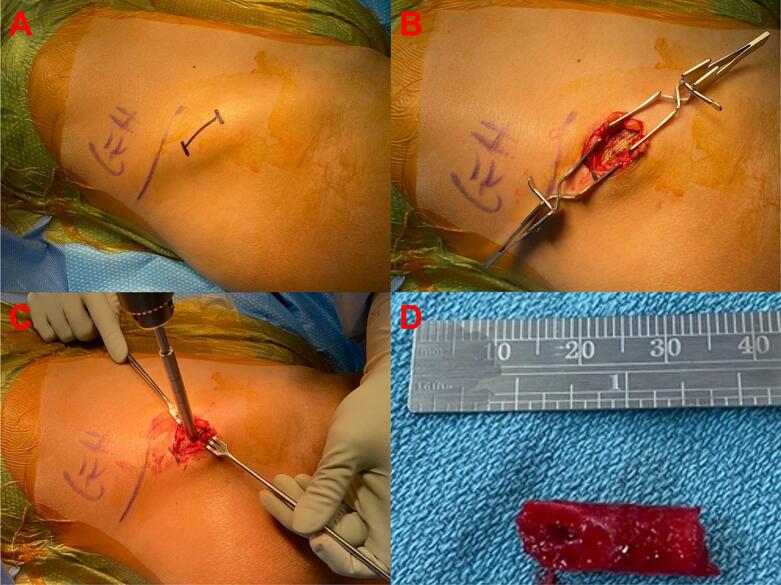
Metabolic bone diseases (MBD) are typically diagnosed by non-invasive imaging and clinical biomarkers. However, imaging does not provide structural information, and biomarkers can be transiently affected by many systemic factors. Bone biopsy and pathologic evaluation is the gold standard for diagnosis of MBD, however, it is rarely utilized. We describe our technique for iliac crest tetracycline-labelled bone using a cannulated drill and assess the utility of bone biopsies to provide diagnostic and therapeutic guidance.
In the 25-year period between March 1998 and January 2023, a total of 95 bone biopsies were performed on 94 patients for an osteological indication at Vanderbilt University Medical Center (VUMC). Patient demographics, bone biopsy indications, complications, diagnostic utility, and subsequent therapeutic guidance were retrospectively reviewed and analyzed.
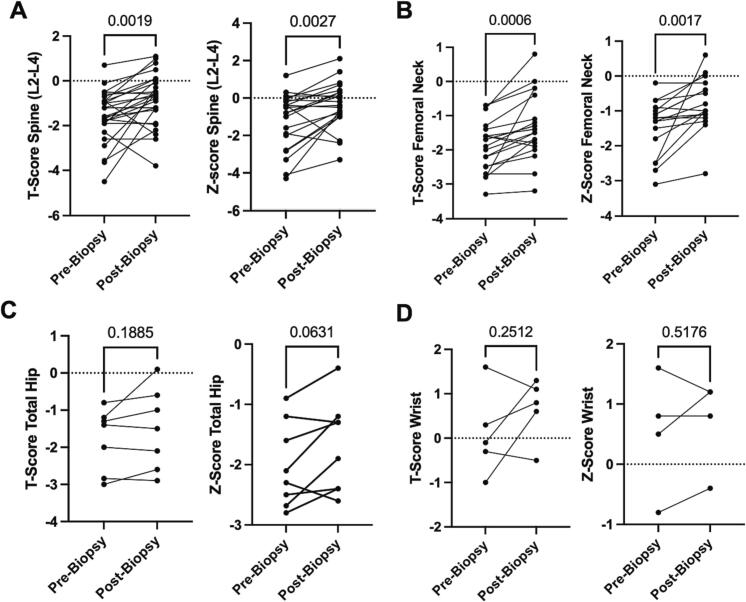
The procedure had minimal complications and was well tolerated by patients. This technique provided good quality specimens for pathology, which helped establish a diagnosis and treatment change in most patients. Patients that had biopsy-guided treatment alterations showed significant increases in Dual-Energy X-ray Absorptiometry (DEXA) bone mineral density (BMD) scores post-biopsy and subsequent treatment.
Despite scientific and technological progress in non-invasive diagnostic imaging, clinical biomarkers, and procedures for MBD, there remains a small but significant subset of patients who may benefit from inclusion of tetracycline-labelled bone biopsy into the diagnostic and therapeutic picture. Future prospective comparison studies are warranted.
Tetracycline-labelled bone biopsies are under-utilized. Biopsy led to a histological diagnosis and ensuing treatment alteration in most patients with significant increases in bone mineral density. The biopsy procedure used herein provided good specimens with low pain/adverse events. Bone biopsy remains a valuable tool in a small, though significant, subset of patients.
代谢性骨病(MBD)通常通过非侵入性成像和临床生物标志物进行诊断。然而,成像无法提供结构信息,且生物标志物可能会受到许多全身因素的短暂影响。骨活检和病理评估是MBD诊断的金标准,但很少被采用。我们描述了使用空心钻进行髂嵴四环素标记骨活检的技术,并评估骨活检在提供诊断和治疗指导方面的效用。
在1998年3月至2023年1月的25年期间,范德比尔特大学医学中心(VUMC)对94例患者进行了共计95次骨活检,以明确骨病学指征。对患者的人口统计学数据、骨活检指征、并发症、诊断效用以及后续的治疗指导进行了回顾性审查和分析。
该操作并发症极少,患者耐受性良好。这项技术为病理学提供了高质量的标本,有助于大多数患者明确诊断并改变治疗方案。接受活检指导下治疗调整的患者在活检及后续治疗后,双能X线吸收法(DEXA)骨矿物质密度(BMD)评分显著提高。
尽管在MBD的非侵入性诊断成像、临床生物标志物和操作方面取得了科技进步,但仍有一小部分但相当重要的患者可能受益于将四环素标记骨活检纳入诊断和治疗方案中。未来有必要进行前瞻性比较研究。
四环素标记骨活检未得到充分利用。活检使大多数患者获得了组织学诊断并随后改变了治疗方案,骨矿物质密度显著增加。本文使用的活检操作提供了良好的标本,疼痛/不良事件发生率低。骨活检在一小部分但相当重要的患者中仍然是一种有价值的工具。