Division of Pharmacy and Optometry, School of Health Sciences, Centre for Pharmacoepidemiology and Drug Safety, University of Manchester, Oxford Road, Manchester, M13 9PT, UK.
Pharmacy Department, Salford Royal Hospital, Northern Care Alliance NHS Foundation Trust, Salford, Greater Manchester, UK.
Drug Saf. 2023 Oct;46(10):1021-1037. doi: 10.1007/s40264-023-01342-z. Epub 2023 Oct 11.
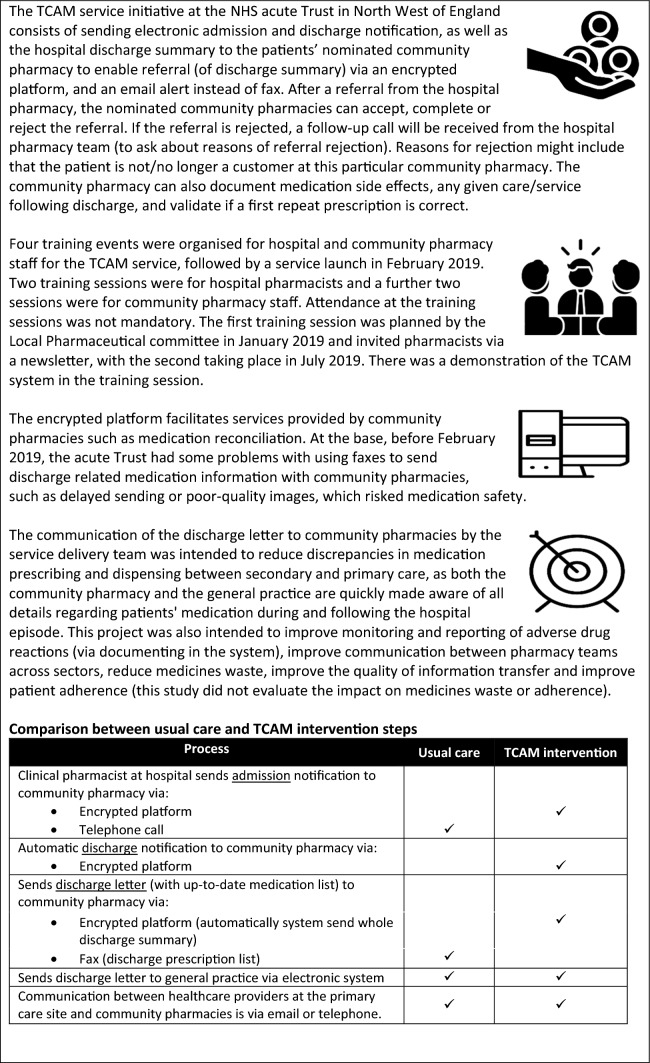
Medication safety problems are common post-hospital discharge, and an important global healthcare improvement target. The Transfers of Care Around Medicines (TCAM) service was launched by a National Health Service Trust in the North-West of England, initially focusing on patients with new or existing Monitored Dosage Systems (MDS). The TCAM service is designed to enable the prompt transfer of medication information, with referrals made by hospitals at discharge to a named community pharmacy. This study aimed to explore the utilisation and impact of the TCAM service on medication safety.
The evaluation included a descriptive analysis of 3033 anonymised patient referrals to 71 community pharmacies over a 1-year period alongside an assessment of the impact of the TCAM service on unintentional medication discrepancies and adverse drug events using a retrospective before-and-after study design. Impact data were collected across 18 general practices by 16 trained clinical pharmacists.
Most patient referrals (70%, 2126/3033) were marked as 'completed' by community pharmacies, with 15% of completed referrals delayed beyond 30 days. Screening of 411 patient records by clinical pharmacists yielded no statistically significant difference in unintentional medication discrepancies or adverse drug event rates following TCAM implementation using a multivariable regression analysis (unintentional medication discrepancies adjusted odds ratio = 0.79 [95% confidence interval 0.44-1.44, p = 0.46]; and adverse drug events adjusted odds ratio = 1.19 [95% confidence interval 0.57-2.45, p = 0.63]), although there remained considerable uncertainty.
The TCAM service facilitated a number of community pharmacy services offered to patients with monitored dosage systems; but the impact of the intervention on unintentional medication discrepancies and adverse drug event rates post-hospital discharge for this patient group was uncertain. The results of this exploratory study can inform the ongoing implementation of the TCAM service at hospital discharge and highlight the need to understand service implementation in different contexts, which may influence its impact on medication safety.
出院后的用药安全问题较为常见,是全球医疗保健改善的一个重要目标。英国西北部的一家国民保健服务信托基金最初专注于新的或现有的监测剂量系统(MDS)患者,推出了用药转移关怀(TCAM)服务。该服务旨在确保及时转移用药信息,由医院在患者出院时向指定的社区药房转介。本研究旨在探索 TCAM 服务在用药安全方面的利用情况和影响。
评估包括对 71 家社区药房在 1 年期间收到的 3033 名匿名患者转诊的描述性分析,以及使用回顾性前后研究设计评估 TCAM 服务对非故意用药差异和药物不良事件的影响。Impact 数据由 16 名经过培训的临床药剂师在 18 个全科医生中收集。
大多数患者转诊(70%,2126/3033)被社区药房标记为“已完成”,15%的已完成转诊延迟超过 30 天。临床药剂师对 411 名患者记录的筛查显示,在使用多变量回归分析时,TCAM 实施后非故意用药差异或药物不良事件发生率没有统计学上的显著差异(非故意用药差异调整比值比=0.79[95%置信区间 0.44-1.44,p=0.46];药物不良事件调整比值比=1.19[95%置信区间 0.57-2.45,p=0.63]),尽管仍存在很大的不确定性。
TCAM 服务为监测剂量系统患者提供了多项社区药房服务;但干预措施对该患者群体出院后非故意用药差异和药物不良事件发生率的影响不确定。本探索性研究的结果可以为 TCAM 服务在出院时的持续实施提供信息,并强调需要了解不同环境下服务的实施情况,这可能会影响其对用药安全的影响。