University of Exeter, Exeter, UK.
North Carolina State University, Raleigh, NC, USA.
J Youth Adolesc. 2024 Feb;53(2):472-484. doi: 10.1007/s10964-023-01868-6. Epub 2023 Oct 11.
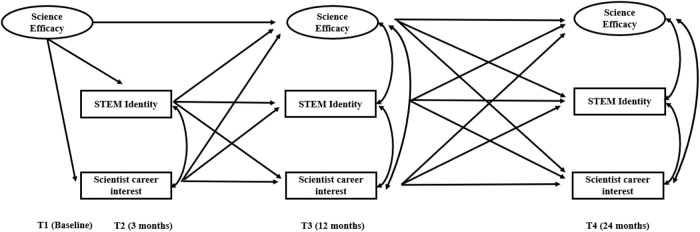
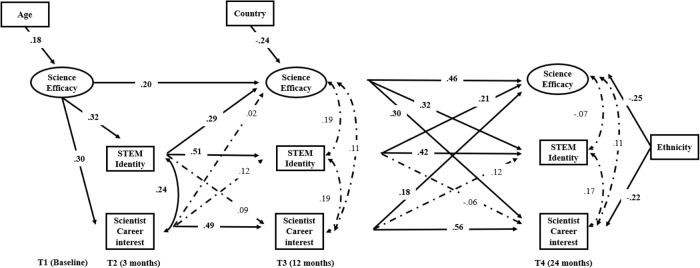
Limited research has explored the longitudinal pathway to youth career interests via identity and efficacy together. This study examined the longitudinal associations between science efficacy, STEM (science, technology, engineering and math) identity, and scientist career interest among girls who are historically considered as an underrepresented group among scientists. The sample included 308 girls (M = 15.22, SD = 1.66; 42.8% White) from six STEM youth programs, each at a different informal science learning site within the U.K. and the U.S. Longitudinal structural equation modelling demonstrated that science efficacy consistently predicted STEM identity and scientist career interest, and similarly, STEM identity consistently predicted science efficacy over a two-year period. Scientist career interest at 12 months predicted science efficacy at 24 months. The coefficients of efficacy predicting STEM identity and scientist career interest were significantly larger compared to STEM identity and scientist career interest in predicting science efficacy from 12 months to 24 months. Further mediation analysis supported a significant pathway from STEM identity at 3 months to scientist career interest at 24 months via 12-month science efficacy. The findings highlight that science efficacy and STEM identity for girls relate to their scientist career interest and these longitudinal associations are reciprocal. This study suggests that science efficacy and STEM identity mutually influence each other, and enhancing science efficacy and STEM identity is key to promoting adolescents' interest in being a scientist.
有限的研究探讨了通过身份认同和效能感来探索青年职业兴趣的纵向途径。本研究考察了科学效能感、STEM(科学、技术、工程和数学)身份认同与科学家职业兴趣之间的纵向关联,研究对象是历史上被认为是科学界代表性不足群体的女孩。该样本包括来自六个 STEM 青年项目的 308 名女孩(M=15.22,SD=1.66;42.8%为白人),她们分别来自英国和美国的六个不同的非正式科学学习场所。纵向结构方程模型表明,科学效能感始终预测 STEM 身份认同和科学家职业兴趣,同样,STEM 身份认同也始终预测科学效能感在两年内的变化。12 个月时的科学家职业兴趣预测 24 个月时的科学效能感。与从 12 个月到 24 个月期间 STEM 身份认同和科学家职业兴趣预测科学效能感的系数相比,效能感预测 STEM 身份认同和科学家职业兴趣的系数显著更大。进一步的中介分析支持了从 3 个月时的 STEM 身份认同到 24 个月时的科学家职业兴趣的显著途径,这是通过 12 个月时的科学效能感实现的。研究结果表明,女孩的科学效能感和 STEM 身份认同与她们的科学家职业兴趣有关,并且这些纵向关联是相互的。本研究表明,科学效能感和 STEM 身份认同相互影响,增强科学效能感和 STEM 身份认同是促进青少年成为科学家兴趣的关键。