School of Medicine, Cardiff University, Cardiff, South Glamorgan, UK.
School of Medicine, University of St Andrews, St Andrews, Fife, UK.
BJS Open. 2023 Sep 5;7(5). doi: 10.1093/bjsopen/zrad083.
Students must be proficient in surgical skills according to General Medical Council and Royal College of Surgeons of England guidelines. If these skills are not appropriately taught, there is a risk of an incoming junior workforce with inadequate surgical skills. This paper aimed to review the literature relating to undergraduate teaching of surgical skills in the UK and summarize future suggested training methods.
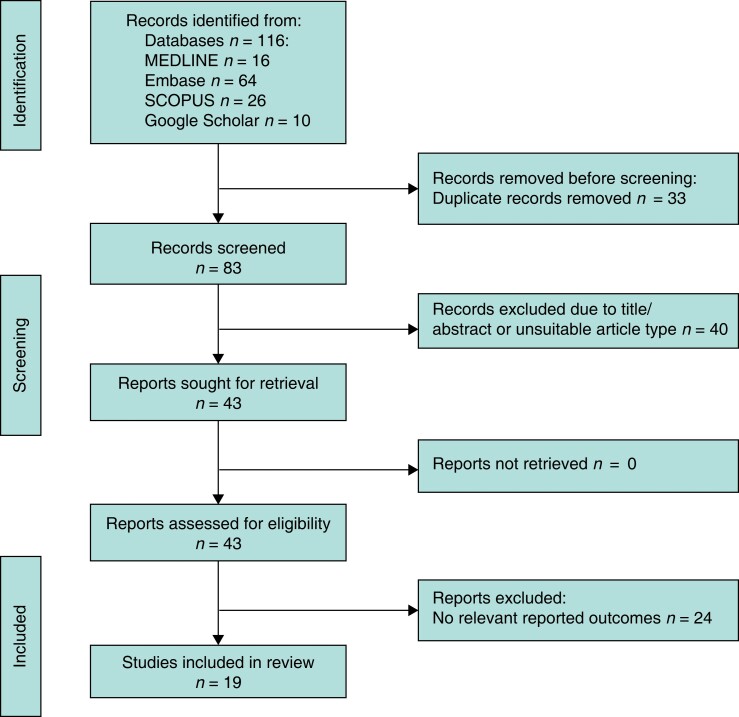
The databases MEDLINE, Embase and SCOPUS were searched, and the existing literature relating to methodology of undergraduate teaching of surgical skills in the UK over the past 10 years was summarized. The Medical Education Research Quality Instrument was used to assess research quality.
A total of 19 papers were included. Cross-sectional evaluations and survey-based studies highlight a clear deficit in surgical skills teaching in the UK. Medical students are currently unable to fulfil their own learning needs and meet requirements set out by the General Medical Council. This lack of surgical teaching appears to negatively affect student desire to pursue a surgical career. The three main themes for improvement are extracurricular surgical skills days, near-peer teaching and simulation. Each method appeared to improve learning, although no studies utilized medium- to long-term follow-up to demonstrate efficacy and there lacks a clear consensus as to the 'standard' of undergraduate surgical skill education. There was also potential for selection bias and response shift bias in many of the studies assessing pre- and postintervention confidence and opinions.
There is a concerning lack of surgical skills teaching that has resulted in medical students and junior doctors not having the necessary surgical skills as per General Medical Council guidance and students feel that their own learning needs are not met. This failure to address the learning deficit may be responsible for the fall in surgical competition ratios. While surgical skills teaching must be improved urgently, more robust evidence is required to evaluate the optimal ways of approaching this issue.
根据英国普通医学委员会和皇家外科学院的指导方针,学生必须精通外科技能。如果这些技能没有得到适当的教授,那么未来的初级劳动力可能会缺乏外科技能。本文旨在回顾英国本科外科技能教学的文献,并总结未来建议的培训方法。
检索 MEDLINE、Embase 和 SCOPUS 数据库,并总结过去 10 年英国本科外科技能教学方法的现有文献。使用医学教育研究质量工具评估研究质量。
共纳入 19 篇论文。横断面评估和基于调查的研究表明,英国的外科技能教学明显存在不足。医学生目前无法满足自己的学习需求,也无法满足普通医学委员会规定的要求。这种外科技能教学的缺乏似乎对外科职业选择产生了负面影响。改进的三个主要主题是课外外科技能日、近程教学和模拟。每种方法似乎都能提高学习效果,尽管没有研究利用中长期随访来证明其疗效,也没有明确共识来确定本科外科技能教育的“标准”。在评估干预前后信心和意见的许多研究中,也存在选择偏倚和反应转移偏倚的可能性。
外科技能教学明显不足,导致医学生和初级医生没有按照普通医学委员会的指导方针掌握必要的外科技能,而且学生认为自己的学习需求没有得到满足。未能解决学习不足的问题可能是外科竞争比例下降的原因。虽然外科技能教学必须紧急改进,但需要更多的有力证据来评估解决这一问题的最佳方法。