van de Kuit Anouk, Verweij Lukas P E, Priester-Vink Simone, Veeger H E J Dirkjan, van den Bekerom Michel P J
Department of Orthopaedic Surgery, Onze Lieve Vrouwe Gasthuis, Amsterdam, The Netherlands.
Department of Orthopaedic Surgery, Amsterdam University Medical Center, Amsterdam, The Netherlands.
Arthrosc Sports Med Rehabil. 2023 Sep 29;5(6):100804. doi: 10.1016/j.asmr.2023.100804. eCollection 2023 Dec.
To evaluate the current literature on the effects of anatomic changes caused by the Latarjet procedure and to identify areas for future research.
English-language studies that addressed the consequences of anatomic alterations after the open Latarjet procedure were included. Articles written in languages other than English, reviews, and case reports were excluded. Titles and abstracts were screened by 2 authors. Studies that met the inclusion criteria were screened by the same authors. The following data were extracted from the included studies: authors, year of publication, journal, country of origin, aims or purpose, study population and sample size, methods, procedure, intervention type, and key findings that relate to the scoping review questions.
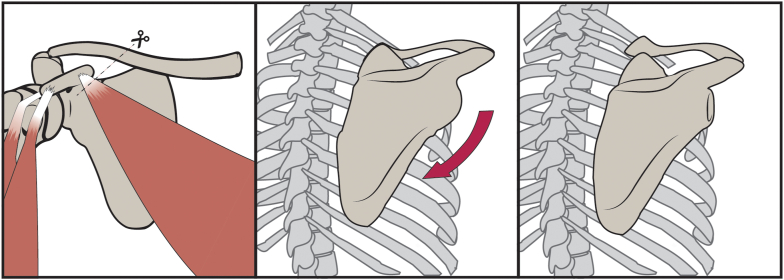
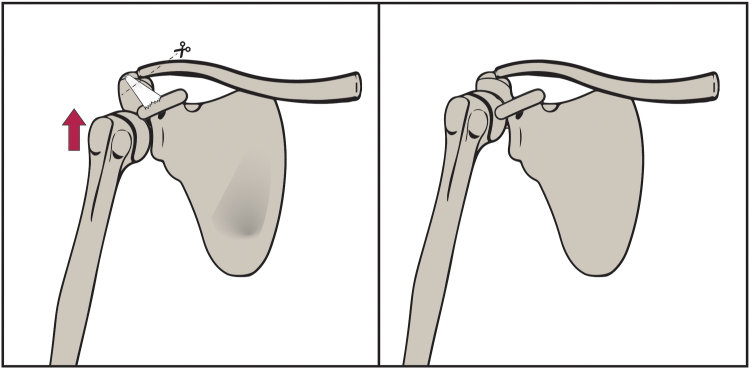
Twenty-two studies were included for analysis, yielding the following findings: First, the Latarjet procedure may change the position of the scapula owing to pectoralis minor tenotomy and/or transfer of the conjoint tendon. Second, dissection of the coracoacromial ligament may result in increased superior translation of the humeral head. The impact of this increased translation on patients' function remains unclear. Third, the subscapularis split shows, overall, better internal rotation strength compared with subscapularis tenotomy. Fourth, passive external rotation may be limited after capsular repair. Fifth, despite the movement of the conjoint tendon, elbow function seems unchanged. Finally, the musculocutaneous nerve is lengthened with a changed penetration angle into the coracobrachialis muscle, but the clinical impact seems limited.
The Latarjet procedure leads to anatomic and biomechanical changes in the shoulder. Areas of future research may include better documentation of scapular movement (bilateral, as well as preoperative and postoperative) and elbow function, the effect of (degenerative) rotator cuff ruptures after the Latarjet procedure on shoulder function, and the impact of capsular closure and its contribution to the development of glenohumeral osteoarthritis.
This comprehensive overview of anatomic changes after the Latarjet procedure, with its effects on shoulder and elbow function, showed gaps in the current literature. Orthopaedic shoulder surgeons and physical therapists could use our findings when providing patient information and performing future clinical research.
评估目前关于Latarjet手术引起的解剖学变化影响的文献,并确定未来研究的领域。
纳入探讨开放性Latarjet手术后解剖学改变后果的英文研究。排除非英文撰写的文章、综述和病例报告。由两名作者筛选标题和摘要。符合纳入标准的研究由同一作者进行筛选。从纳入研究中提取以下数据:作者、发表年份、期刊、原产国、目的或目标、研究人群和样本量、方法、手术步骤、干预类型以及与范围综述问题相关的主要发现。
纳入22项研究进行分析,得出以下结果:第一,由于胸小肌切断术和/或联合肌腱转移,Latarjet手术可能改变肩胛骨位置。第二,喙肩韧带的解剖可能导致肱骨头向上平移增加。这种增加的平移对患者功能的影响尚不清楚。第三,总体而言,肩胛下肌劈开与肩胛下肌切断术相比,显示出更好的内旋力量。第四,关节囊修复后被动外旋可能受限。第五,尽管联合肌腱移位,但肘关节功能似乎未改变。最后,肌皮神经延长,进入肱二头肌短头的穿透角度改变,但临床影响似乎有限。
Latarjet手术导致肩部解剖学和生物力学变化。未来研究领域可能包括更好地记录肩胛骨运动(双侧以及术前和术后)和肘关节功能、Latarjet手术后(退行性)肩袖撕裂对肩部功能的影响以及关节囊闭合的影响及其对盂肱关节骨关节炎发展的作用。
对Latarjet手术后解剖学变化及其对肩部和肘关节功能影响的全面概述显示了当前文献中的空白。骨科肩部外科医生和物理治疗师在提供患者信息和开展未来临床研究时可参考我们的研究结果。