Burdzy Alexander, Dai Michelle, Nagubandi Veda, Nguyen My, Marten Carly, Paul-Quinn Jennifer
Penn Pre-Health Programs, University of Pennsylvania, Philadelphia, Pennsylvania, USA.
College of Osteopathic Medicine, Touro University Nevada, Henderson, Nevada, USA.
J Med Educ Curric Dev. 2023 Oct 3;10:23821205231203917. doi: 10.1177/23821205231203917. eCollection 2023 Jan-Dec.
This study investigates the efficacy and feasibility of an asynchronous, peer-to-peer health disparities enrichment course on postbaccalaureate prehealth students' knowledge, behaviors, and reaction to course materials.
Growing awareness of social inequities has prompted educators of prehealth and medical students to explore student education by addressing systemic healthcare issues. This cross-sectional study assessed reactions, learning, and self-reported behavior changes in students after taking the course "Social Determinants, Disparities, and Preparing for the Future of Healthcare" (SDDH).
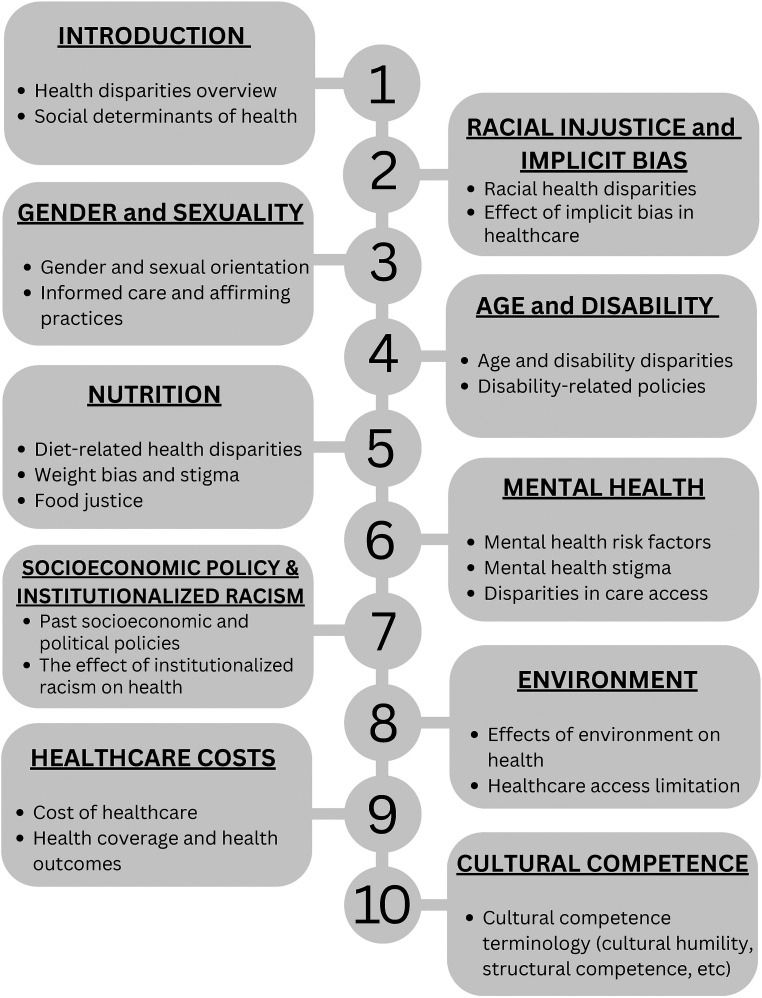
The curriculum was designed by prehealth postbaccalaureate students for their peers. Course goals were to educate participants on social determinants of health and to build cultural and structural competence in their roles as future healthcare professionals. SDDH is an asynchronous, noncredit-bearing, 5-h online course with 10 modules covering various topics. The Kirkpatrick Model was used to assess the effectiveness of the curriculum, alongside qualitative and quantitative analyses of student performance.
Out of the 102 active students in the prehealth program that accepted the invitation to join, 29 students successfully completed the course (rate of completion = 28%). On average, students expressed positive reactions and attitudes toward the course and experienced an observable increase in knowledge assessment scores upon curriculum completion (-value = .0002). Students' self-reported observations demonstrated sustained behavioral change 3 months after course completion.
It is critical to educate prehealth students on health disparities, structural, and cultural competence. A course such as SDDH may help prehealth students build effective communication skills for advocacy and develop an empathetic, patient-centered approach earlier on in their career pursuit. Some barriers to students completing the entire course include its length, uncredited status, and voluntary self-enrollment.
本研究调查了一门异步、 peer-to-peer健康差异强化课程对本科后健康预科学生的知识、行为以及对课程材料的反应的有效性和可行性。
对社会不平等现象的日益认识促使健康预科和医学生的教育工作者通过解决系统性医疗保健问题来探索学生教育。这项横断面研究评估了学生在参加“社会决定因素、差异与为医疗保健未来做准备”(SDDH)课程后的反应、学习情况以及自我报告的行为变化。
该课程由本科后健康预科学生为同龄人设计。课程目标是教育参与者了解健康的社会决定因素,并培养他们作为未来医疗保健专业人员角色的文化和结构能力。SDDH是一门异步、无学分的5小时在线课程,有10个模块,涵盖各种主题。使用柯克帕特里克模型评估课程的有效性,同时对学生表现进行定性和定量分析。
在接受邀请参加健康预科项目的102名活跃学生中,29名学生成功完成了课程(完成率 = 28%)。平均而言,学生对课程表达了积极的反应和态度,并且在课程结束时知识评估分数有明显提高(-值 = 0.0002)。学生的自我报告观察表明,课程结束3个月后行为有持续变化。
对健康预科学生进行健康差异、结构和文化能力方面的教育至关重要。像SDDH这样的课程可能有助于健康预科学生在职业追求早期培养有效的宣传沟通技巧,并形成以患者为中心的同理心方法。学生完成整个课程的一些障碍包括课程长度、无学分状态和自愿报名。