Western Hospital Group, Alingsås; Faculty of Medicine, Lund University, Lund, Sweden.
Department of Clinical Sciences, Faculty of Medicine, Lund University, Sweden and Department of Orthopaedics and Traumatology, Rigshospitalet, Copenhagen University Hospital, Denmark.
Acta Orthop. 2023 Oct 10;94:505-510. doi: 10.2340/17453674.2023.20284.
In patients around retirement age controversy exists as to whether to treat displaced femoral neck fracture (dFNF) with internal fixation (IF) or arthroplasty. An arthroplasty in this age group may need revision due to a long expected remaining lifetime. IF carries a higher risk of early failure but a maintained native hip if healing occurs. We aimed to determine the cumulative 5-year rate of conversion to arthroplasty after IF and implant revision after primary total hip arthroplasty (THA), respectively.
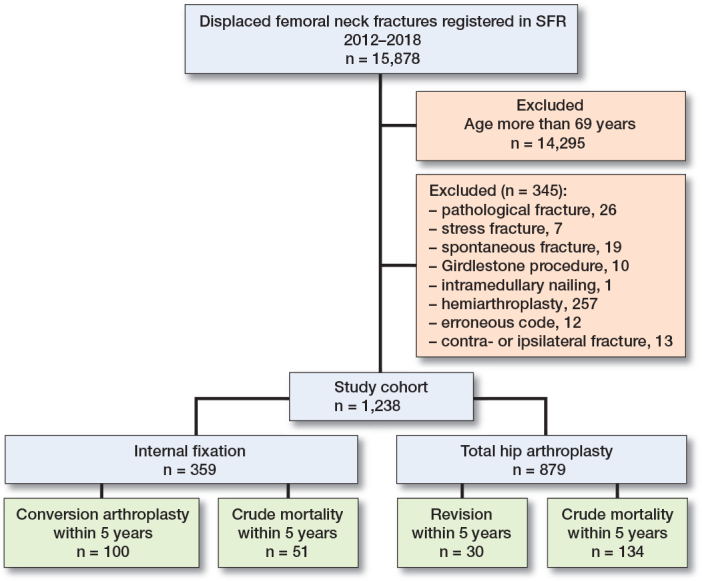
In this longitudinal cohort study, patients aged 60-69 years registered with a dFNF in the Swedish Fracture Register (SFR) 2012-2018 were cross-referenced with available data from the Swedish Arthroplasty Register (SAR) until December 31, 2019. Conversion to arthroplasty or revision were analyzed utilizing competing risk, with death as competing event.
At 5 years, the cumulative rate of conversion to arthroplasty after IF was 31% (95% confidence interval [CI] 26-37). For primary THA, the 5-year rate of revision was 4.0% (CI 2.8-5.8). The 5-year mortality did not differ, being 20% (CI 16-27) and 23% (CI 20-28) after IF and THA, respectively. Regression analyses did not identify any risk factors for conversion arthroplasty based on the variables in the register.
A follow-up of 5 years catches most reoperations after IF, resulting in a 31% conversion rate. The 4% revision rate at 5 years after primary THA should be seen as an intermediate result, as late complications may occur.
在即将退休的患者中,对于移位性股骨颈骨折(dFNF),是采用内固定(IF)还是关节置换术(arthroplasty)治疗存在争议。在这个年龄段进行关节置换术可能由于预期寿命较长而需要翻修。IF 早期失败的风险较高,但如果愈合,可保留原生髋关节。我们旨在分别确定 IF 后和初次全髋关节置换术(THA)后翻修后,5 年内转换为关节置换术的累积发生率。
在这项纵向队列研究中,2012-2018 年在瑞典骨折登记处(SFR)登记的 60-69 岁患者与瑞典关节置换登记处(SAR)中可用数据进行交叉参考,截至 2019 年 12 月 31 日。利用竞争风险分析转换为关节置换术或翻修,以死亡为竞争事件。
在 5 年时,IF 后转换为关节置换术的累积发生率为 31%(95%置信区间 [CI] 26-37)。对于初次 THA,5 年的翻修率为 4.0%(CI 2.8-5.8)。5 年死亡率没有差异,IF 和 THA 后分别为 20%(CI 16-27)和 23%(CI 20-28)。回归分析未根据登记处的变量确定任何与转换关节置换术相关的危险因素。
IF 后 5 年的随访时间捕捉到了大多数再手术,导致 31%的转换率。初次 THA 后 5 年的 4%翻修率应视为中间结果,因为可能会出现晚期并发症。