Centre for Integrative Anatomy, Department of Cell and Developmental Biology, University College London, London, UK.
Department of Life Sciences, Natural History Museum, London, UK.
BMC Biol. 2023 Oct 13;21(1):216. doi: 10.1186/s12915-023-01715-x.
The origin of birds from non-avian theropod dinosaur ancestors required a comprehensive restructuring of the body plan to enable the evolution of powered flight. One of the proposed key mechanisms that allowed birds to acquire flight and modify the associated anatomical structures into diverse forms is mosaic evolution, which describes the parcelization of phenotypic traits into separate modules that evolve with heterogeneous tempo and mode. Avian mosaicism has been investigated with a focus on the cranial and appendicular skeleton, and as such, we do not understand the role of the axial column in avian macroevolution. The long, flexible neck of extant birds lies between the cranial and pectoral modules and represents an opportunity to study the contribution of the axial skeleton to avian mosaicism.
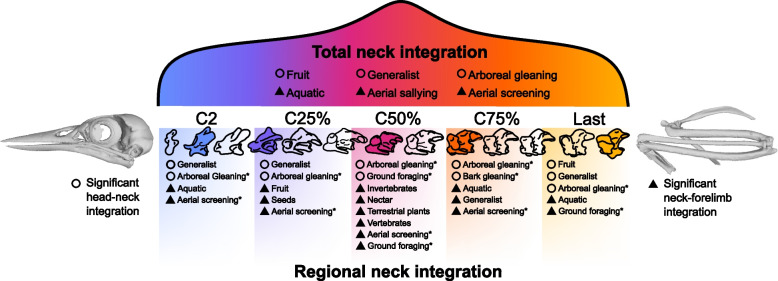
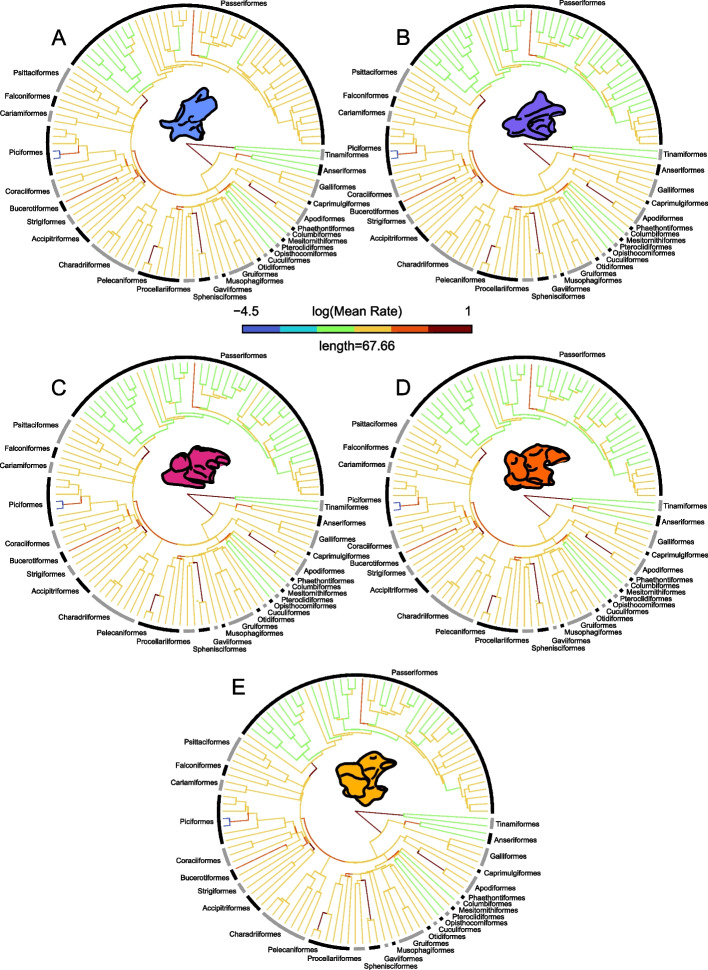
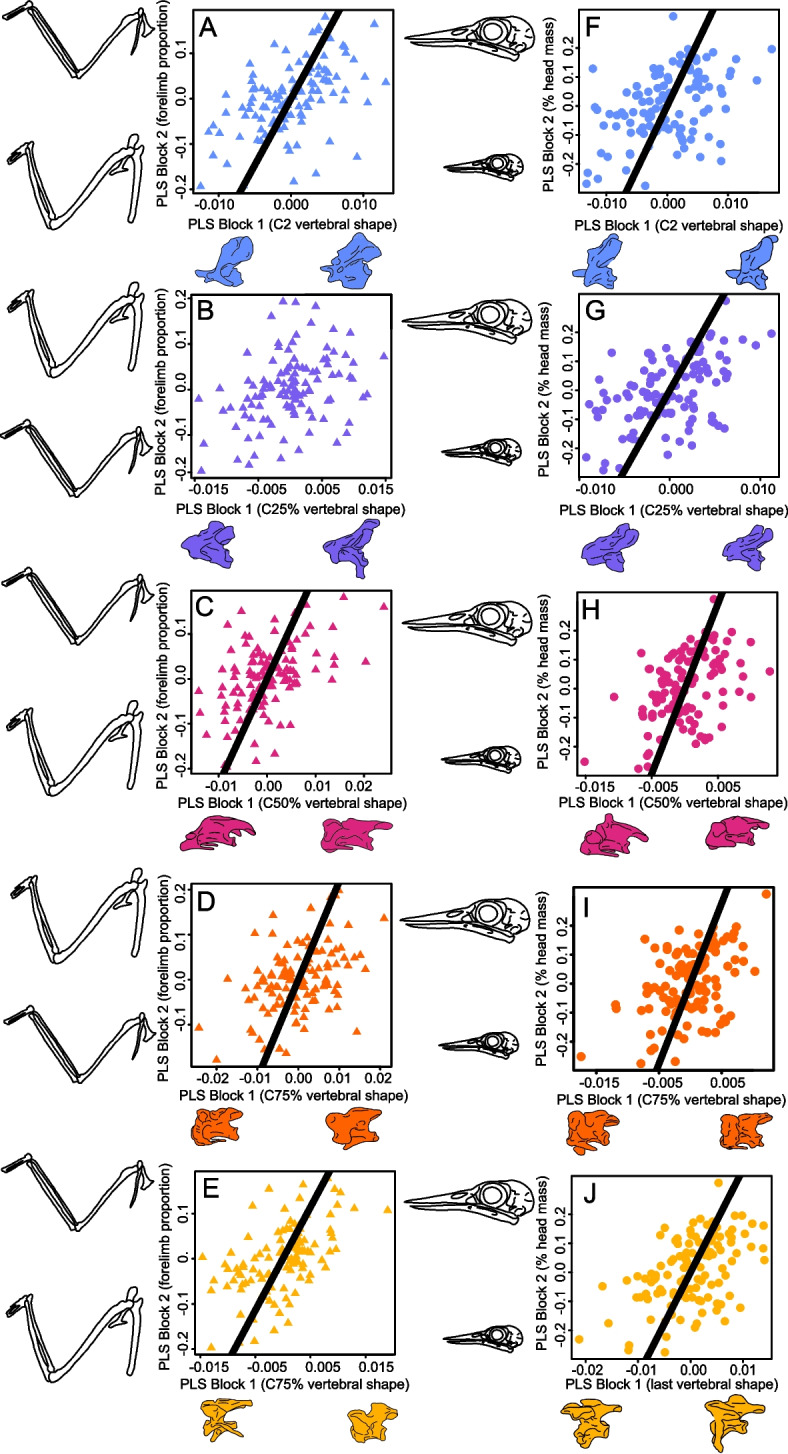
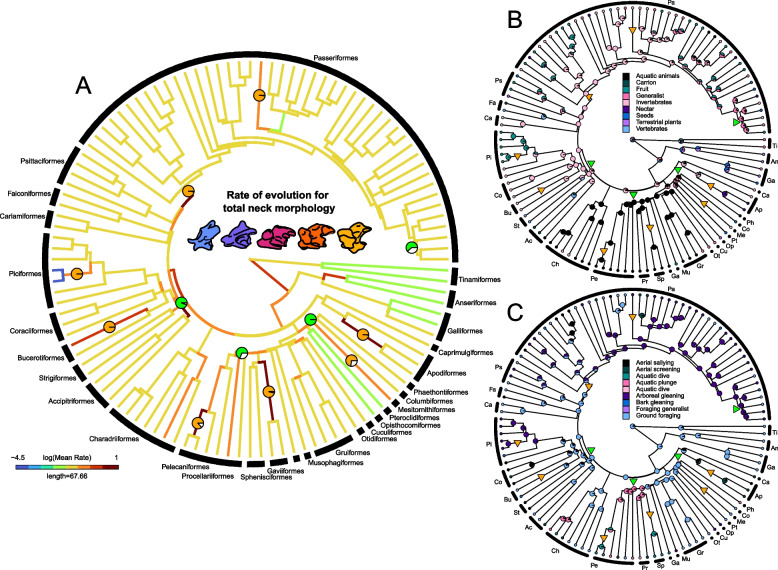
Here, we use 3D geometric morphometrics in tandem with phylogenetic comparative methods to provide, to our knowledge, the first integrative analysis of avian neck evolution in context with the head and wing and to interrogate how the interactions between these anatomical systems have influenced macroevolutionary trends across a broad sample of extant birds. We find that the neck is integrated with both the head and the forelimb. These patterns of integration are variable across clades, and only specific ecological groups exhibit either head-neck or neck-forelimb integration. Finally, we find that ecological groups that display head-neck and neck-forelimb integration tend to display significant shifts in the rate of neck morphological evolution.
Combined, these results suggest that the interaction between trophic ecology and head-neck-forelimb mosaicism influences the evolutionary variance of the avian neck. By linking together the biomechanical functions of these distinct anatomical systems, the cervical vertebral column serves as a keystone structure in avian mosaicism and macroevolution.
鸟类起源于非鸟兽脚恐龙祖先,需要对身体结构进行全面重构,才能实现飞行能力的进化。有一个被提出的关键机制,即镶嵌进化,它描述了表型特征的分割成独立的模块,以不同的速度和模式进化,这使得鸟类能够获得飞行能力,并将相关的解剖结构改造成多样化的形式。鸟类镶嵌进化已经得到了广泛的研究,主要集中在头颅和附肢骨骼上,因此,我们并不了解轴柱在鸟类宏观进化中的作用。现生鸟类的长而灵活的颈部位于头颅和前肢模块之间,为研究轴骨骼对鸟类镶嵌进化的贡献提供了机会。
在这里,我们使用 3D 几何形态测量学与系统发育比较方法相结合,提供了迄今为止对鸟类颈部进化的第一个综合分析,以了解头部和翅膀与颈部之间的相互作用如何影响广泛的现生鸟类样本中的宏观进化趋势。我们发现,颈部与头部和前肢都有整合。这些整合模式在进化枝之间是可变的,只有特定的生态类群表现出头颈或颈前肢的整合。最后,我们发现,表现出头颈和颈前肢整合的生态类群,其颈部形态进化的速度往往会发生显著变化。
综合这些结果表明,营养生态与头-颈-前肢镶嵌进化之间的相互作用,影响了鸟类颈部的进化变化。通过将这些不同解剖系统的生物力学功能联系在一起,颈椎作为鸟类镶嵌进化和宏观进化的关键结构。