Developmental Biology Research Laboratory, Hospital Infantil de México Federico Gómez, Mexico City 06720, Mexico.
Cell Biology Laboratory, Universidad Autónoma Metropolitana-Cuajimalpa, Mexico City 05348, Mexico.
Int J Mol Sci. 2023 Sep 29;24(19):14744. doi: 10.3390/ijms241914744.
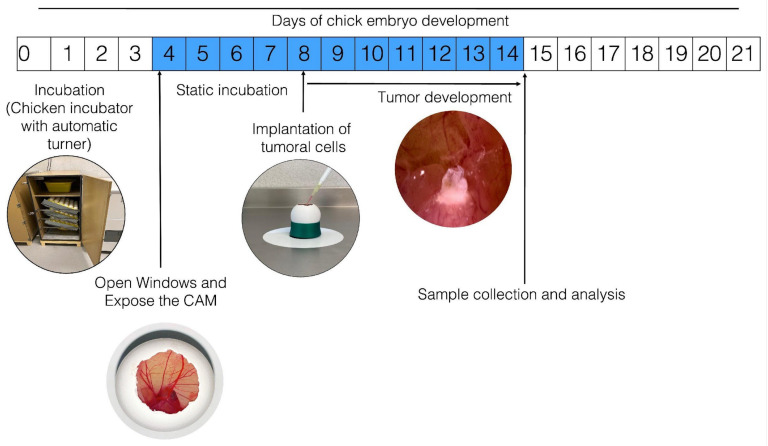
The chorioallantoic membrane (CAM) can be used as a valuable research tool to examine tumors. The CAM can be used to investigate processes such as migration, invasion, and angiogenesis and to assess novel antitumor drugs. The CAM can be used to establish tumors in a straightforward, rapid, and cost-effective manner via xenotransplantation of cells or tumor tissues with reproducible results; furthermore, the use of the CAM adheres to the three "R" principle, i.e., replace, reduce, and refine. To achieve successful tumor establishment and survival, several technical aspects should be taken into consideration. The complexity and heterogeneity of diseases including neuroblastoma and cancers in general and their impact on human health highlight the importance of preclinical models that help us describe tumor-specific biological processes. These models will not only help in understanding tumor biology, but also allow clinicians to explore therapeutic alternatives that will improve current treatment strategies. In this review, we summarize the technical characteristics as well as the main findings regarding the use of this model to study neuroblastoma for angiogenesis, metastasis, drug sensitivity, and drug resistance.
鸡胚尿囊膜(CAM)可用作研究肿瘤的有价值的研究工具。CAM 可用于研究迁移、侵袭和血管生成等过程,并评估新型抗肿瘤药物。通过异种移植细胞或肿瘤组织,CAM 可用于以简单、快速和具有成本效益的方式建立肿瘤,并可获得可重复的结果;此外,CAM 的使用符合三“R”原则,即替代、减少和优化。为了成功建立和维持肿瘤,需要考虑几个技术方面。包括神经母细胞瘤和一般癌症在内的疾病的复杂性和异质性及其对人类健康的影响,突出了有助于描述肿瘤特异性生物学过程的临床前模型的重要性。这些模型不仅有助于了解肿瘤生物学,还使临床医生能够探索改善当前治疗策略的治疗替代方案。在这篇综述中,我们总结了使用该模型研究神经母细胞瘤血管生成、转移、药物敏感性和耐药性的技术特点和主要发现。