Laboratory of Plant Genetic Improvement and Biotechnology, Jiangxi Normal University, Nanchang 330200, China.
Rice Research Institute, National Engineering Laboratory for Rice (Nanchang), Jiangxi Academy of Agricultural Sciences, Nanchang 330200, China.
Int J Mol Sci. 2023 Oct 2;24(19):14832. doi: 10.3390/ijms241914832.
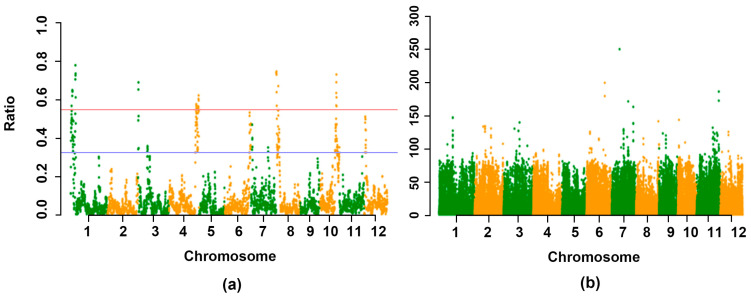
The improvement of grain yield, quality, and resistance can be achieved through the utilization of heterosis. The combination of cytoplasmic male sterility (CMS) and fertility restoration () gene(s) greatly facilitates the commercial development of three-line hybrid rice based on heterosis. The basis for investigating the relationship between CMS and genes lies in the rapid localization of wild rice fertility restoration genes. A set of the BCF population derived from interspecific crosses between Xieqingzao B (XB) and the BCF XB//Dongxiang wild rice (DWR)/XB line L5339 was used to detect quantitative trait loci (QTL) for fertility restoration. The population was then crossed with two male sterile lines, Zhong9A (Z9A) and DongB11A (DB11A), in order to generate a testcrossing population for investigating spikelet fertility. Based on the linkage mapping, seven QTLs were detected on chromosomes 1, 3, 5, 6, 8, and 10, explaining 2.76 to 12.46% of the phenotypic variation. Of them, two novel fertility restoration QTLs, and , can restore fertility of the CMS-DWR line DB11A by 16.56% and 15.12%, respectively. By employing joint QTL-seq and GradedPool-Seq methods, two novel QTLs for DB11A, and , were identified at the physical locations of 10,900,001-11,700,000 bp and 28,016,785-31,247,556 bp, respectively. These findings are useful for exploring the natural variations of genes in rice. Therefore, rice's new genetic resources for the selection and breeding of rice restorer lines provide promising candidates for QTL fine localization and clarification.
杂种优势的利用可以提高粮食产量、品质和抗性。细胞质雄性不育(CMS)与育性恢复()基因的结合,极大地促进了基于杂种优势的三系杂交水稻的商业化发展。研究 CMS 与基因关系的基础是快速定位野生稻育性恢复基因。一组来自谢青早 B(XB)与 BCF XB//东乡野生稻(DWR)/XB 系 L5339 的种间杂交的 BCF 群体,被用于检测育性恢复的数量性状位点(QTL)。然后,该群体与两个不育系中 9A(Z9A)和东 B11A(DB11A)杂交,以生成一个用于调查小穗育性的测验交群体。基于连锁图谱,在染色体 1、3、5、6、8 和 10 上检测到 7 个 QTL,解释了 2.76%至 12.46%的表型变异。其中,两个新的育性恢复 QTL和可以分别将 CMS-DWR 系 DB11A 的育性恢复 16.56%和 15.12%。通过联合 QTL-seq 和 GradedPool-Seq 方法,在物理位置 10900001-11700000 bp 和 28016785-31247556 bp 处分别鉴定出两个新的 DB11A 的 QTL和,这对于探索水稻中基因的自然变异具有重要意义。因此,为水稻育性恢复系的选择和选育提供了有希望的候选基因,为 QTL 的精细定位和阐明提供了新的遗传资源。