Moawad Gaby, Youssef Youssef, Fruscalzo Arrigo, Faysal Hani, Kheil Mira, Pirtea Paul, Guani Benedetta, Ayoubi Jean Marc, Feki Anis
Department of Obstetrics and Gynecology, George Washington University, Washington, DC 20037, USA.
The Center for Endometriosis and Advanced Pelvic Surgery, Washington, DC 22101, USA.
J Clin Med. 2023 Sep 22;12(19):6130. doi: 10.3390/jcm12196130.
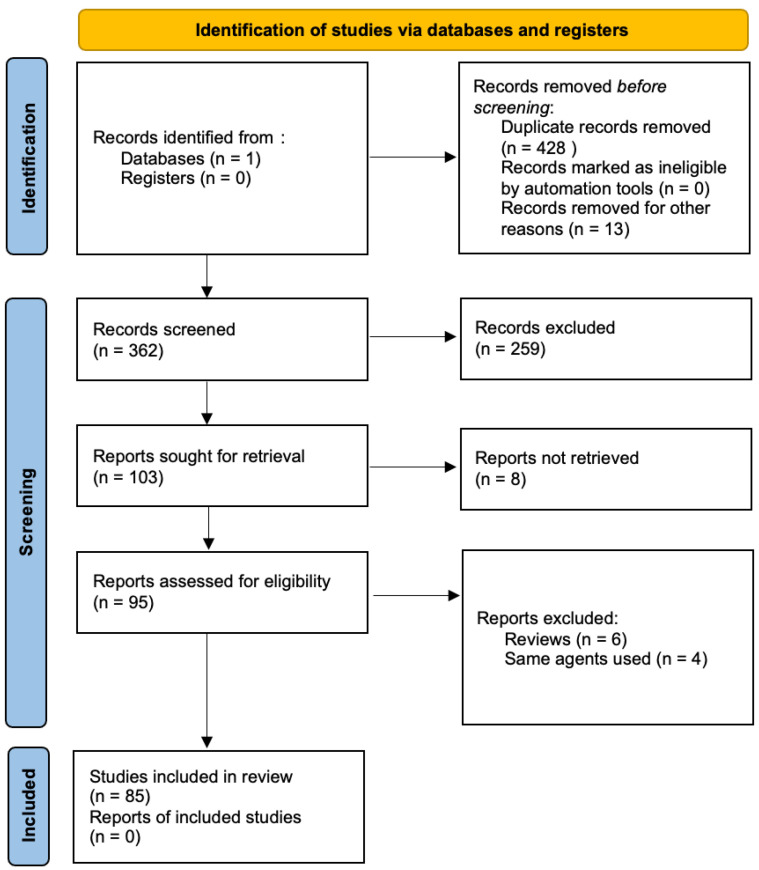
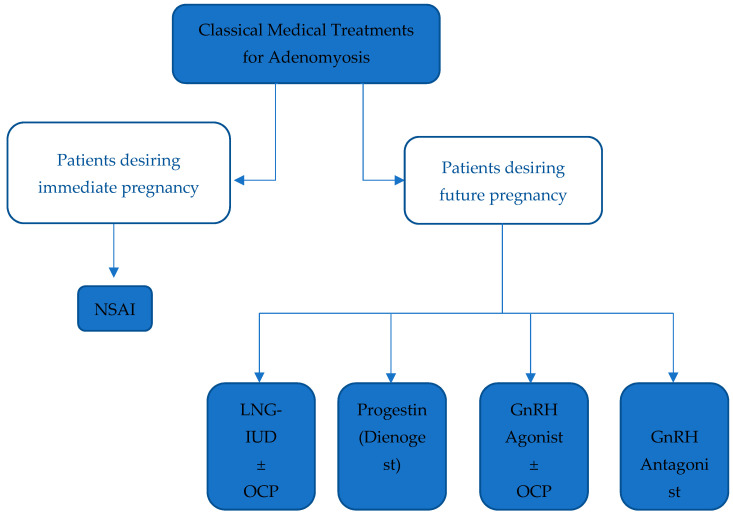
Uterine Adenomyosis is a benign condition characterized by the presence of endometrium-like epithelial and stromal tissue in the myometrium. Several medical treatments have been proposed, but still, no guidelines directing the management of adenomyosis are available. While a hysterectomy is typically regarded as the definitive treatment for adenomyosis, the scarcity of high-quality data leaves patients desiring fertility with limited conservative options. Based on the available data, the levonorgestrel-IUD appears to offer the most favorable outcomes. Other treatments, including GnRH antagonists, dienogest, prolactin, and oxytocin modulators, show promise; however, further data are required to establish their efficacy definitively. Furthermore, there are many emerging therapies that have been developed that seem worthy of consideration in the near future. The aim of this narrative review was to explore the current medical treatments available for adenomyosis and to provide a glimpse of future therapies under assessment. For this scope, we performed a literature search on PubMed and Medline from incept to September 2022 using the keywords: "medical treatment", "non-steroidal anti-inflammatory", "progesterone intrauterine device", "dienogest", "combined oral contraceptives", "gonadotropin releasing hormone agonist", "gonadotropin releasing hormone antagonist", "danazol", "aromatase inhibitors", "ulipristal acetate", "anti-platelet therapy", "dopamine", "oxytocin antagonists", "STAT3", "KRAS", "MAPK", "micro-RNA", "mifepristone", "valproic acid", "levo-tetrahydropalamatine", and "andrographolide". The search was limited to articles in English, with subsequent screening of abstracts. Abstracts were screened to select relevant studies.
子宫腺肌病是一种良性疾病,其特征是子宫肌层中存在类似子宫内膜的上皮和间质组织。已经提出了几种医学治疗方法,但仍然没有指导子宫腺肌病管理的指南。虽然子宫切除术通常被视为子宫腺肌病的确定性治疗方法,但高质量数据的稀缺使渴望生育的患者的保守选择有限。根据现有数据,左炔诺孕酮宫内节育器似乎能提供最有利的结果。其他治疗方法,包括促性腺激素释放激素拮抗剂、地诺孕素、催乳素和催产素调节剂,显示出前景;然而,需要更多数据来明确确定它们的疗效。此外,已经开发出许多新兴疗法,在不久的将来似乎值得考虑。本叙述性综述的目的是探讨目前可用于子宫腺肌病的医学治疗方法,并简要介绍正在评估的未来疗法。为此,我们在PubMed和Medline上进行了文献检索,检索时间从开始到2022年9月,使用的关键词为:“医学治疗”、“非甾体抗炎药”、“孕酮宫内节育器”、“地诺孕素”、“复方口服避孕药”、“促性腺激素释放激素激动剂”、“促性腺激素释放激素拮抗剂”、“达那唑”、“芳香化酶抑制剂”、“醋酸乌利司他”、“抗血小板治疗”、“多巴胺”、“催产素拮抗剂”、“信号转导和转录激活因子3”、“KRAS基因”、“丝裂原活化蛋白激酶”、“微小RNA”、“米非司酮”、“丙戊酸”、“左旋四氢巴马汀”和“穿心莲内酯”。检索仅限于英文文章,随后对摘要进行筛选。筛选摘要以选择相关研究。