Leiherer Andreas, Muendlein Axel, Saely Christoph H, Geiger Kathrin, Brandtner Eva-Maria, Heinzle Christine, Gaenger Stella, Mink Sylvia, Laaksonen Reijo, Fraunberger Peter, Drexel Heinz
Vorarlberg Institute for Vascular Investigation and Treatment (VIVIT), Academic Teaching Hospital Feldkirch, Carinagasse 47, A-6800 Feldkirch, Austria.
Private University of the Principality of Liechtenstein, FL-9495 Triesen, Liechtenstein.
J Clin Med. 2023 Sep 23;12(19):6151. doi: 10.3390/jcm12196151.
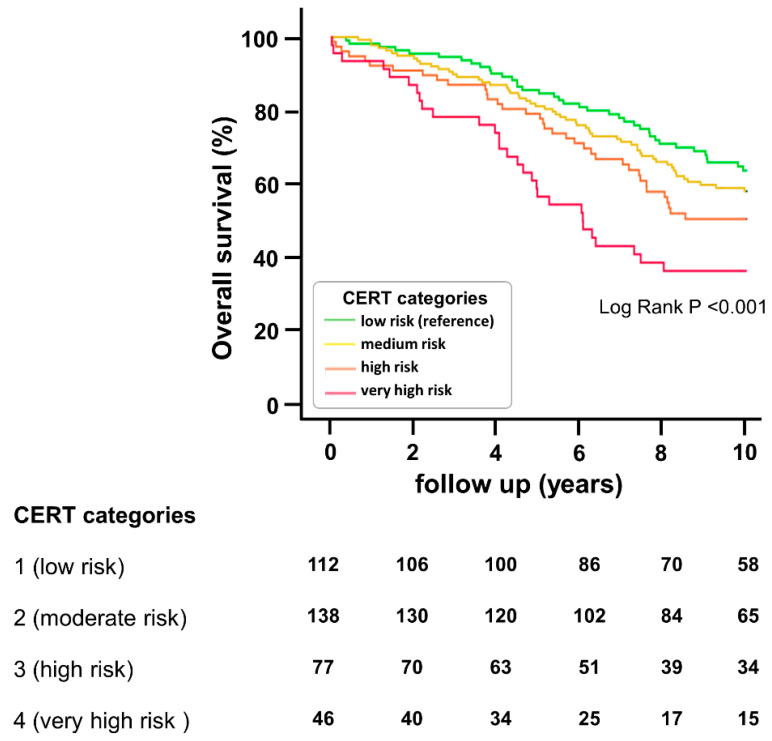
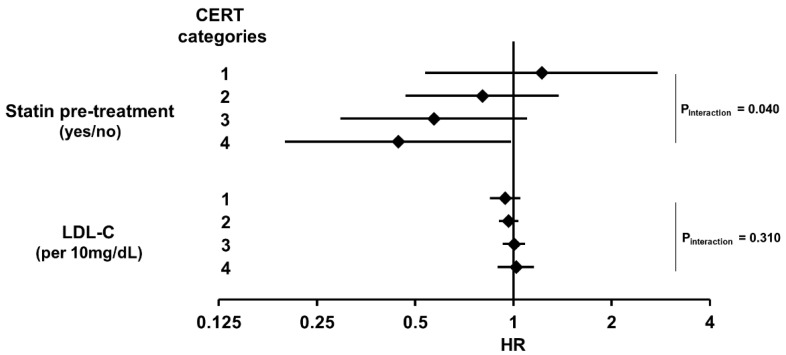
(1) Background: Ceramides are a new kind of lipid biomarker and have already been demonstrated to be valuable risk predictors in coronary patients. Patients with peripheral artery disease (PAD) are a population with a worse prognosis and higher mortality risk compared to coronary artery disease (CAD) patients. However, the value of ceramides for risk prediction in PAD patients is still vague, as addressed in the present study. (2)Methods: This observational study included 379 PAD patients. The primary endpoint was all-cause mortality at 10 years of follow-up. A set of ceramides was measured by LC-MS/MS and combined according to the Coronary Event Risk Test (CERT) score, which categorizes patients into one of four risk groups (low risk, moderate risk, high risk, very high risk). (3) Results: Kaplan-Meier survival curves revealed that the overall survival of patients decreased with the increasing risk predicted by the four CERT categories, advancing from low risk to very high risk. Cox regression analysis demonstrated that each one-category increase resulted in a 35% rise in overall mortality risk (HR = 1.35 [1.16-1.58]). Multivariable adjustment, including, among others, age, LDL-cholesterol, type 2 diabetes, and statin treatment before the baseline, did not abrogate this significant association (HR = 1.22 [1.04-1.43]). Moreover, we found that the beneficial effect of statin treatment is significantly stronger in patients with a higher risk, according to CERT. (4) Conclusions: We conclude that the ceramide-based risk score CERT is a strong predictor of the 10-year mortality risk in patients with PAD.
(1)背景:神经酰胺是一种新型脂质生物标志物,已被证明是冠心病患者有价值的风险预测指标。与冠状动脉疾病(CAD)患者相比,外周动脉疾病(PAD)患者的预后更差,死亡风险更高。然而,正如本研究所指出的,神经酰胺在PAD患者风险预测中的价值仍不明确。(2)方法:这项观察性研究纳入了379例PAD患者。主要终点是随访10年的全因死亡率。通过液相色谱-串联质谱法(LC-MS/MS)测量一组神经酰胺,并根据冠状动脉事件风险测试(CERT)评分进行组合,该评分将患者分为四个风险组之一(低风险、中度风险、高风险、极高风险)。(3)结果:Kaplan-Meier生存曲线显示,随着四个CERT类别预测风险的增加,患者的总体生存率下降,从低风险到极高风险。Cox回归分析表明,每增加一个类别,总体死亡风险就会增加35%(HR = 1.35 [1.16 - 1.58])。多变量调整,包括年龄、低密度脂蛋白胆固醇、2型糖尿病以及基线前的他汀类药物治疗等,并没有消除这种显著关联(HR = 1.22 [1.04 - 1.43])。此外,我们发现,根据CERT,他汀类药物治疗在高风险患者中的有益效果明显更强。(4)结论:我们得出结论,基于神经酰胺的风险评分CERT是PAD患者10年死亡风险的有力预测指标。