Erdoğan Aslan, İnan Duygu, Genç Ömer, Yıldız Ufuk, Demirtola Ayşe İrem, Çetin İlyas, Güler Yeliz, Tekin Ali Fuat, Barutçu Süleyman, Güler Ahmet, Karagöz Ali
Department of Cardiology, Basaksehir Cam & Sakura City Hospital, Istanbul 34480, Turkey.
Department of Radiology, Basaksehir Cam & Sakura City Hospital, Istanbul 34480, Turkey.
J Clin Med. 2023 Sep 26;12(19):6201. doi: 10.3390/jcm12196201.
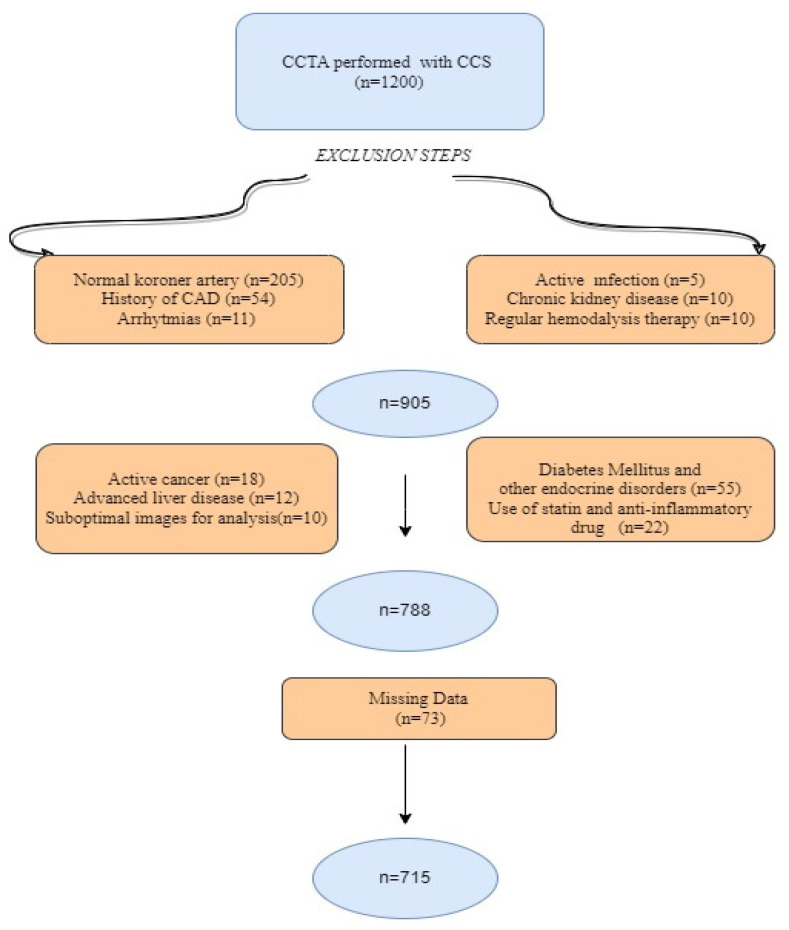
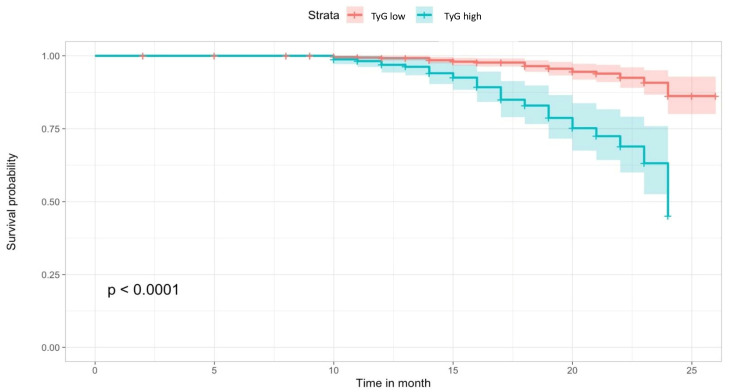
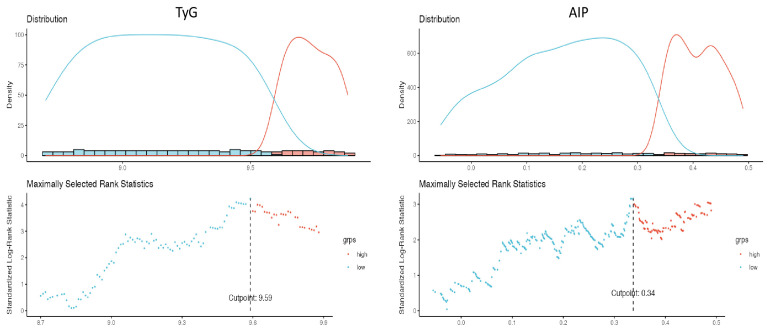
This study aimed to explore the potential association between the triglyceride-glucose index (TyG) and the atherogenic index of plasma (AIP)-both considered surrogate markers for atherosclerosis-and major adverse cardiovascular events (MACEs) in patients diagnosed with chronic coronary syndrome (CCS). We conducted a retrospective analysis, encompassing 715 consecutive patients with intermediate CCS risk, who presented at the outpatient clinic between June 2020 and August 2022. MACEs included non-fatal myocardial infarction, hospitalization for heart failure, cerebrovascular events, non-cardiac mortality, and cardiac mortality. The primary outcome was the composite occurrence of MACEs during the follow-up period. For time-to-event analysis of the primary outcome, we employed Kaplan-Meier plots and Cox proportional hazard models. The median age of the overall study population was 55 years, with a median follow-up duration of 17 months. Multivariate Cox regression analysis identified age, hypertension, Coronary Artery Disease-Reporting and Data System score, and TyG index as independent predictors of the primary outcome. Notably, individuals with high TyG levels exhibited a significantly higher primary outcome rate compared to those with low TyG levels (18.7% vs. 3.8%, < 0.001). Similarly, patients with elevated TyG values demonstrated statistically higher rates of cerebrovascular events, hospitalizations for heart failure, non-fatal myocardial infarctions, non-cardiac mortality, and cardiac mortality. These findings suggest that TyG may serve as a predictive marker for adverse cardiovascular outcomes in patients with CCS.
本研究旨在探讨甘油三酯-葡萄糖指数(TyG)与血浆致动脉粥样硬化指数(AIP)(二者均被视为动脉粥样硬化的替代标志物)以及慢性冠状动脉综合征(CCS)患者的主要不良心血管事件(MACEs)之间的潜在关联。我们进行了一项回顾性分析,纳入了2020年6月至2022年8月期间在门诊就诊的715例连续的CCS中度风险患者。MACEs包括非致命性心肌梗死、因心力衰竭住院、脑血管事件、非心脏性死亡和心脏性死亡。主要结局是随访期间MACEs的复合发生情况。对于主要结局的事件发生时间分析,我们采用了Kaplan-Meier曲线和Cox比例风险模型。整个研究人群的中位年龄为55岁,中位随访时间为17个月。多变量Cox回归分析确定年龄、高血压、冠状动脉疾病报告和数据系统评分以及TyG指数是主要结局的独立预测因素。值得注意的是,与TyG水平低的个体相比,TyG水平高的个体主要结局发生率显著更高(18.7%对3.8%,<0.001)。同样,TyG值升高的患者在脑血管事件、因心力衰竭住院、非致命性心肌梗死、非心脏性死亡和心脏性死亡方面的发生率在统计学上更高。这些发现表明,TyG可能作为CCS患者不良心血管结局的预测标志物。