Vieira Douglas Gomes, Vedovatto Marcelo, Fernandes Henrique Jorge, Lima Eduardo de Assis, D'Oliveira Marcella Candia, Curcio Uriel de Almeida, Ranches Juliana, Ferreira Matheus Fellipe, Sousa Osvaldo Alex de, Cappellozza Bruno Ieda, Franco Gumercindo Loriano
Faculdade de Medicina Veterinária e Zootecnia, Universidade Federal de Mato Grosso do Sul, Campo Grande 79070-900, MS, Brazil.
Dean Lee Research and Extension Center, Louisiana State University, Alexandria, LA 71302, USA.
Animals (Basel). 2023 Sep 27;13(19):3033. doi: 10.3390/ani13193033.
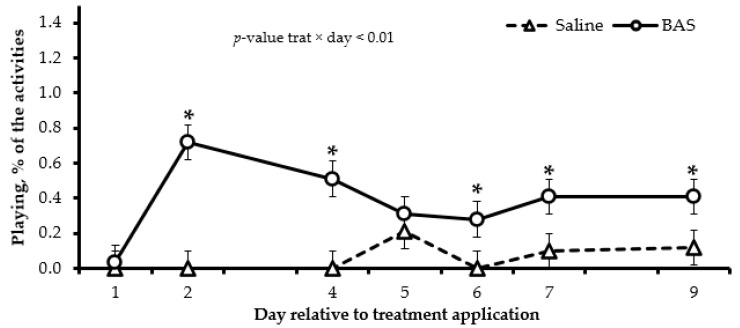
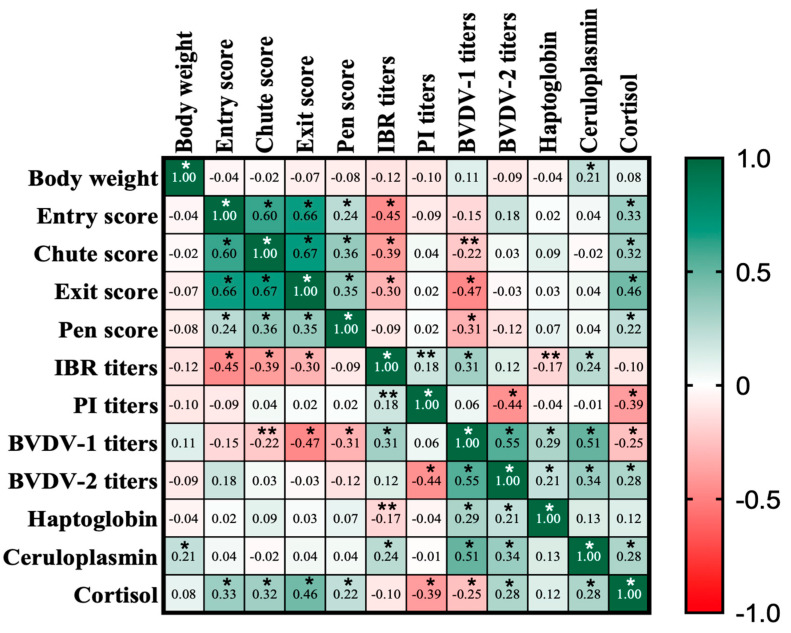
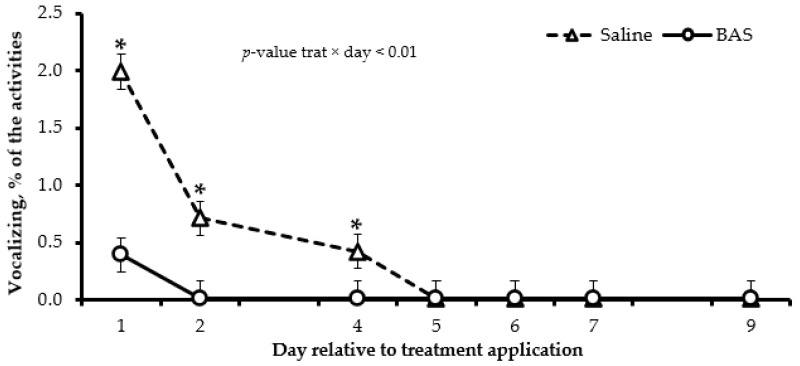
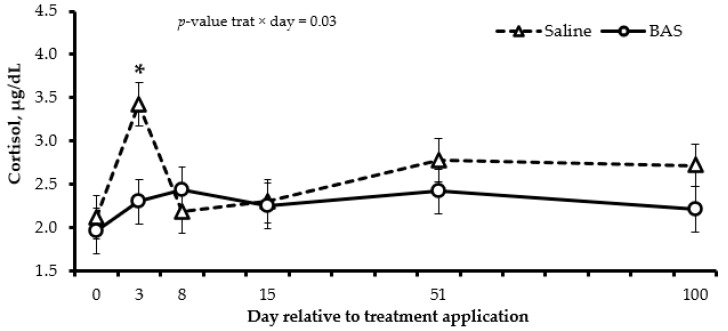
An analog of a bovine-appeasing substance (BAS) was previously demonstrated to have calming effects, and it could be an alternative to alleviate the stress caused by weaning. Thus, the objective of this study was to evaluate the effects of BAS administration at weaning on growth, stress, behavior, and response to vaccination of Nellore calves. Eighty-six Nellore calves (40 females and 46 males) were abruptly weaned and randomly assigned into 1 of 2 treatments: (1) saline solution (0.9% NaCl; = 43) and (2) BAS (Secure Catte, IRSEA Group, Quartier Salignan, France; = 43). The solutions were topically applied (5 mL/calf) to the nuchal skin area of each animal. On d 0, before treatment application, calves were vaccinated against infectious bovine rhinotracheitis (IBR), parainfluenza-3 (PI) virus, and bovine viral diarrhea virus types 1 and 2 (BVDV-1 and 2). Calves from each treatment were kept in different pastures for 15 d (time of BAS action) and then moved to a single pasture. Body weight (BW), blood samples, and temperament in the chute (entry score, chute score, and exit score) were collected on d 0, 3, 8, 15, 51, and 100, and behavior on pasture on d 1, 2, 4, 5, 6, 7, and 9. Calves assigned to BAS vs. Saline treatment tended to have greater BW on d 15 ( = 0.10), tended to have lower entry scores on d 8 and 51 ( = 0.10), and chute scores on d 8 ( = 0.07), and had lower exit scores on d 8 ( = 0.02). Calves assigned to BAS vs. Saline treatment also had greater time grazing on d 7 and 9 ( < 0.01), eating concentrate on d 2, 5, and 6 ( = 0.05), walking on d 1, 2, 5, and 9 ( < 0.01), standing and ruminating on d 2, 7 and 9 ( < 0.01), and playing on d 2, 4, 6, 7, and 9 ( < 0.01). Furthermore, they had lower time lying on 1 and 2 ( < 0.01), standing on d 5 and 9 ( < 0.01), and vocalizing on d 1 and 2 ( < 0.01). Calves assigned to BAS vs. Saline treatment had greater serum titter concentrations of PI t on d 15 and 51 ( = 0.05) and BVDV-1 on d 51 ( = 0.02). However, they had lower serum concentrations of cortisol on d 3 ( = 0.03). BAS administration did not affect ( ≥ 0.12) the serum titer concentration of IBR and BVDV-2 titers or the plasma concentration of haptoglobin and ceruloplasmin. The BAS administration improved BW, reduced temperament and serum cortisol concentration, and improved behavior and response to vaccination.
先前已证明一种牛安抚物质(BAS)类似物具有镇静作用,它可能是缓解断奶应激的一种替代物。因此,本研究的目的是评估断奶时给予BAS对Nellore犊牛生长、应激、行为及疫苗接种反应的影响。86头Nellore犊牛(40头雌性和46头雄性)突然断奶,并随机分为2种处理中的1种:(1)生理盐水(0.9% NaCl;n = 43)和(2)BAS(Secure Catte,IRSEA集团,法国萨利尼昂区;n = 43)。将溶液局部涂抹(5 mL/犊牛)于每头动物的颈部皮肤区域。在第0天,在处理应用前,犊牛接种了牛传染性鼻气管炎(IBR)、副流感3型(PI)病毒以及1型和2型牛病毒性腹泻病毒(BVDV - 1和BVDV - 2)疫苗。每种处理的犊牛在不同牧场饲养15天(BAS作用时间),然后转移到一个单一牧场。在第0、3、8、15、51和100天收集体重(BW)、血样以及在斜槽中的性情(进入评分、斜槽评分和退出评分),并在第1、2、4、5、6、7和9天收集在牧场的行为。与生理盐水处理组相比,给予BAS处理的犊牛在第15天体重倾向于更大(P = 0.10),在第8天和第51天进入评分倾向于更低(P = 0.10),在第8天斜槽评分更低(P = 0.07),在第8天退出评分更低(P = 0.02)。与生理盐水处理组相比,给予BAS处理的犊牛在第7天和第9天放牧时间更长(P < 0.01),在第2、5和6天采食精料时间更长(P = 0.05),在第l、2、5和9天行走时间更长(P < 0.01),在第2、7和9天站立反刍时间更长(P < 0.01),在第2、4、6、7和9天玩耍时间更长(P < 0.01)。此外,它们在第1天和第2天躺卧时间更短(P < 0.01),在第5天和第9天站立时间更短(P < 0.01),在第1天和第2天发声时间更短(P < 0.01)。与生理盐水处理组相比,给予BAS处理的犊牛在第15天和第51天PI抗体滴度血清浓度更高(P = 0.05),在第51天BVDV - l抗体滴度血清浓度更高(P = 0.02)。然而,它们在第3天血清皮质醇浓度更低(P = 0.03)。给予BAS处理对IBR和BVDV - 2抗体滴度血清浓度或触珠蛋白和铜蓝蛋白血浆浓度没有影响(P≥0.12)。给予BAS处理可提高体重,降低性情和血清皮质醇浓度,并改善行为和疫苗接种反应。