Man Milena Adina, Ungur Rodica Ana, Motoc Nicoleta Stefania, Pop Laura Ancuta, Berindan-Neagoe Ioana, Ruta Victoria Maria
Department of Medical Sciences-Pulmonology, Faculty of Medicine, University of Medicine and Pharmacy, 8 Victor Babeș Street, 400012 Cluj-Napoca, Romania.
"Leon Daniello" Clinical Hospital of Pneumophtysiology, 400371 Cluj-Napoca, Romania.
Diagnostics (Basel). 2023 Oct 9;13(19):3157. doi: 10.3390/diagnostics13193157.
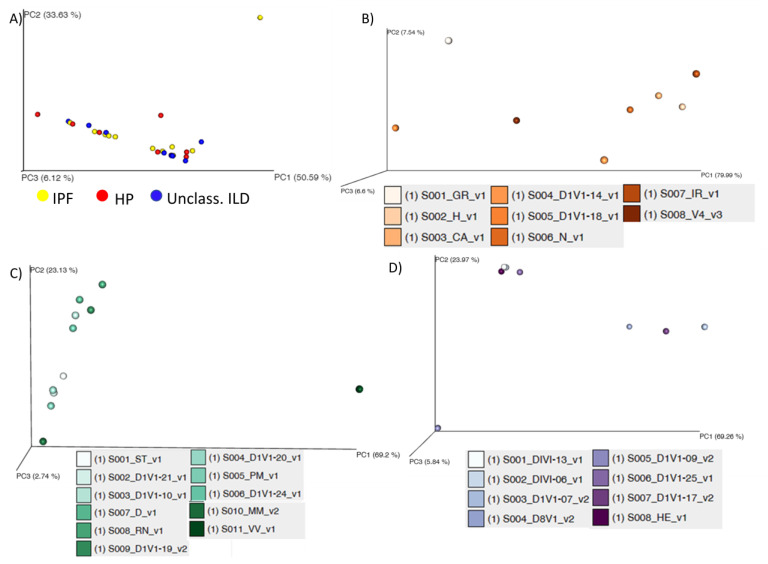
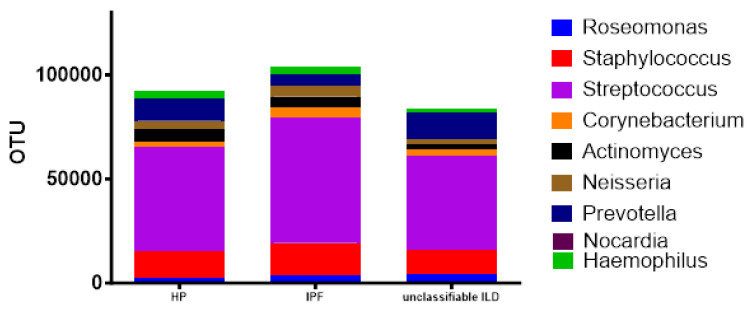
(1) Introduction: Although historically, the lung has been considered a sterile organ, recent studies through 16S rRNA gene sequencing have identified a substantial number of microorganisms. The human microbiome has been considered an "essential organ," carrying about 150 times more information (genes) than are found in the entire human genome. The purpose of the present study is to characterize and compare the microbiome in three different interstitial lung diseases: idiopathic pulmonary fibrosis (IPF), hypersensitivity pneumonitis, and nondifferential interstitial lung disease. (2) Material and methods: This was a prospective cohort study where the DNA of 28 patients with ILD was extracted from the lavage and then processed using the standard technique of 16S RNA gene sequencing. In a tertiary teaching hospital in the northern, western part of Romania, samples were collected through bronchoscopy and then processed. (3) Results: The same four species were found in all the patients but in different quantities and compositions: , , and . was the most prevalent genus, followed by and . Statistically significant differences in the OUT count for the ten most abundant taxa were found for the genus: , , , , and . The comparative analysis showed a richer microbiota in patients with IPF, as shown by the alpha diversity index. (4) Conclusions: In interstitial lung diseases, the microorganisms normally found in the lung are reduced to a restricted flora dominated by the family. These changes significantly disrupt the continuity of the observed bacterial pattern from the oropharynx to the bronchial tree and lung, possibly impacting the evolution and severity of interstitial lung diseases.
(1) 引言:尽管从历史上看,肺一直被认为是一个无菌器官,但最近通过16S rRNA基因测序的研究已经鉴定出大量微生物。人类微生物组被视为一个“重要器官”,其携带的信息(基因)比整个人类基因组中的信息多约150倍。本研究的目的是对三种不同的间质性肺疾病:特发性肺纤维化(IPF)、过敏性肺炎和非特异性间质性肺疾病中的微生物组进行表征和比较。(2) 材料与方法:这是一项前瞻性队列研究,从28例间质性肺疾病患者的灌洗物中提取DNA,然后使用16S RNA基因测序的标准技术进行处理。在罗马尼亚北部和西部的一家三级教学医院,通过支气管镜收集样本,然后进行处理。(3) 结果:在所有患者中都发现了相同的四种物种,但数量和组成不同:[此处原文缺失具体物种名称]、[此处原文缺失具体物种名称]、[此处原文缺失具体物种名称]和[此处原文缺失具体物种名称]。[此处原文缺失具体属名]是最常见的属,其次是[此处原文缺失具体属名]和[此处原文缺失具体属名]。在十个最丰富的分类单元的OUT计数中,发现[此处原文缺失具体属名]、[此处原文缺失具体属名]、[此处原文缺失具体属名]、[此处原文缺失具体属名]和[此处原文缺失具体属名]属存在统计学显著差异。比较分析显示,如α多样性指数所示,IPF患者的微生物群更丰富。(4) 结论:在间质性肺疾病中,通常在肺中发现的微生物减少为以[此处原文缺失具体科名]科为主的受限菌群。这些变化显著破坏了从口咽到支气管树和肺所观察到的细菌模式的连续性,可能影响间质性肺疾病的演变和严重程度。