
基于大豆的多元醇作为基于化石的多元醇在热塑性聚氨酯合成中的替代品:其含量对形态和物理化学性质的影响。
Soybean-Based Polyol as a Substitute of Fossil-Based Polyol on the Synthesis of Thermoplastic Polyurethanes: The Effect of Its Content on Morphological and Physicochemical Properties.
作者信息
Ernzen Juliano R, Covas José A, Marcos-Fernández Angel, Fiorio Rudinei, Bianchi Otávio
机构信息
Mantoflex Poliuretanos, Caxias do Sul 95045175, Brazil.
PGMAT, Universidade de Caxias do Sul (UCS), Caxias do Sul 95070560, Brazil.
出版信息
Polymers (Basel). 2023 Oct 6;15(19):4010. doi: 10.3390/polym15194010.
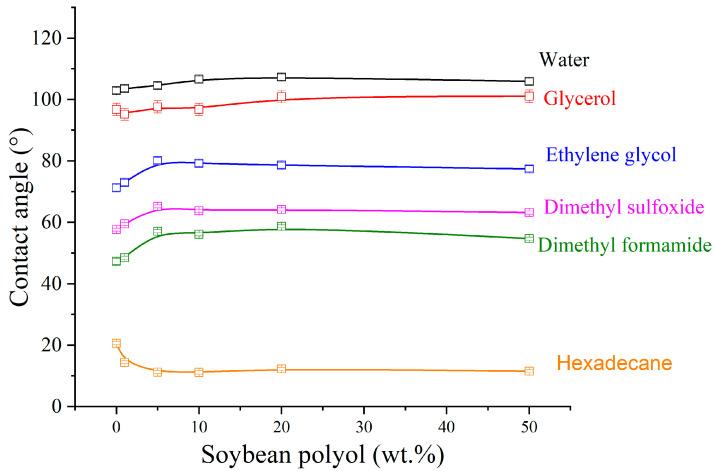
Thermoplastic polyurethanes (TPUs) are remarkably versatile polymers due to the wide range of raw materials available for their synthesis, resulting in physicochemical characteristics that can be tailored according to the specific requirements of their final applications. In this study, a renewable bio-based polyol obtained from soybean oil is used for the synthesis of TPU via reactive extrusion, and the influence of the bio-based polyol on the multi-phase structure and properties of the TPU is studied. As raw materials, 4,4'-diphenylmethane (MDI), 1,4-butanediol, a fossil-based polyester polyol, and a bio-based polyol are used. The fossil-based to soybean-based polyol ratios studied are 100/0, 99/1, 95/5, 90/10, 80/20, and 50/50% by weight, respectively. The TPUs were characterized by size exclusion chromatography (SEC), gel content analysis, Fourier transform infrared spectroscopy (FTIR), differential scanning calorimetry (DSC), small-angle X-ray scattering (SAXS), dynamic mechanical analysis (DMA), and contact angle measurements. The results reveal that incorporating the renewable polyol enhances the compatibility between the rigid and flexible segments of the TPU. However, due to its high functionality, the addition of soybean-based polyol can promote cross-linking. This phenomenon reduces the density of hydrogen bonds within the material, also reducing polarity and restricting macromolecular mobility, as corroborated by higher glass transition temperature (T) values. Remarkably, the addition of small amounts of the bio-based polyol (up to 5 wt.% of the total polyol content) results in high-molecular-weight TPUs with lower polarity, combined with suitable processability and mechanical properties, thus broadening the range of applications and improving their sustainability.
热塑性聚氨酯(TPU)是非常通用的聚合物,这是因为可用于其合成的原材料种类繁多,从而产生了可以根据其最终应用的特定要求进行定制的物理化学特性。在本研究中,一种从大豆油中获得的可再生生物基多元醇通过反应挤出用于TPU的合成,并研究了生物基多元醇对TPU多相结构和性能的影响。作为原材料,使用了4,4'-二苯基甲烷(MDI)、1,4-丁二醇、一种化石基聚酯多元醇和一种生物基多元醇。所研究的化石基多元醇与大豆基多元醇的重量比分别为100/0、99/1、95/5、90/10、80/20和50/50%。通过尺寸排阻色谱法(SEC)、凝胶含量分析、傅里叶变换红外光谱法(FTIR)、差示扫描量热法(DSC)、小角X射线散射法(SAXS)、动态力学分析(DMA)和接触角测量对TPU进行了表征。结果表明,加入可再生多元醇可增强TPU刚性链段和柔性链段之间的相容性。然而,由于其高官能度,添加大豆基多元醇会促进交联。这种现象降低了材料内氢键的密度,也降低了极性并限制了大分子的流动性,更高的玻璃化转变温度(T)值证实了这一点。值得注意的是,添加少量生物基多元醇(高达总多元醇含量的5 wt.%)会产生具有较低极性的高分子量TPU,同时具有合适的加工性能和机械性能,从而拓宽了应用范围并提高了其可持续性。


 Zotero 插件