Liu Yang, Zhou Naifu, Luo Chengrui, Zhang Qi, Sun Peng, Fu Jianmin, Li Shuzhan, Li Ze
Key Laboratory of Cultivation and Protection for Non-Wood Forest Trees, Central South University of Forestry and Technology, Ministry of Education, Changsha 410004, China.
Hunan Provincial Key Laboratory of Forestry Biotechnology, College of Life Science and Technology, Changsha 410004, China.
Plants (Basel). 2023 Oct 9;12(19):3507. doi: 10.3390/plants12193507.
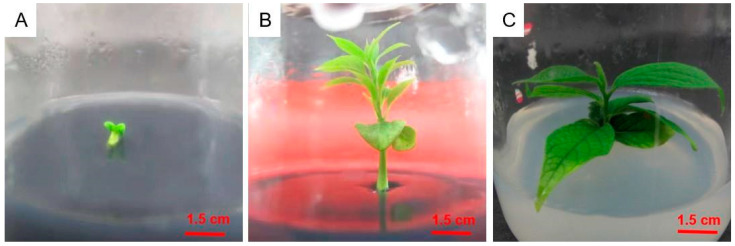
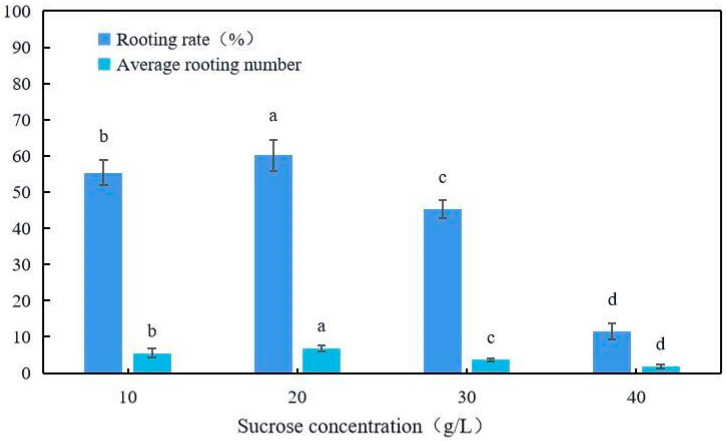
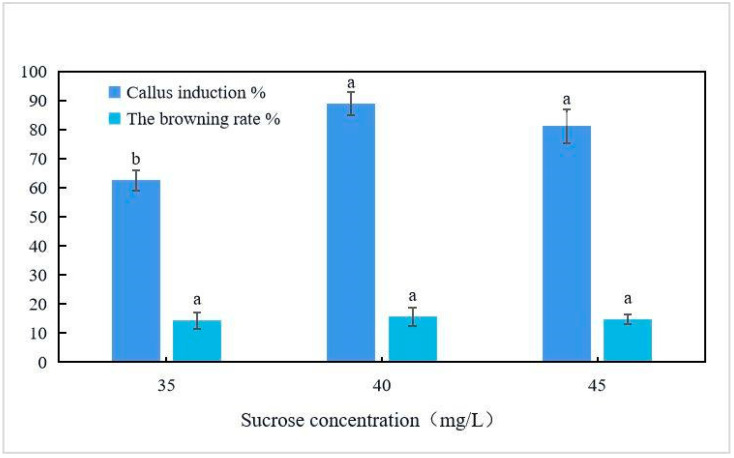
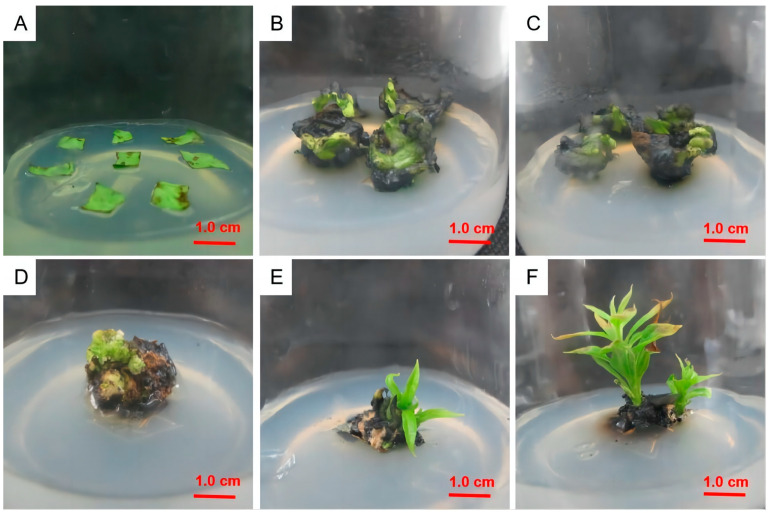
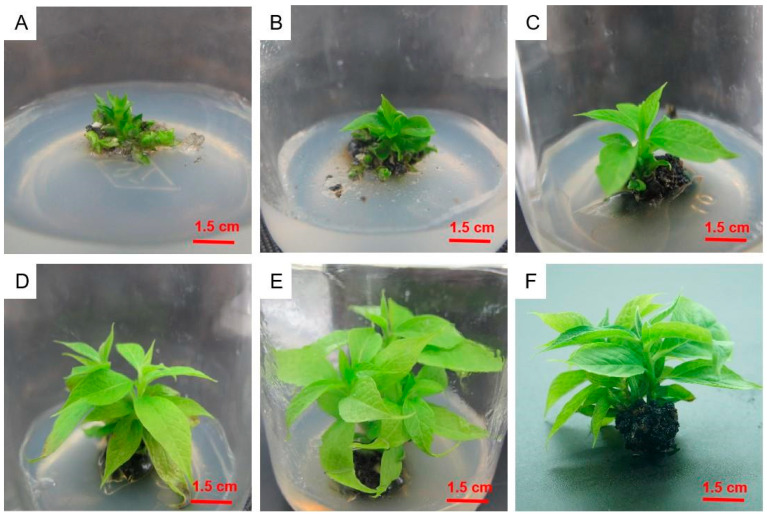
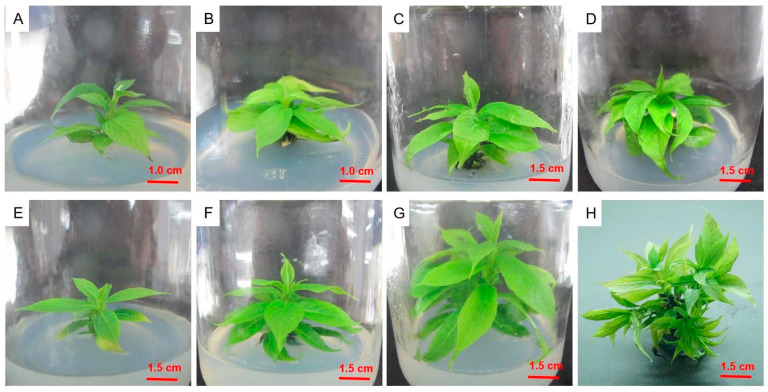
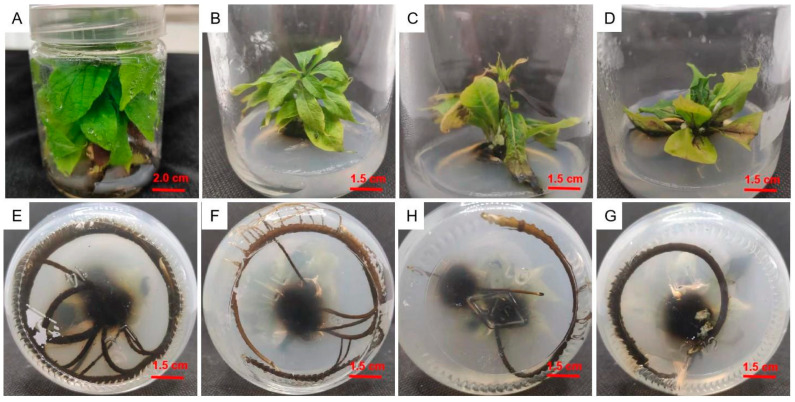
Persimmons () are economically important trees that are widely cultivated for wood production in China, and Cheng is the main persimmon grafting stock. However, an efficient tissue culture system has not been perfected for . due to the limits of proliferation and rooting cultures. Therefore, this study examined the effects of different plant growth regulators and concentrations on the primary culture of young embryos, induction of leaf callus, differentiation of adventitious shoots, and rooting culture of . . The optimal formula for young embryo germination was 1/2 Murashige and Skoog (MS) medium containing 0.5 mg/L gibberellic acid (GA); after 25 days, the sprouting rate of the young embryos was 67.3%. The best medium for leaf callus induction was 1/2MS medium containing 2.0 mg/L of 6-benzylaminopurine (6-BA) and 0.5 mg/L of naphthaleneacetic acid (NAA), and the callus induction rate was 88.9%. Then, the callus was transferred to 1/2MS medium containing 2.0 mg/L of zeatin (ZT), 0.5 mg/L of NAA, and 2.0 mg/L of thidiazuron (TDZ) to induce adventitious shoots; after 25 days, 5.4 buds were produced per explant, and the induction rate of the adventitious shoots was 88.3%. The adventitious shoots were transferred to 1/2MS medium containing 2.0 mg/L of ZT, 2.0 mg/L of 6-(γ,γ-dimethylallylamino)purine (2iP), and 0.1 mg/L of indole acetic acid (IAA) for the proliferation culture, for which the multiplication coefficient approached 7.5. After multiplication, the adventitious shoots were inoculated into 1/2MS medium containing 1.0 mg/L of indole butyric acid (IBA), 0.5 mg/L of NAA, and 1.0 mg/L of kinetin (KT); the rooting rate was 60.2%, and the average number of roots was 6.9.
柿树是具有重要经济价值的树木,在中国广泛种植用于木材生产,而“成”是主要的柿树嫁接砧木。然而,由于增殖培养和生根培养的限制,尚未完善针对“成”的高效组织培养体系。因此,本研究考察了不同植物生长调节剂及其浓度对幼胚初代培养、叶片愈伤组织诱导、不定芽分化以及“成”生根培养的影响。幼胚萌发的最佳配方是含有0.5 mg/L赤霉素(GA)的1/2 Murashige和Skoog(MS)培养基;25天后,幼胚的萌发率为67.3%。诱导叶片愈伤组织的最佳培养基是含有2.0 mg/L 6-苄基腺嘌呤(6-BA)和0.5 mg/L萘乙酸(NAA)的1/2MS培养基,愈伤组织诱导率为88.9%。然后,将愈伤组织转移至含有2.0 mg/L玉米素(ZT)、0.5 mg/L NAA和2.0 mg/L噻苯隆(TDZ)的1/2MS培养基中诱导不定芽;25天后,每个外植体产生5.4个芽,不定芽诱导率为88.3%。将不定芽转移至含有2.0 mg/L ZT、2.0 mg/L 6-(γ,γ-二甲基烯丙基氨基)嘌呤(2iP)和0.1 mg/L吲哚乙酸(IAA)的1/2MS培养基中进行增殖培养,增殖系数接近7.5。增殖后,将不定芽接种到含有1.0 mg/L吲哚丁酸(IBA)、0.5 mg/L NAA和1.0 mg/L激动素(KT)的1/2MS培养基中;生根率为60.2%,平均根数为6.9。