
金纳米颗粒增强放疗诱导脑胶质瘤免疫原性细胞死亡的能力。
Gold Nanoparticles Enhance the Ability of Radiotherapy to Induce Immunogenic Cell Death in Glioblastoma.
机构信息
Department of Nuclear Medicine, the Third Affiliated Hospital of Soochow University, Changzhou, Jiangsu, People's Republic of China.
Institute of Clinical Translation of Nuclear Medicine and Molecular Imaging, Soochow University, Changzhou, Jiangsu Province, People's Republic of China.
出版信息
Int J Nanomedicine. 2023 Oct 9;18:5701-5712. doi: 10.2147/IJN.S419712. eCollection 2023.
BACKGROUND
Radiation therapy (RT) is commonly used to treat glioblastoma, but its immunomodulatory effect on tumors, through mechanisms such as immunogenic cell death (ICD), is relatively weak. Gold nanoparticles (AuNPs) have been suggested as potential radio-sensitizers, but it is unclear if they can enhance radiation-induced ICD. This study aimed to investigate the potential of AuNPs to improve the effectiveness of radiation-induced ICD.
METHODS
G422 cells were treated with a combination of AuNPs and RT to induce cell death. Various assays were conducted to assess cell death, surface expression of CRT, and release of HMGB1 and ATP. In vitro co-culture experiments with bone marrow-derived dendritic cells (BMDCs) were performed to analyze the immunogenicity of dying cancer cells. Flow cytometry was used to measure the maturation rate of BMDCs. An in vivo mouse tumor prophylactic vaccination model was employed to assess immunogenicity.
RESULTS
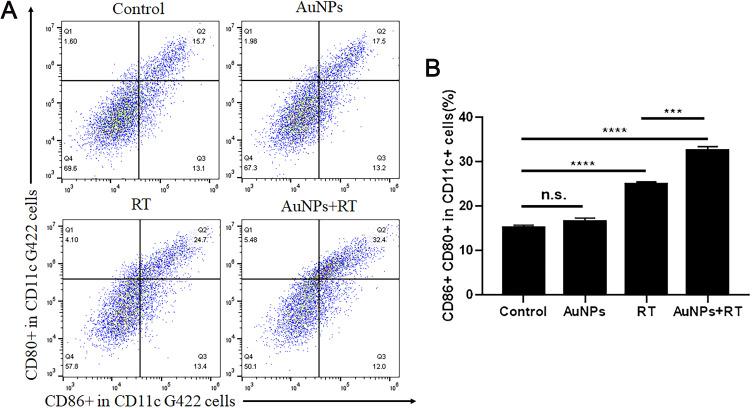
The study findings presented here confirm that the combination of radiotherapy (RT) with AuNPs can induce a stronger ICD effect on glioblastoma cells compared to using RT alone. Specifically, treatment with AuNPs combined with RT resulted in the emission of crucial damage-associated molecular patterns (DAMPs) such as CRT, HMGB1 (479.41±165.34pg/mL vs 216.04±178.16 pg/mL, *P<0.05) and ATP (The release of ATP in the AuNPs + RT group was 1.2 times higher than in the RT group, *P<0.05). The proportion of BMDC maturation rate was higher in the group treated with AuNPs and RT compared to the group treated with RT alone. (32.53±0.52% vs 25.03±0.28%,***P < 0.001). In the tumor vaccine experiment, dying tumor cells treated with AuNPs and RT effectively inhibited tumor growth in mice when exposed to living tumor cells.
CONCLUSION
These results indicate that AuNPs have the ability to enhance RT-induced ICD.
背景
放射治疗(RT)常用于治疗胶质母细胞瘤,但它对肿瘤的免疫调节作用较弱,通过免疫原性细胞死亡(ICD)等机制。金纳米粒子(AuNPs)已被提议作为潜在的放射增敏剂,但尚不清楚它们是否能增强辐射诱导的 ICD。本研究旨在探讨 AuNPs 提高辐射诱导 ICD 效果的潜力。
方法
用 AuNPs 和 RT 联合处理 G422 细胞诱导细胞死亡。通过各种检测来评估细胞死亡、CRT 表面表达、HMGB1 和 ATP 的释放。用骨髓来源的树突状细胞(BMDCs)进行体外共培养实验来分析死亡癌细胞的免疫原性。用流式细胞术测量 BMDCs 的成熟率。采用体内小鼠肿瘤预防性接种模型来评估免疫原性。
结果
本研究证实,与单独使用 RT 相比,放射治疗(RT)与 AuNPs 联合使用可对神经胶质瘤细胞产生更强的 ICD 效应。具体来说,AuNPs 联合 RT 治疗可导致关键的损伤相关分子模式(DAMPs)的释放,如 CRT、HMGB1(479.41±165.34pg/mL vs 216.04±178.16 pg/mL,*P<0.05)和 ATP(AuNPs+RT 组中 ATP 的释放是 RT 组的 1.2 倍,*P<0.05)。与单独使用 RT 相比,用 AuNPs 和 RT 处理的 BMDC 成熟率更高。(32.53±0.52% vs 25.03±0.28%,***P < 0.001)。在肿瘤疫苗实验中,用 AuNPs 和 RT 处理的死亡肿瘤细胞在暴露于活肿瘤细胞时能有效抑制小鼠肿瘤生长。
结论
这些结果表明,AuNPs 具有增强 RT 诱导的 ICD 的能力。


 Zotero 插件