Felli Eric, Selicean Sonia, Guixé-Muntet Sergi, Wang Cong, Bosch Jaume, Berzigotti Annalisa, Gracia-Sancho Jordi
Department of Visceral Surgery and Medicine, Inselspital, Bern University Hospital, University of Bern, Switzerland.
Department for BioMedical Research, Visceral Surgery and Medicine, University of Bern, Switzerland.
JHEP Rep. 2023 Aug 2;5(11):100869. doi: 10.1016/j.jhepr.2023.100869. eCollection 2023 Nov.
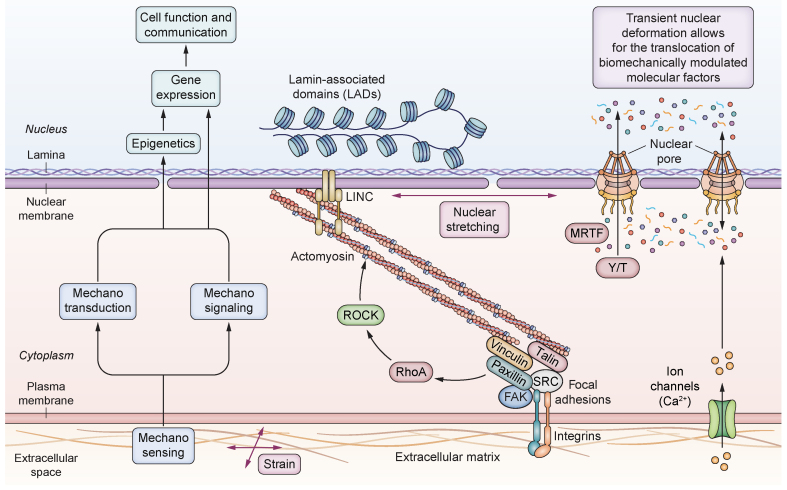
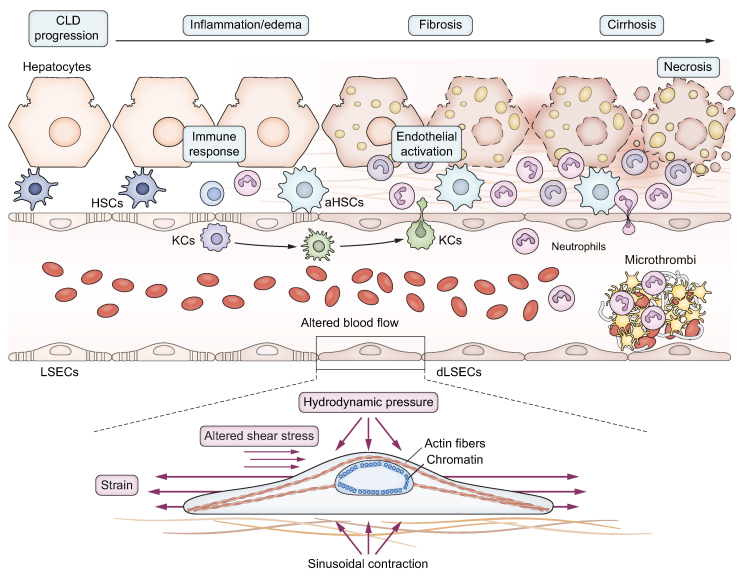
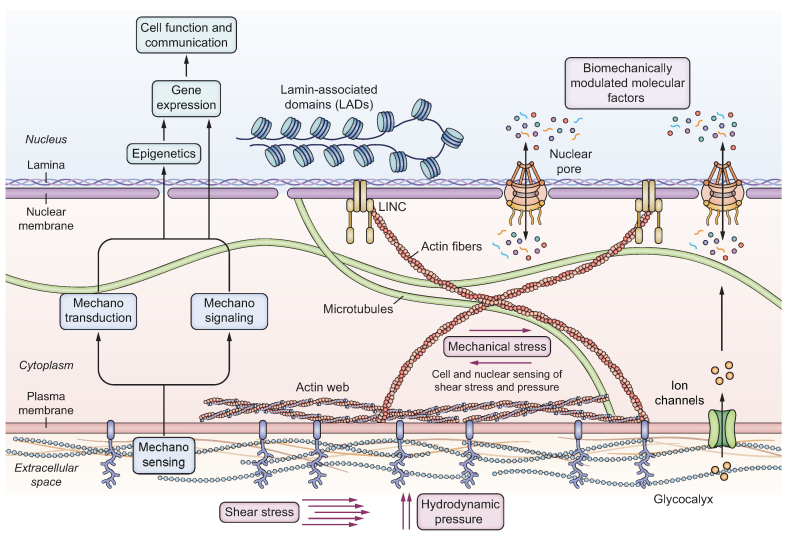
The interplay between mechanical stimuli and cellular mechanobiology orchestrates the physiology of tissues and organs in a dynamic balance characterized by constant remodelling and adaptative processes. Environmental mechanical properties can be interpreted as a complex set of information and instructions that cells read continuously, and to which they respond. In cirrhosis, chronic inflammation and injury drive liver cells dysfunction, leading to excessive extracellular matrix deposition, sinusoidal pseudocapillarization, vascular occlusion and parenchymal extinction. These pathological events result in marked remodelling of the liver microarchitecture, which is cause and result of abnormal environmental mechanical forces, triggering and sustaining the long-standing and progressive process of liver fibrosis. Multiple mechanical forces such as strain, shear stress, and hydrostatic pressure can converge at different stages of the disease until reaching a point of no return where the fibrosis is considered non-reversible. Thereafter, reciprocal communication between cells and their niches becomes the driving force for disease progression. Accumulating evidence supports the idea that, rather than being a passive consequence of fibrosis and portal hypertension (PH), mechanical force-mediated pathways could themselves represent strategic targets for novel therapeutic approaches. In this manuscript, we aim to provide a comprehensive review of the mechanobiology of PH, by furnishing an introduction on the most important mechanisms, integrating these concepts into a discussion on the pathogenesis of PH, and exploring potential therapeutic strategies.
机械刺激与细胞力学生物学之间的相互作用,以持续重塑和适应性过程为特征,在动态平衡中协调组织和器官的生理功能。环境机械特性可被解读为细胞持续读取并作出反应的一组复杂信息和指令。在肝硬化中,慢性炎症和损伤导致肝细胞功能障碍,进而引起细胞外基质过度沉积、肝血窦假毛细血管化、血管闭塞和实质细胞消亡。这些病理事件导致肝脏微结构显著重塑,这既是异常环境机械力的原因,也是其结果,引发并维持了肝纤维化这一长期且渐进的过程。多种机械力,如应变、剪切应力和静水压力,可在疾病的不同阶段汇聚,直至达到纤维化被认为不可逆的临界点。此后,细胞与其微环境之间的相互通讯成为疾病进展的驱动力。越来越多的证据支持这样一种观点,即机械力介导的途径本身可能代表新型治疗方法的战略靶点,而非仅仅是纤维化和门静脉高压(PH)的被动结果。在本手稿中,我们旨在通过介绍最重要的机制、将这些概念融入对PH发病机制的讨论以及探索潜在治疗策略,对PH的力学生物学进行全面综述。