Department of Neuroimaging, King's College London, United Kingdom.
Department of Psychology, Queen's University, Canada.
PLoS Comput Biol. 2023 Oct 16;19(10):e1011571. doi: 10.1371/journal.pcbi.1011571. eCollection 2023 Oct.
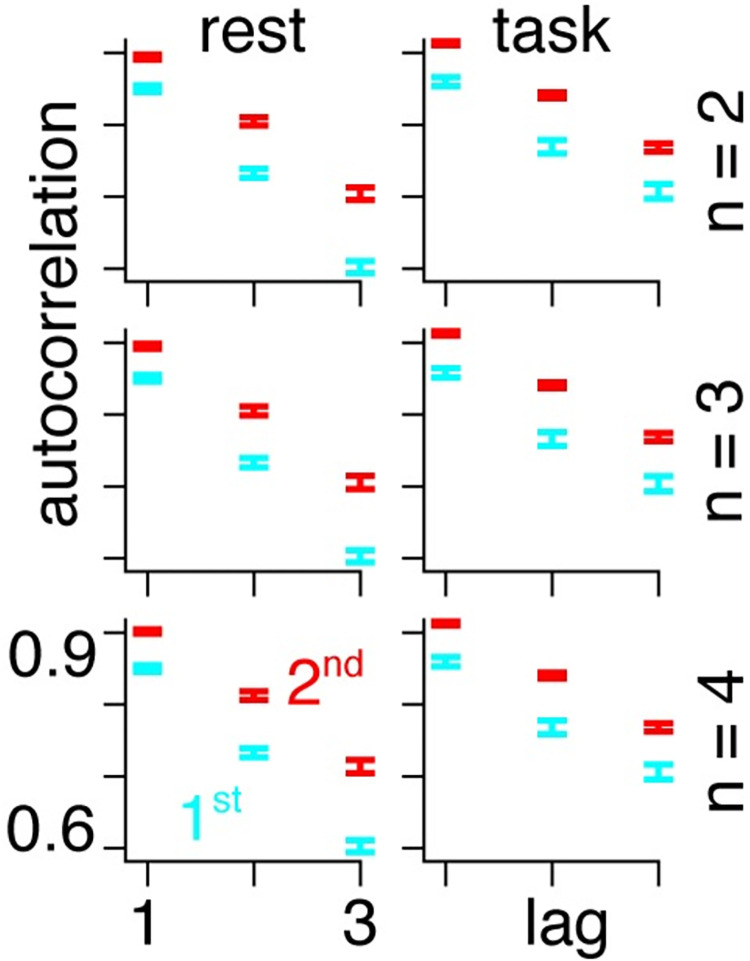
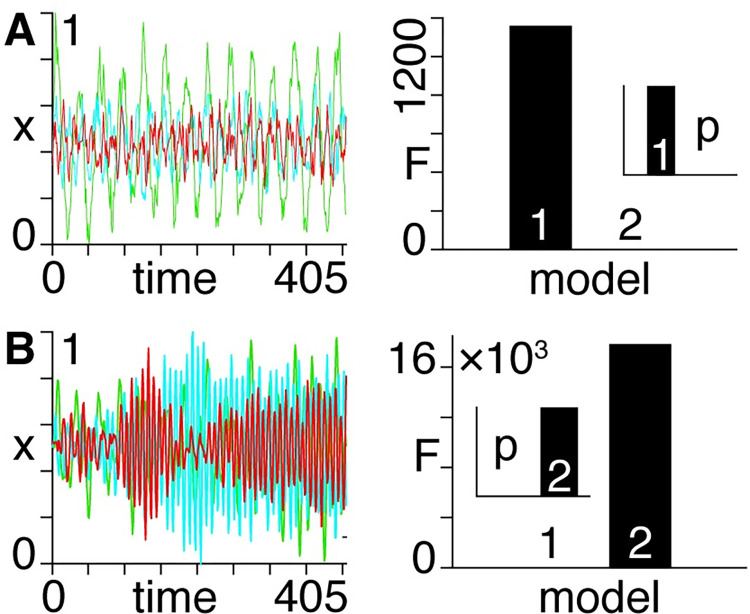
The definition of a brain state remains elusive, with varying interpretations across different sub-fields of neuroscience-from the level of wakefulness in anaesthesia, to activity of individual neurons, voltage in EEG, and blood flow in fMRI. This lack of consensus presents a significant challenge to the development of accurate models of neural dynamics. However, at the foundation of dynamical systems theory lies a definition of what constitutes the 'state' of a system-i.e., a specification of the system's future. Here, we propose to adopt this definition to establish brain states in neuroimaging timeseries by applying Dynamic Causal Modelling (DCM) to low-dimensional embedding of resting and task condition fMRI data. We find that ~90% of subjects in resting conditions are better described by first-order models, whereas ~55% of subjects in task conditions are better described by second-order models. Our work calls into question the status quo of using first-order equations almost exclusively within computational neuroscience and provides a new way of establishing brain states, as well as their associated phase space representations, in neuroimaging datasets.
脑状态的定义仍然难以捉摸,在神经科学的不同子领域中存在着不同的解释——从麻醉中的清醒水平,到单个神经元的活动、脑电图中的电压和 fMRI 中的血流。这种缺乏共识给神经动力学的准确模型的发展带来了重大挑战。然而,动力系统理论的基础是对系统“状态”构成的定义,即对系统未来的规定。在这里,我们通过将动态因果建模 (DCM) 应用于静息和任务条件 fMRI 数据的低维嵌入,来提出采用这种定义来在神经影像学时间序列中建立脑状态。我们发现,在静息状态下,约 90%的被试可以用一阶模型更好地描述,而在任务状态下,约 55%的被试可以用二阶模型更好地描述。我们的工作对在计算神经科学中几乎完全使用一阶方程的现状提出了质疑,并为在神经影像学数据集建立脑状态及其相关相空间表示提供了一种新方法。