Department of Urology, Beijing Hospital, National Center of Gerontology, Institute of Geriatric Medicine, Chinese Academy of Medical Sciences, Beijing, China.
Graduate School of Peking Union Medical College, Chinese Academy of Medical Sciences, Beijing, China.
BMJ Open. 2023 Oct 16;13(10):e075136. doi: 10.1136/bmjopen-2023-075136.
Several studies have suggested a potential link between use of proton pump inhibitors (PPIs) and the risk of kidney stones, attributed to alterations in urine mineral levels. Our study aimed to investigate the association between PPI use and kidney stones in US adults.
Cross-sectional study.
National Health and Nutrition Examination Survey (2007-2018).
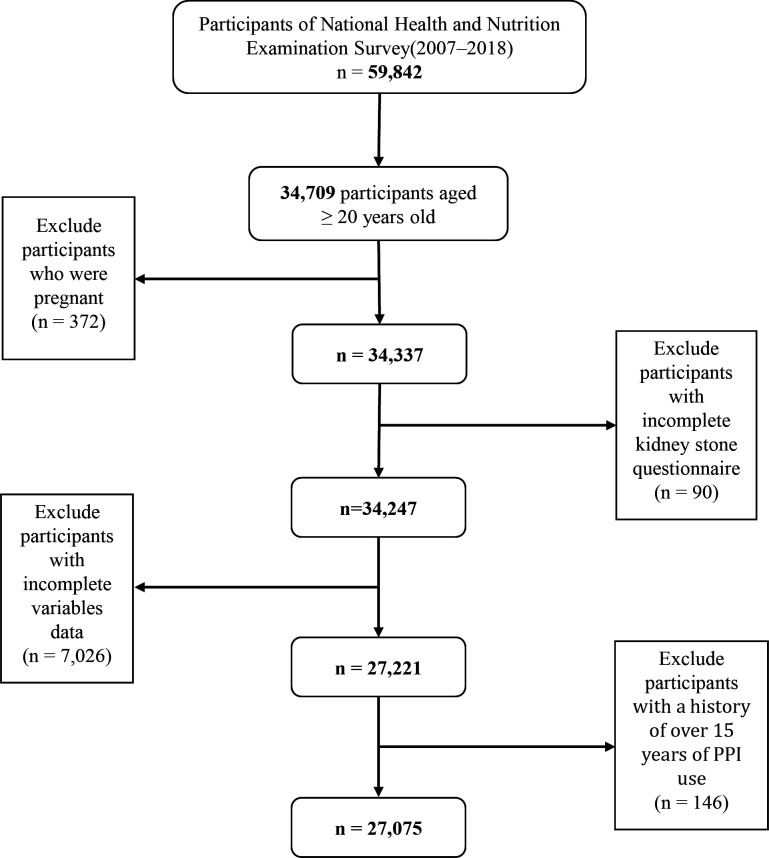
27 075 individuals with complete information on PPI use and history of kidney stones were included in this study.
Non-linear analysis, logistic regression analysis and subgroup analysis were conducted to estimate the relationship between PPI use and the occurrence and recurrence of kidney stones, after adjusting for potential confounding factors.
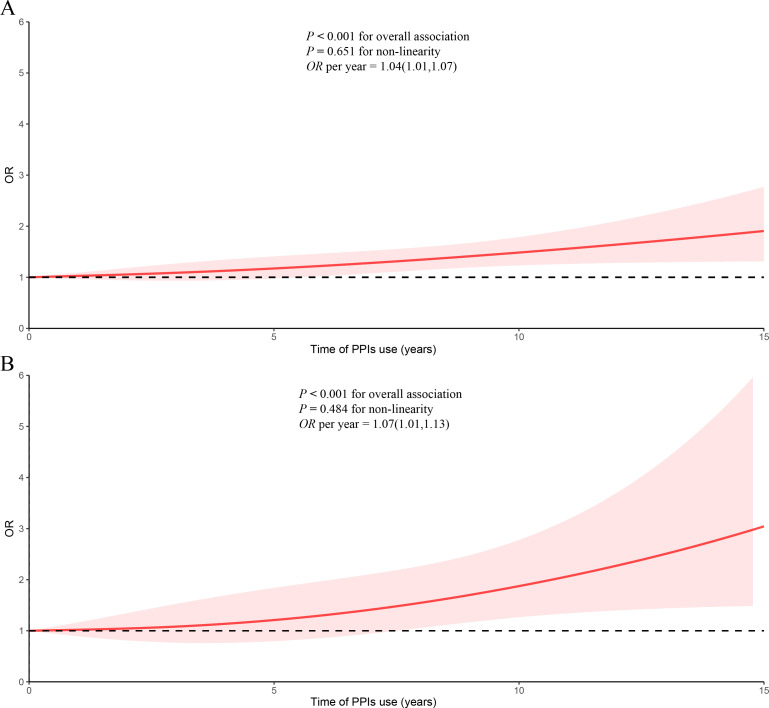
Multivariable logistic regression analysis revealed a significant association between PPI use and kidney stones (OR 1.31, 95% CI 1.07 to 1.60), with a 4% increase in the prevalence of kidney stones for each additional year of PPI use (p<0.001). Similarly, PPI use was significantly associated with recurrent kidney stones (OR 1.49, 95% CI 1.04 to 2.13), with a 7% increase in the recurrence of kidney stones for each additional year of PPI use (p<0.001). Furthermore, these associations remained significant even after conducting propensity score matching analysis on a subset of PPI users and non-users (all p≤0.001). Subgroup analyses showed that the effects of PPI use on kidney stones differed by age, sex, race and body mass index.
This study indicated that long-term use of PPI was associated with a higher risk of both the presence and recurrence of kidney stones.
多项研究表明,质子泵抑制剂(PPIs)的使用与肾结石风险之间存在潜在关联,这归因于尿液矿物质水平的变化。我们的研究旨在调查美国成年人中 PPI 使用与肾结石之间的关联。
横断面研究。
全国健康与营养调查(2007-2018 年)。
本研究共纳入 27075 名完整记录 PPI 使用情况和肾结石病史的个体。
在调整潜在混杂因素后,采用非线性分析、逻辑回归分析和亚组分析来估计 PPI 使用与肾结石发生和复发之间的关系。
多变量逻辑回归分析显示,PPI 使用与肾结石之间存在显著关联(OR 1.31,95%CI 1.07 至 1.60),PPI 使用每增加 1 年,肾结石的患病率增加 4%(p<0.001)。同样,PPI 使用与肾结石复发显著相关(OR 1.49,95%CI 1.04 至 2.13),PPI 使用每增加 1 年,肾结石复发的风险增加 7%(p<0.001)。此外,即使在对 PPI 使用者和非使用者的亚组进行倾向评分匹配分析后,这些关联仍然具有统计学意义(均 p≤0.001)。亚组分析表明,PPI 使用对肾结石的影响因年龄、性别、种族和体重指数而异。
本研究表明,长期使用 PPI 与肾结石的发生和复发风险增加相关。